

Blog written by Indu R Eswarappa, Career Coach & Education Change-Maker
In the past few months, I’ve seen students, freshers, even working professionals suddenly getting curious about prompt engineering. Some are exploring prompt engineer jobs for freshers, others are actively searching for a prompt engineering internship for students, but most of them are still unclear about what this career actually looks like in real life.
And this is where I want you to pause for a moment. Because in my experience, when something becomes this popular this quickly, our brain tends to get attracted to the trend—not necessarily the truth behind it.
AI is exciting, no doubt. But just because a role is trending doesn’t automatically mean it’s the right career path for you.
So instead of jumping straight into how to become a prompt engineer, let’s take a slightly more grounded approach.
In this blog, I’ll walk you through what this role actually involves, the skills required, realistic career opportunities, and even what the prompt engineer salary in India looks like right now.
Because the goal is not just to learn how to become a prompt engineer.
👉 The goal is to make sure you don’t choose something today that you question later.
What Does a Prompt Engineer Actually Do?
Now before we go deeper into how to become a prompt engineer, I want you to really understand what this role looks like day-to-day.
Because this is where most people get it wrong.
From the outside, it looks simple—“just write prompts and get answers.”
But when you actually step into the role, it’s much more layered than that.
Let me break this down for you in a simple way.
Key Responsibilities
1. Designing Effective Prompts
The core responsibility of a prompt engineer is to design inputs that guide AI to give accurate, relevant, and useful outputs.
This is not just about asking questions.
It’s about:
- Framing instructions clearly
- Providing the right context
- Structuring the request step-by-step
A small change in wording can completely change the output. So a big part of learning how to become a prompt engineer is developing that precision in communication.
2. Testing, Iterating, and Improving Outputs
This is where the real work happens.
You don’t write one prompt and get a perfect result.
You test → observe → tweak → test again.
Sometimes you’ll run multiple variations of the same prompt to see what works best. This trial-and-error process is a huge part of the job—and honestly, not everyone enjoys this phase.
That’s why I always say—before chasing prompt engineer jobs for freshers, ask yourself: Do I enjoy experimenting like this repeatedly?
3. Understanding AI Behavior
A good prompt engineer doesn’t just write instructions—they try to understand how the AI “thinks” (in a functional sense).
This includes:
- Knowing how models interpret language
- Identifying patterns in responses
- Predicting where errors might happen
Over time, you start recognizing what kind of prompts give consistent results and what doesn’t.
4. Collaborating with Teams or Clients
Depending on your role, you might work with:
- Developers
- Content teams
- Product managers
- Or even clients directly
For example, if you’re working on an AI product, your job might be to improve how the AI responds to users. In freelancing or a prompt engineering internship for students, you may also need to understand client requirements and tailor prompts accordingly.
Work Environment
Now let’s talk about where and how you’ll actually work. Unlike traditional roles, prompt engineering is mostly digital and flexible.
You could be:
- Working remotely from home
- Part of a tech or AI startup
- Freelancing on projects
- Or doing a prompt engineering internship while still studying
Most of your work will happen on a laptop—testing prompts, analyzing outputs, documenting results.
But here’s something important many people don’t realize:
👉 Even though the environment is flexible, the work itself requires focused thinking for long periods.
It’s not a passive or “easy” job.
Some days you might spend hours just refining one output. Other days, you’ll be exploring completely new use cases.
Skills You Actually Need to Become a Prompt Engineer

Now, this is the part where most people rush.
They start searching for courses, tools, certifications… without first understanding what skills are actually required for how to become a prompt engineer.
In my experience, this role is not just technical—and it’s definitely not just creative either.
It’s a mix of how you think, how you communicate, and how you analyze patterns.
So let’s break this down in a simple way.
Soft Skills
1. Clarity of Thought (More Important Than You Think)
If I had to pick one skill that matters the most here—it’s this.
Prompt engineering is all about how clearly you can think.
Because if your thinking is scattered, your prompts will be scattered… and the output will reflect that.
A big part of learning how to become a prompt engineer is training your mind to:
- Break problems into steps
- Give structured instructions
- Avoid vague or confusing language
2. Curiosity and Experimentation Mindset
You need to enjoy testing things.
Not once. Not twice. Repeatedly.
In many cases, the first output won’t be great. Even the second might not be.
But if you enjoy tweaking and exploring different approaches, you’ll do well here.
This is especially important if you’re planning to apply for a prompt engineering internship for students, where learning happens through experimentation.
3. Communication Skills
Now this might sound obvious—but it’s deeper than just “good English.”
You should be able to:
- Explain what you want clearly
- Structure instructions logically
- Anticipate how something might be misunderstood
Because AI responds based on how you communicate, not what you assume.
4. Attention to Detail
Small changes in wording can lead to completely different outputs.
So yes—detail matters. A lot.
Whether it’s:
- Adding one extra instruction
- Changing the order of steps
- Or refining tone and context
These small tweaks are what separate average outputs from high-quality ones.
Technical Abilities
1. Understanding How AI Tools Work
You don’t need to be a hardcore coder to start.
But you do need to understand:
- How tools like ChatGPT or other AI models respond
- What kind of inputs they handle well
- Where they tend to make mistakes
This understanding is a core part of how to become a prompt engineer—because without it, you’re just guessing.
2. Basic Knowledge of Language and Logic
This role sits somewhere between language and logic.
You’ll need:
- Sentence structuring skills
- Logical sequencing (step 1 → step 2 → step 3)
- Ability to simplify complex instructions
It’s not about being a writer—it’s about being clear and precise.
3. Testing and Optimization Skills
A lot of your work will involve:
- Running multiple prompt variations
- Comparing outputs
- Improving accuracy over time
This is where many people lose interest. Because it requires patience.
And honestly, if you’re someone who prefers quick results, this part can feel frustrating.
That’s why when people look at prompt engineer jobs for freshers, they sometimes miss this part—your background still plays a role.
Educational Pathways and Required Qualifications

Now this is where things get a bit different—and honestly, a bit confusing for many people trying to figure out how to be a prompt engineer.
Because unlike traditional careers, there isn’t one fixed degree or a straight path you must follow.
You do not need a specific “prompt engineering degree” to start.
In fact, many people exploring prompt engineering as a career come from:
- Engineering backgrounds
- Content or marketing fields
- Design or creative roles
- Even completely unrelated streams
Typical Career Path: How to Become a Prompt Engineer
Now let’s talk about something most people don’t think about when they search how to be a prompt engineer.
They focus on learning the skill…
But they don’t think about how the career actually grows over time.
And in my experience, that’s where confusion starts later.
Because this field is still evolving—there isn’t a “fixed ladder” like traditional careers. But yes, there is a pattern if you observe it carefully.
Let me break it down for you in a simple, realistic way.
Entry-Level Stage (0–2 Years)
Typical Roles:
Prompt Engineering Intern, AI Content Assistant, Junior Prompt Engineer, Freelance Beginner
What You’ll Actually Do:
At this stage, your focus is not on “big projects”—it’s on learning how things work.
You’ll be:
- Writing basic prompts and testing outputs
- Assisting teams in AI-related tasks
- Experimenting with different tools
- Learning through trial and error
If you’re starting through a prompt engineering internship for students, this is where most of your growth happens.
You might also explore small freelance gigs or personal projects to build confidence.
Growth Tip:
Don’t chase titles at this stage.
Focus on:
- Understanding how AI responds
- Practicing consistently
- Building small real-world use cases
Because when people apply for prompt engineer jobs for freshers, what really matters is proof of work, not just certificates.
Mid-Level Stage (2–5 Years)
Typical Roles:
Prompt Engineer, AI Specialist, Workflow Designer, Automation Specialist
What Changes Here:
Now you’re not just writing prompts—you’re solving problems.
You’ll:
- Work on real business use cases
- Optimize prompts for better accuracy
- Build workflows using AI tools
- Collaborate with teams (tech, marketing, product)
At this stage, you start becoming more independent—and your work has a direct impact.
Growth Tip:
Pick a direction.
General knowledge is good—but specialization is what creates real opportunities.
Also, start paying attention to market demand—this is where your understanding of prompt engineer salary in India starts becoming relevant based on your skill depth.
Senior-Level Stage (5–10+ Years)
Typical Roles:
Senior Prompt Engineer, AI Strategist, AI Product Consultant, Lead Automation Expert
What Your Role Looks Like:
At this stage, you’re not just executing—you’re designing systems.
You’ll:
- Create large-scale AI workflows
- Guide teams on how to use AI effectively
- Solve complex, high-impact problems
- Possibly consult or lead AI initiatives
You might also:
- Work with startups
- Build your own AI-based solutions
- Or move into leadership/strategy roles
Growth Tip:
Now your thinking matters more than your tools.
Focus on:
- Problem-solving ability
- Decision-making clarity
- Understanding real-world application of AI
Because tools will change—but your thinking approach is what sustains long-term growth.
Return on Investment (ROI) in Prompt Engineering
Now let’s talk about something that’s on everyone’s mind—but rarely discussed properly.
👉 “Is this actually worth it?”
👉 “What kind of income can I expect?”
👉 “What is the real prompt engineer salary in India?”
If you’re trying to seriously understand a career in prompt engineering, you can’t ignore the ROI part.
Let’s break this down in a practical way.
Learning Investment (Time + Money)
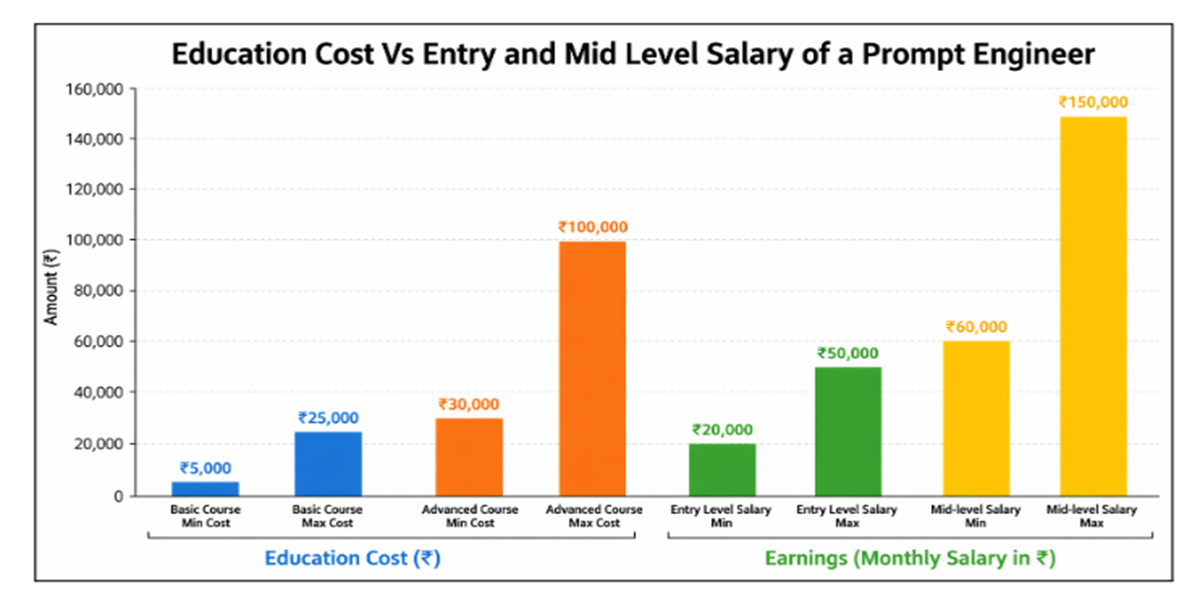
Unlike traditional careers, the financial investment here is relatively lower—but your time investment is what really matters.
Basic Learning (Beginner Stage):
₹5,000 to ₹25,000
- Online courses
- Basic AI tools understanding
- Self-practice
Advanced Learning (Skill Building):
₹30,000 to ₹1 lakh
- Structured programs
- Specialized AI or prompt engineering courses
- Hands-on projects
Now honestly, you can learn for free as well. But structured learning helps you avoid random trial-and-error and saves time—if used properly.
Earning Potential in India
Let’s come to the part most people are curious about.
Entry-Level (0–2 Years)
₹20,000 to ₹50,000 per month
- Internships
- Freelance beginner projects
- Junior roles
If you’re starting through a prompt engineering internship, your focus here should not be income—it should be skill-building.
Mid-Level (2–5 Years)
₹60,000 to ₹1.5 lakh per month
- Full-time roles
- Specialized prompt engineering work
- Workflow or automation-based projects
This is where your income starts depending on:
- Your problem-solving ability
- Your specialization
- Your consistency
Education Cost Vs Earnings as a Prompt Engineer
Return on Time (ROT) in Prompt Engineering
Now this is something a lot of people don’t think about when exploring how to become a prompt engineer.
They look at salary. They look at courses.
But they don’t ask—how quickly will I actually start seeing results?
And honestly, this is where expectations need to be realistic.
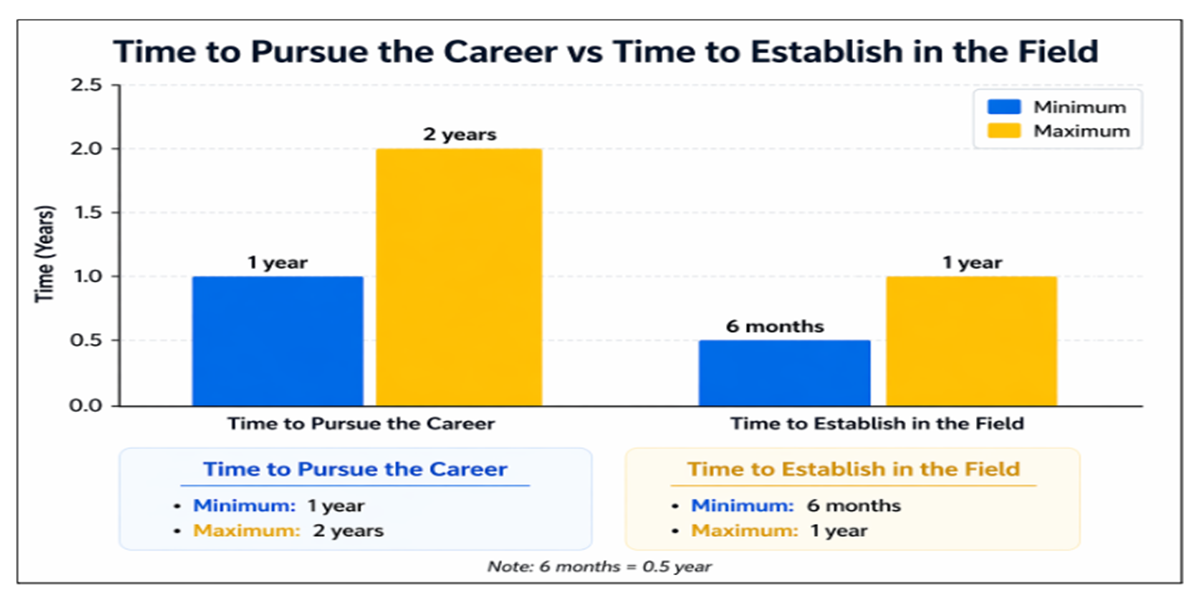
Break-even Point (When Do You Start Seeing Results?)
In my experience, prompt engineering has a relatively faster start compared to many traditional careers—but only if you approach it the right way.
Most people can start seeing initial returns within:
👉 6 months to 1 years
But here’s the catch.
This depends on:
- How consistently you practice
- Whether you’re doing real projects (not just courses)
- Whether you’re actively applying for internships or gigs
If you’re doing a prompt engineering internship, freelancing, or small real-world tasks early on—you’ll likely start earning sooner.
Future Prospects: The Next 20–30 Years in Prompt Engineering
The field of prompt engineering is still in its early stages, which makes it both exciting and a little unpredictable. Over the next 20–30 years, we’re likely to see major shifts in how AI systems are used across industries—and that directly impacts how this career evolves.
Artificial Intelligence will become more advanced, but also more integrated into everyday work. This means prompt engineers won’t just focus on writing instructions—they’ll play a role in designing how AI tools are used in business, education, healthcare, and more.
Conclusion
Navigating this path can be challenging, and that’s where NextMovez can help. Our career counselling or career coaching can support you at every step. A career coach can guide you in understanding whether prompt engineering truly fits your strengths, help you choose the right direction within the field, and share practical guidance on building skills and real-world experience.
Because at the end of the day, the goal is not just to figure out how to become a prompt engineer. The goal is to choose a career you can grow in, stay consistent with, and feel confident about over time.