
By Preethi Durga, Career Strategist & Education Innovator
Preethi Durga, Chief Career Decision Architect, NextMovez, where she designs career decision frameworks including C3S, the Career Success Strategy System, and the Career Crafting Conversations (CCC) series.
Looking Beyond a Narrow Career Shortlist
Engineering and medicine remain respected professions, and for many people they are the right choice. The difficulty begins when they become the default shortlist before you examine other fields with the same seriousness.
This guide is written first for Class 10–12 students and their parents, and for graduates and freshers choosing a first direction. Working professionals considering a change will find notes meant for them too, but they are the secondary audience here.
The best career options in India span design, finance, law, analytics, policy, product, marketing, people functions, sustainability and more.
Looking at careers beyond engineering and medicine is not about rejecting established professions. It is about widening the comparison before committing years of study, money and effort.
The India Skills Report 2025, based on the Wheebox Global Employability Test taken by 6.5 lakh candidates, found that 54.81% met its employability benchmark. The figure is a useful reminder that a degree alone does not determine employability. Role-specific capability, practical exposure and evidence of skill still matter.
That is why alternative career paths deserve the same questions as traditional ones:
- What does the work involve?
- What must I learn?
- What will the transition require?
- What evidence do I already have through subjects, projects, activities or work?
| Decision note: Scope tells you about the market. It does not decide whether a role is right for you. |
How to Compare the Best Career Options in India with More Clarity
A strong career decision is not a ranking exercise. A profession may have good demand and still be a poor fit for someone who dislikes its daily tasks, training route or work environment.
The World Economic Forum’s Future of Jobs Report 2025, a global employer survey of more than 1,000 employers across 55 economies, says employers expect 39% of workers’ core skills to change by 2030, while seven in ten employers consider analytical thinking an essential core skill. As a global survey, it is not an India-specific labour-market measure.
LinkedIn’s Skills on the Rise 2026 for India also highlights AI and automation, data analysis, operational efficiency, negotiation and stakeholder management.
These reports do not mean everyone should move toward the same role. They suggest that career choices increasingly benefit from domain knowledge, transferable skills and continued learning.
For Class 10–12 students and graduates, ask which subjects, projects and activities you have genuinely enjoyed and done well in. For professionals, also ask how much existing experience can move with you. A transition that uses ten years of domain knowledge is different from one that requires a full rebuild.
Career Fields Worth Considering

When people search for the best career options in India, a list is useful only if it explains the work behind each title.
| Career Direction | What the Work Involves | Possible Entry/Education Route | What to Test Before Choosing |
| UX Research/Human-Centred Design | User interviews, journey mapping, usability studies and product collaboration. | Relevant degree or transferable background, plus research methods, portfolio work and practical projects. | Do you enjoy research, iteration and turning observations into clear recommendations? |
| Business Analysis | Process mapping, requirements, data analysis and cross-team coordination. | Business, technology or domain experience, supported by analysis skills, tools and project evidence. | Are you comfortable with detail, structured problem-solving and stakeholder coordination? |
| Digital Marketing | Content, SEO, campaigns, analytics, audience research and performance optimisation. | Relevant degree or targeted learning, supported by campaign, content and analytics experience. | Do you enjoy creative judgement as well as measurable performance? |
| Strategic Communications | Messaging, content strategy, stakeholder communication, reputation and campaign planning. | Communications, media, marketing or adjacent experience, supported by strong writing and campaign evidence. | Do you enjoy shaping clear messages for different audiences and managing communication priorities? |
| Finance, Risk and Compliance | Analysis, reporting, risk, investment support and compliance. | Relevant finance, commerce or business education; some roles may require specialised certifications or qualifications. | Are you comfortable with quantitative work, domain learning and any required qualifications? |
| Law | Legal research, contracts, advisory work, advocacy and regulatory interpretation. | To practise as an advocate in India, the usual route includes completing a BCI-recognised LL.B., enrolling with the relevant State Bar Council, and complying with the applicable All India Bar Examination/Certificate of Practice requirements. | Have you checked the formal qualification requirements and the day-to-day reading and writing load? |
| Human Resources and Learning | Hiring, learning, employee experience and workforce operations. | Relevant degree or transferable people-management experience, supported by HR, L&D or people-operations exposure. | Do communication, judgement and stakeholder management match your strengths? |
| Sustainability | ESG initiatives, sustainability reporting, research, compliance and cross-functional implementation. | Relevant domain education or experience, supported by sustainability, ESG or reporting knowledge. | Do you enjoy combining research, business context and long-term impact considerations? |
| Public Policy | Policy research, regulation, stakeholder analysis, programme evaluation and public-interest work. | Relevant social science, law, economics, public policy or domain background, supported by research and writing experience. | Do you enjoy evidence-based research, complex systems and policy-oriented writing? |
| Product Operations | Cross-functional coordination, process improvement, product workflows, data and operational execution. | Operations, business, product or adjacent experience, supported by analytical and project coordination skills. | Do you enjoy making systems work better across teams, tools and processes? |
The strongest careers beyond engineering and medicine become clearer when you study repeated work, not only titles or salary headlines. Comparing alternative career paths should reduce the list to two or three directions worth testing.
| Decision note: A career title is useful only when you understand the work that repeats every week. |
A Practical Filter for Career Decisions
A useful way to compare the best career options in India is to apply the same five checks to each possibility.
This filter, along with the validate-test-invest sequence used later in this piece, reflects the same case-based reasoning NextMovez applies in its Career Crafting Conversations (CCC) episodes, where a real career decision is worked through step by step rather than resolved with a single verdict.
1. Role clarity
Can you name the actual role? “I want to work in technology” is broad. “I am comparing product operations, business analysis and UX research” is specific enough to investigate.
For a Class 12 student, “I want something creative” becomes useful when it turns into “I am comparing UX design, digital marketing and strategic communications.”
2. Reality clarity
What does a normal week look like? What creates pressure? How is performance measured? The National Career Service, run by India’s Ministry of Labour and Employment, is one official source for exploring job sectors, career information and skill courses.
3. Self-fit evidence
Look for repeated patterns. As a student or graduate, which subjects, projects, competitions, club roles or internships have you kept returning to and done well in?
Professionals can add the work managers, colleagues or clients have trusted them with: analysis, writing, planning, negotiation or stakeholder handling.
4. Transition feasibility
What will the move require in time, money, qualifications and experience? Can you test it through a project, short course, internal assignment or informational conversation first?
5. Experience continuity
For students and freshers, ask what you have already built that can carry forward: subjects, projects, internships, volunteering and skills. For professionals, ask what can travel with you. Industry knowledge, client understanding and operational judgement may remain useful even when the role changes.
| Decision note: The more expensive the transition, the stronger the evidence you should ask for before committing. |
| Already narrowing toward two or three of these?
A NextMovez Career Clarity Call can help you apply this filter to your own shortlist before you invest further. |
Your Best-Fit Career Zone
The five checks above help you compare careers. The Best-Fit Career Zone looks at you. It is the area where your natural way of working, your interests and your abilities overlap with the kind of work and environment in which you are likely to do well.
NextMovez looks at seven aspects:
- Personality: how you naturally think, decide and deal with people.
- Interests: the subjects and activities that hold your attention without being pushed.
- Motivators: what makes effort feel worthwhile, such as impact, recognition, stability, creativity or growth.
- Values: what matters to you most and what you are unwilling to compromise on in your work.
- Work environment: the pace, structure, team setting and independence in which you work well.
- Learning preferences: whether you learn best by reading, doing, discussing or being mentored.
- Skills and abilities: what you can already do well and what you can realistically build.
This is different from the three checks above that look at the role, the work and your evidence. Role clarity asks whether you can name the actual role. Reality clarity asks what the work looks like in practice. Self-fit evidence looks at proof from what you have already done.
The Best-Fit Career Zone sits underneath all three: it describes the kind of work, environment and learning style that suit you, so the roles you name and the evidence you gather point in a consistent direction.
It does not rule a single job title in or out; it narrows the field to the directions worth testing.
Try This Before Choosing Your Career Direction
Pick three careers from the table above and spend a week on this short exercise:
- Read two real job descriptions for each career, from job portals or company career pages.
- Note the repeated responsibilities that appear in both descriptions.
- Note the qualifications and skills they ask for, and whether your current route can realistically reach them.
- Mark the difficult tasks and ask honestly whether you could keep doing them week after week.
- Run one small exposure experiment for each career: a short online lesson, a mini-project or a conversation with someone who does the job.
Then compare your notes. The career whose repeated tasks you can imagine doing, and whose entry route you can realistically follow, deserves your next step.
ROI and ROT: Comparing Time, Cost and Learning
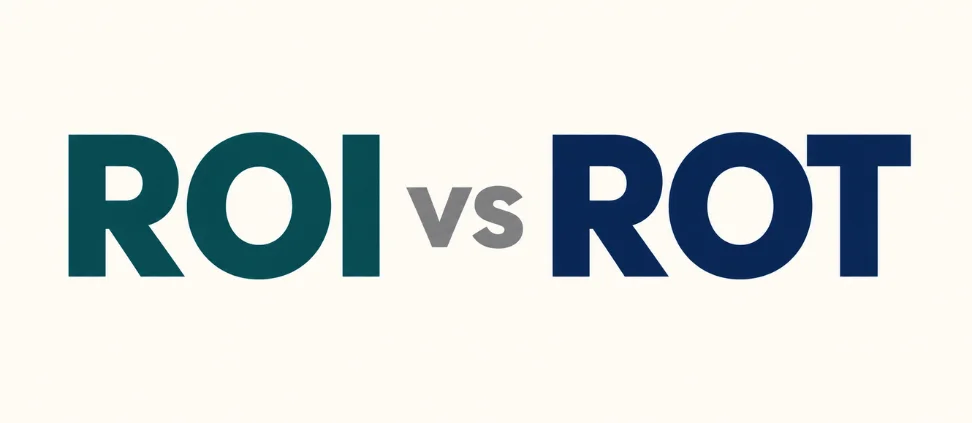
Return on Investment, or ROI, is often discussed in salary terms. A career decision also benefits from looking at Return on Time, or ROT.
One option may require a two-year full-time degree. Another may be testable through a six-month project and targeted learning. The longer route may still be worthwhile, but the qualification should have a clear purpose for the target role.
Compare fees, time away from work, likely entry level, qualification credibility and what you can demonstrate afterwards. For professionals, include opportunity cost.
A move that discards most of your experience deserves closer examination than one that builds on it.
When More Information Does Not Create More Clarity
Career research can quietly add cognitive load. Salary posts, course advertisements, relatives’ advice and social media opinions can make every option seem possible.
That is where decision fatigue can show up. Repeatedly comparing too many open options consumes attention without improving the decision. Reduce the field: compare two or three serious options, give yourself enough time to think clearly, then gather evidence through conversations, projects and real job descriptions.
Do not assume one confusing or stressful stretch means you have chosen wrongly. A difficult first term, a weak teacher or pressure from relatives and friends can create strain without making the subject or career itself a poor fit.
Professionals can apply the same thought to a demanding quarter, an unclear manager relationship or poor role design.
Ask separately:
“What do I dislike about this subject or profession?” and “What do I dislike about the way it is being taught, structured or presented to me?”
Professionals can ask the same about the way their current role is structured.
| Decision note: A difficult work period is information, not an automatic verdict on your entire career. |
Illustrative Composite Case Study: Testing a Direction Before Committing
This is an illustrative composite case study, not a single client story.
Aanya, a Class 12 student, kept hearing from relatives that engineering or medicine was the sensible choice. She did not dislike either, but three other directions kept pulling at her: UX research, because she enjoyed noticing why apps confused her friends; business analysis, because she liked finding patterns in the data from a school project; and law, because she was good at debate and writing.
Rather than deciding from a list of titles, Aanya and her parents compared the three directions on daily tasks, the subjects and skills each needs, the entry route, the years of study and cost, and the evidence she already had. Her data project and her writing record gave her visible evidence for two of the three.
Instead of committing to a stream or course immediately, she ran a smaller test: read two real job descriptions for each role, complete a short introductory lesson on user research, redesign one school-club form as a mini-project, and talk to two practising professionals about the parts of the job a description never mentions.
The test narrowed her list to UX research and business analysis, and her parents could see the reasoning rather than a preference. For the first time in months, Aanya felt relief rather than pressure to decide overnight. Engineering stayed on the table as one option, but it no longer had to carry the whole decision by itself.
Her sequence was simple: validate the direction, test it, then decide what deserves a larger investment.
NextMovez: Helping You Navigate Career Choices and Achieve Lasting Success

NextMovez begins with the decision that needs to be made rather than with a long list of occupations. If someone is comparing the best career options in India, the useful question is: What evidence would make one direction stronger than the others?
Career Counselling can structure that comparison through role clarity, actual work conditions, repeated evidence, practical constraints and transition feasibility.
C3S, the Career Success Strategy System, is positioned as direction validation rather than ordinary counselling. It examines a small number of serious directions before a larger commitment is made. For professionals, it can also consider what experience can transfer and what would need to be developed.
The C3S journey follows a distinctive sequence that moves from understanding yourself to validating a specific direction:
Understand patterns → guided assessment and reflection → Best-Fit Career Zone → career clusters → CCRJ realistic exploration → specific-direction validation → personalised roadmap.
The NextMovez guide on Career Counselling for Working Professionals offers a related framework for reviewing a professional career decision while respecting existing experience.
Career Coaching becomes more useful once direction is clearer.
Support can then focus on execution:
- Skill development
- Projects
- Professional positioning
- Interview preparation
- Milestones
- Accountability
The distinction matters. Direction uncertainty needs validation. A clear direction may need execution support.
| Bring the decision you are actually weighing.
Write down the two or three directions you are seriously considering, along with the constraints that matter: time, money, responsibilities and current experience. A NextMovez Career Clarity Call can then focus on testing those choices rather than adding more options. |
Frequently Asked Questions
What are the best career options in India beyond engineering and medicine?
There is no single list for everyone. Business analysis, design, finance, law, marketing, HR, sustainability, product and communications can all be worth exploring. Compare role reality, qualifications, evidence of fit and transition cost.
Are engineering and medicine still good career choices?
Yes. Both remain valuable professions when the work, training demands and long-term path suit the person considering them.
How should I compare career fields with different entry routes?
Use the same questions for each: What work will I do? What qualifications are required? How long will the transition take? What will it cost? What evidence do I already have?
Can I change career direction without starting from zero?
Often, yes. Industry knowledge, client understanding, project management, communication and analytical skills may transfer. The amount depends on the specific move.
Do I need another degree to move into a new field?
Not always. Some careers require formal qualifications; others can be entered through targeted learning, portfolios, certifications, projects or adjacent experience.
How should I compare salary with learning and time?
Look at immediate compensation and the longer learning path. Compare ROI and ROT together rather than treating salary as the only measure.
How do I know whether I need Career Counselling or Career Coaching?
Career Counselling is more useful when direction needs validation. Career Coaching is more useful when direction is reasonably clear, but execution needs support.
Is an MBA a good option if I am still unsure about my direction?
It can be, but the degree should have a clear purpose. Identify the functions you are considering, likely role outcomes, cost and time, and whether a smaller test could clarify the direction first.
Conclusion: Let NextMovez Help You Make Your Next Decision with Confidence and Evidence
The best career options in India are easier to evaluate when you stop looking for one perfect answer and compare a small number of realistic directions.
Study the work itself. Check entry requirements. Look for repeated evidence in what you already do well. Compare ROI and ROT. Notice what experience can transfer. Then choose a next step that gives you better information without creating unnecessary commitment.
A sound career decision does not need dramatic certainty. It needs enough evidence to explain why the next step makes sense.
There is a particular kind of relief that comes from finally weighing two or three real options instead of carrying an endless, vague list around in your head, and it is available to you well before you have all the answers. When you are ready to test what you are actually considering, NextMovez is here to help you take that next step with evidence rather than guesswork.
Resources and References
- India Skills Report 2025, Wheebox – Used for the 6.5 lakh candidate assessment base and the 54.81% employability-benchmark result.
- World Economic Forum, Future of Jobs Report 2025 – Used for the 39% core-skills change forecast and the seven-in-ten analytical-thinking finding, drawn from a global employer survey.
- LinkedIn News India, Skills on the Rise 2026 – Used for current India skill-demand signals across AI, data, operations, negotiation and stakeholder management.
- National Career Service, Ministry of Labour and Employment – Official source for career information, skill courses, counsellors and employment services in India.
- NextMovez – Service and C3S reference used for Career Counselling, Career Coaching and direction-validation terminology.