
“I Work Hard. So Why Does It Feel Like I’m Going Nowhere?”
Ravi had been with the same company for four years.
He showed up on time. Met his targets. Took on extra work when the team needed it.
And yet, when his manager asked him where he saw himself in three years, he went completely blank.
Not because he lacked ambition. But because no one had ever helped him think that far ahead.
He had experience. He had effort. What he didn’t have was guidance.
Ravi’s problem was not lack of effort. It was not even lack of skill. His real problem was that no one had helped him connect his effort to a clear career direction. This is where many employee training and development programs fail. They teach skills, but they do not always help employees understand which skills are worth building for their next stage of growth.
This is one of the most common gaps in the modern workplace — and it’s exactly why career development programs for employees exist.
Not to add more to an already full plate. But to create the one thing most hardworking employees are quietly missing: direction.
Here’s the sharper truth: career development programs for employees work only when they begin with clarity. Without direction, employees can keep attending workshops, collecting certifications, and building random skills without ever seeing real career movement. A hardworking employee without direction can look productive and still feel stuck.
Who Should Read This Blog?
This blog is useful for:
- Working professionals who feel stuck despite working hard
- Employees who are taking courses but still feel unclear about growth
- HR leaders designing employee training and development programs
- Managers who want to retain and grow high-potential team members
- Professionals wondering which skills to develop for career growth
- Companies that want career development to improve performance, confidence and retention
Why Career Development Programs Matter More in 2026
The conversation around employee growth isn’t just a soft HR topic anymore. A few numbers explain why career growth programs for employees matter more than they used to.
- The World Economic Forum’s Future of Jobs 2025 report points to skills like analytical thinking, creative thinking, resilience, flexibility, technological literacy, leadership and lifelong learning as increasingly important for today’s workforce.
- LinkedIn’s Workplace Learning Report 2025 shows that career growth, internal mobility and leadership skill development have become central to how companies approach workplace learning.
- Gallup’s State of the Global Workplace 2026 found that global employee engagement fell to just 20 percent in 2025 — a clear sign that employees need structured growth, not just more workload.
Together, these numbers point to one thing: employees are rarely short on effort. They’re short on structure.
The Neuroscience Behind Why Structure Accelerates Growth
Once the board exams are over, most families start asking the same question:
“How do we make sure our child chooses the right path?”
It sounds like a straightforward decision. Choose a stream. Select subjects. Move forward.
But in reality, how to decide career after 10th is rarely that simple.
Many parents start by looking at available streams, future salaries, or popular professions. While these factors matter, they do not answer the most important question: “Is this the right fit for my child?”
That is why the goal should not be choosing quickly. The goal should be choosing with evidence.
Here is the NextMovez Career Decision Framework — a structured approach parents can use before making any stream or career-related decision.
What Career Development Programs for Employees Actually Do

Let’s be clear about what these programs are — and what they aren’t.
They’re not just training sessions. They’re not annual reviews dressed up in new language. And they’re definitely not a box to check on a compliance list.
Real career development programs for employees do four things:
- Build self-awareness — Employees understand their strengths, work styles, and what kind of growth actually fits them.
- Create skill alignment — Learning is tied to where the employee is going, not just what the company needs right now.
- Offer structured guidance — Through coaching systems, mentorship, and clear pathways, employees stop guessing and start growing.
- Support long-term thinking — Instead of reacting to quarterly pressure, employees begin planning their growth over months and years.
That last one is where most organizations fall short.
Because career development isn’t a one-time event. It’s an ongoing process that requires consistent attention, honest feedback, and real support.
Types of Employee Training and Development Programs
Not all employee training and development programs look the same. The right approach depends on the size of the team, the industry, and what the employee actually needs.
Here are the most effective types:
Mentorship-Based Programs
Employees are paired with experienced professionals who provide guidance, feedback, and real-world context. This works especially well for mid-level employees who have the skills but lack strategic direction.
Skills-Based Training
Focused on specific career development skills — communication, problem-solving, leadership, technical proficiency. These are short, targeted, and tied to clear outcomes.
Career Counselling Sessions
One-on-one sessions where employees work with a trained counsellor to understand their strengths, explore growth paths, and build a realistic roadmap. This is particularly effective for employees who feel stuck or overwhelmed.
Leadership Development Tracks
Designed for employees being prepared for senior roles. These programs include executive coaching, decision-making frameworks, and cross-functional exposure.
Online Career Development Courses
Flexible, self-paced career development courses that employees can take without disrupting their work schedule. Best used alongside in-person coaching for maximum effect.
Each of these works best when it’s part of a system — not just a standalone offering. That’s the difference between training that’s forgotten in a week and career development that actually changes how someone works.
Skills to Develop for Career Growth — The Ones That Actually Matter
Here’s where a lot of employees get it wrong.
They think career growth is about learning more. So they collect certifications, take courses, fill up weekends with content — and still end up unsure if any of it is moving them forward.
The issue isn’t volume. It’s fit.
Career development is not about learning more. It is about learning what actually moves you forward.
The skills to develop for career growth should be chosen based on three things:
- Where the employee wants to go — not just where they are
- What their natural strengths support — not what’s trending on LinkedIn
- What the next role or opportunity actually requires — not what sounds impressive
Some of the most valuable career development skills today are not technical at all. Things like:
- Strategic thinking
- Emotional intelligence
- Clear communication under pressure
- The ability to receive and act on feedback
- Self-direction and accountability
These are the abilities that separate people who keep growing from people who plateau.
And the good news? They can be built — but only when there’s a coaching system in place that helps the employee recognize what they need and gives them a practical way to get there.
Before Choosing a Program, Check This: Skill Gap or Direction Gap?
At NextMovez, we often see professionals confuse two very different problems.
A skill gap means: you’re in the right direction, but you need a specific capability to move ahead.
Example: a project manager who enjoys coordination may need PMP or stakeholder management training to handle larger projects.
A direction gap means: you’re trying to grow in a role, industry, or work style that doesn’t fit how you think, perform, or sustain energy.
Example: a marketing professional may complete data analytics courses but still feel drained if their real strength lies in brand strategy, communication and consumer insight.
Training can solve a skill gap. It cannot solve a direction gap.
This is where career counselling for working professionals becomes important. Before investing more time and money into courses, an employee first needs to understand whether they need upskilling, role repositioning, or career direction clarity. The wrong course does not waste only money. It wastes confidence.
Case Study: From Scattered Effort to Structured Growth
Background: Priya was a marketing associate at a mid-sized firm. Three years in, she was doing solid work but felt invisible during discussions about team promotions.
She had completed several career development courses on her own — content strategy, data analytics, social media. But she had no idea which direction to take her career, or whether any of it was relevant to where she wanted to go.
The Problem: Too many skills. No clear direction. No one helping her connect the dots.
What Changed: Priya’s company enrolled her in a structured career development program for employees that included one-on-one career counselling. In her sessions, she identified that her real strength was in brand strategy — not execution. She stopped pursuing random courses and instead focused on two specific skills to develop for career growth: stakeholder communication and campaign planning.
Before vs. After:
Before: Learning scattered across five different subjects, no career roadmap, low confidence in meetings.
After: Clear focus on two relevant skills, a 12-month development plan, and a visible path toward a strategy role.
Within six months, she was leading cross-functional brand discussions — not because she learned more, but because she finally learned the right things.
What changed wasn’t effort. It was direction.
Priya didn’t need five more courses. She needed someone to help her see the pattern behind her growth block. Once she understood that her strength was brand strategy and stakeholder thinking, her learning became focused. That’s what a strong career development program should do. It shouldn’t add noise. It should reduce it.
How NextMovez Helps Working Professionals Build Career Direction Before Skill Development
Most career programs tell employees what to do.
NextMovez helps them understand why — and then builds a system around that understanding.
Through its Career Counselling for Working Professionals service, NextMovez works with employees who are feeling stuck, overwhelmed, or uncertain about their growth path. The approach is structured, deeply personal, and grounded in clarity — not generic advice.
Most professionals don’t realize they need structured support until they’ve already spent months — sometimes years — moving in the wrong direction. If that sounds familiar, Career Counselling for Working Professionals at NextMovez, part of the C3S Career Success Strategy System, is built exactly for this situation — helping you identify where you actually stand, what’s holding you back, and what your next real move should be.
Here’s what the process looks like:
Step 1. Decode the career pattern — What’s repeating? Is the person stuck because of skill gaps, role mismatch, work environment, confidence drop, or unclear direction?
Step 2. Understand the professional’s Best-Fit Career Zone — Map personality, motivators, strengths, values, work style, environment fit and learning style.
Step 3. Separate effort from alignment — Check whether the employee is genuinely under-skilled or simply growing in the wrong direction.
Step 4. Identify the right career development skills — Don’t recommend random courses. Identify the skills that support the professional’s next realistic direction.
Step 5. Build a practical roadmap — Create a month-by-month development plan with skill building, exposure, role positioning and review points.
Step 6. Support execution where needed — If the professional needs long-term accountability, coaching and structured implementation, this becomes execution support, not one-time counselling.
For companies looking to build a stronger, more confident team, NextMovez also offers the Employee Family Benefit Program — a counselling initiative that extends career guidance to the families of employees, helping them make better decisions that ultimately support the employee’s own growth.
Because when an employee feels clear and supported — at work and at home — their performance improves across the board.
Before investing in another course or certification, pause and ask: Is this a skill gap or a direction gap? If you’re not sure, a structured career clarity conversation can help you avoid months of scattered effort. Talk to a NextMovez career counsellor.
Generic Training vs Structured Career Development
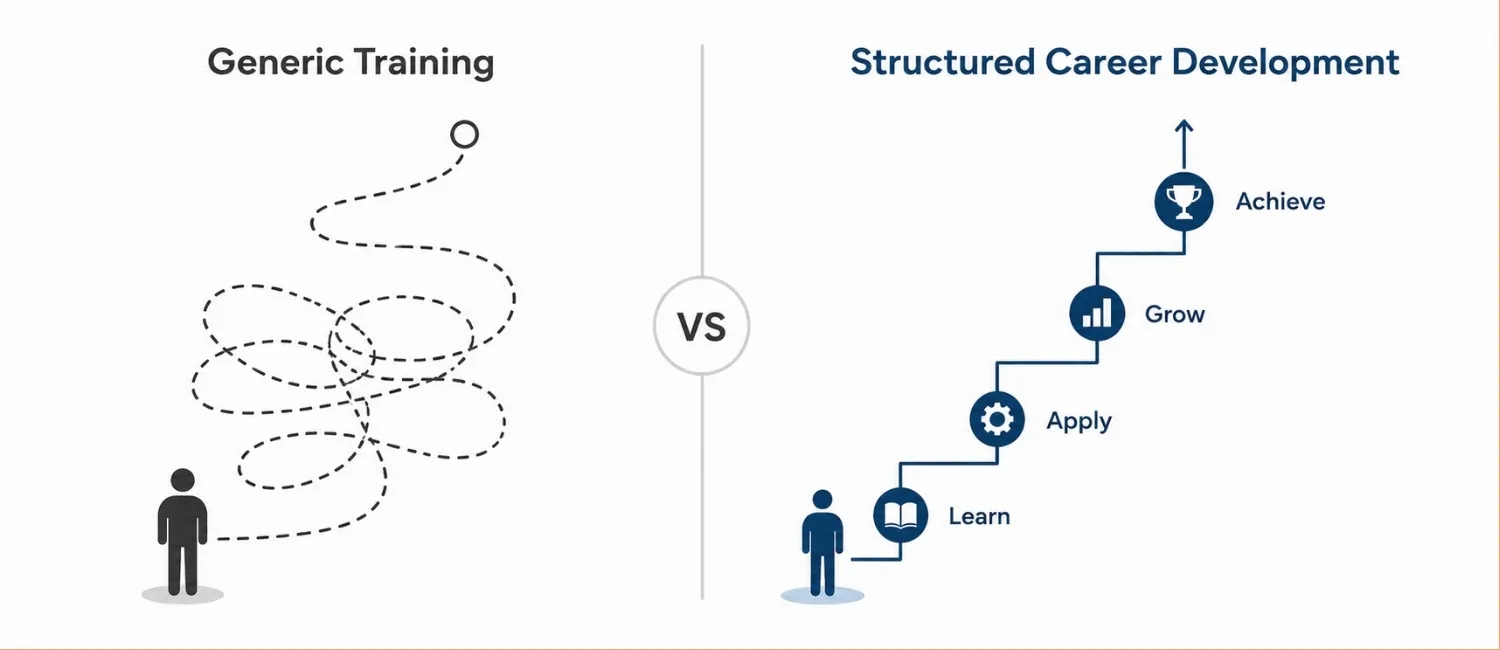
Generic training starts with courses. Structured career development starts with clarity.
Generic training asks, “What skill should we teach?” Structured career development asks, “What growth direction are we building toward?”
Generic training may improve knowledge. Structured career development improves decision quality, confidence and role readiness.
Generic training can become another checkbox. Structured career development becomes a growth system.
For HR Leaders: How to Choose the Right Employee Career Development Program
- Do not start with a training calendar. Start with employee growth diagnosis.
- Separate employees who need skill-building from those who need role clarity.
- Connect every program to business outcomes, not just attendance.
- Include one-on-one coaching for employees who feel stuck or misaligned.
- Measure progress across confidence, role readiness, skill application, internal mobility and retention.
- Make managers part of the process, because development fails when the workplace doesn’t support the employee’s next step.
Before You Move Forward, Ask These Questions
If you’re an employee thinking about your own growth, ask yourself:
- Am I building skills because I’m clear on where I’m going — or just because they seem useful?
- Do I have a roadmap, or am I reacting to whatever feels urgent right now?
- When did I last have an honest conversation about my career direction with someone who could actually help?
And if you’re a company or HR team:
- Do our employee training and development programs go beyond compliance?
- Are we giving employees real direction — or just more content to consume?
- What would change if every employee had access to structured career counselling?
These questions don’t have easy answers. But asking them is the first step toward building something that actually works.
Frequently Asked Questions
- What are career development programs for employees?
Career development programs for employees are structured initiatives that help people understand their strengths, build relevant skills, and move toward a clear career direction. Unlike one-off training sessions, they combine self-assessment, coaching and skill-building into an ongoing process. The best career growth programs for employees don’t just teach new things — they help employees understand which skills actually matter for where they want to go next, so effort and growth stay connected.
- Why are career development programs important?
They give employees something most workplaces don’t provide on their own: direction. Without a growth path, even hardworking employees can end up guessing what to focus on next. Career development programs create structure — clear milestones, honest feedback, and a sense of progress — which keeps people engaged and reduces the quiet disengagement that shows up in workplace surveys year after year. They also help companies retain the people they’ve already invested in.
- What are the best skills to develop for career growth?
The best skills to develop for career growth depend on where you’re headed, not what’s trending. That said, a few tend to matter across almost every path: strategic thinking, emotional intelligence, clear communication under pressure, and the ability to act on feedback. These skills separate people who keep growing from those who plateau, because they apply regardless of role, industry, or seniority level.
- Are career development courses enough for career growth?
Not on their own. Career development courses can build specific skills, but they don’t tell you which skills are worth building. Many professionals complete courses without ever gaining clarity on their direction, which leaves them busy but not necessarily closer to their goals. Courses work best when they follow a clear roadmap — one built through self-awareness and career counselling, not guesswork or trending topics online.
- How do employee training and development programs improve retention?
Employees stay longer at companies that invest in their growth. Employee training and development programs signal that an organization sees a future for its people, not just a task list. When training is tied to a real career path — not just compliance requirements — employees feel more confident, more valued, and less likely to look elsewhere for the direction they aren’t getting at home.
- How can career counselling help working professionals?
Career counselling helps working professionals step back and see patterns they can’t always spot on their own — whether they’re facing a skill gap, a direction gap, or simple burnout from moving without a plan. Through structured conversations and assessments, a counsellor helps professionals understand their strengths, clarify their next move, and build a realistic roadmap instead of chasing every opportunity that comes their way.
- What is the difference between upskilling and career direction clarity?
Upskilling means building a specific capability, like a certification or technical skill, to move ahead in a role you already know suits you. Career direction clarity comes first — it’s about understanding whether you’re even growing in the right direction. Training can solve a skill gap, but it cannot solve a direction gap. Get the direction right, and upskilling becomes far more effective.
Building Career Development Skills That Actually Stick
If you’re an HR leader or a manager reading this, here’s a simple truth:
Employee training and development programs only work when they’re tied to something personal.
Generic workshops produce temporary motivation. Real growth comes from helping employees understand themselves — their strengths, their gaps, and the direction that actually fits them.
Here’s what the most effective career growth programs for employees have in common:
- They start with assessment, not assumption
- They offer individual coaching, not just group sessions
- They connect learning to long-term goals — not just current job requirements
- They measure progress over months, not just days
- They treat career growth as a continuous process, not a one-time event
When these elements are in place, employees don’t just feel supported. They start performing differently. Their decisions sharpen. Their confidence grows. And their loyalty to the organization — because the organization invested in them — tends to go up.
That’s the real ROI of career development.
Conclusion: Growth Is a System, Not a Stroke of Luck
Employees who grow consistently aren’t always the most talented. They’re the ones with the clearest direction.
They know what they’re working toward. They have the right career development skills for where they’re going. And they have a support system that keeps them on track when things get confusing.
That’s what structured career growth programs for employees create — not just better performance reviews, but real, sustained growth.
Growth is not luck. Growth is a system. And it starts the same way it did for Ravi and Priya: with clarity first, skills second.
Whether you’re an employee trying to find your footing or a company looking to build a stronger team, the path forward is the same:
Get clear. Build right. Keep going.
And if you need a place to start — NextMovez is ready to help you get there.
If you’re a working professional feeling stuck, or an HR leader looking to support employees more meaningfully, NextMovez can help you build career development with clarity, not guesswork.
Book a Career Clarity Call with NextMovez and take the first structured step.
Ready to build a real career development plan? Talk to a NextMovez career counsellor today.
References
- World Economic Forum, Future of Jobs Report 2025
- LinkedIn, Workplace Learning Report 2025
- Gallup, State of the Global Workplace 2026
- Wheebox/ETS, India Skills Report 2025 (referenced where India-specific employability claims are used)