
Blog written by Indu R Eswarappa, Career Coach & Education Change-Maker
Table of Contents
- Introduction: Is Biomedical Science for You?
- What’s the Future Like for Biomedical Scientists?
- Key Responsibilities of a Biomedical Scientist
- Work Environment: Where Biomedical Scientists Work
- How to Become a Medical Scientist After 12th
- Essential Soft Skills and Technical Abilities
- Career Progression: Career Levels & Growth
- Salary Expectations, ROI & ROT
- Future Prospects: The Next 20–30 Years
- Final Thoughts: The Scientist Career Path
- Resources & References
Introduction: Is Biomedical Science for You?
Ever thought about a career that blends healthcare, research, and innovation—but doesn’t require an MBBS or NEET? If yes, you might be the perfect fit for biomedical science!
What is a medical scientist?
A medical scientist is a professional who researches human health, investigates diseases, and develops or tests new treatments—often behind the scenes in labs, hospitals, or biotech companies.
Take Neha’s story: She started in pharmacy, but her curiosity about disease diagnostics led her into biomedical science. Today, she works in a leading hospital lab, helping diagnose rare infections and supporting doctors with research insights.
If you’re passionate about science, love solving puzzles, and want to make a real healthcare impact—learning how to become a biomedical scientist after 12th could be your best next step.
Still weighing your options after 12th? Platforms like NextMovez offer personalized career guidance to help you map out the right path.
What's the Future Like for Biomedical Scientists?
India’s biomedical sector is booming. With healthcare spending expected to rise from 3.3% to 5% of GDP by 2030, demand for biomedical scientists in hospitals, pharma, and diagnostics is set to soar.
Why is this exciting?
- Biomedical scientists are at the heart of new treatments, diagnostics, and public health breakthroughs.
- Career stability is excellent—jobs are growing globally, and India is catching up fast.
- You’ll be part of innovations like personalized medicine, AI-based diagnostics, and biotechnology startups.
If you’re mapping your career after 12th, this path promises decades of relevance and growth.
Key Responsibilities of a Biomedical Scientist
Curious about what biomedical scientists really do? Here’s a quick breakdown:
Clinical Research Associate:
Runs clinical trials, collects/analyzes safety data, coordinates with hospitals.
Biomedical Scientist (Core Role):
Performs complex lab tests for diagnosing diseases (genetic, infectious, etc.). Interprets results, develops/testing new methods, collaborates with doctors.
Medical Laboratory Manager:
Oversees lab operations, staff, budgets, compliance, and quality.
Research Scientist (Biotech/Pharma):
Develops new diagnostic tools, researches diseases, publishes findings.
Tip: Start by identifying if your interest lies in research, diagnostics, or clinical work. This clarity will help you chart your own path.
Work Environment: Where Biomedical Scientists Work

Biomedical scientists enjoy a mix of stability, variety, and purpose. You could work at:
- Hospitals and diagnostic labs
- Pharmaceutical/biotechnology companies
- Academic/clinical research institutions
- Public health or government labs
Daily work includes:
- Collaborating with health professionals and researchers
- Using advanced tech (PCR, spectrometers, microscopes, etc.)
- Strict safety/ethical protocols, accurate data analysis
It’s hands-on, people-driven, and always evolving with new science!
How to Become a Medical Scientist After 12th
Level: | Course Name | Duration | Entrance Exams | Eligibility | Popular Universities/Institutes |
UG | B.Sc. Biomedical Science | 3 years | NEET (UG), CUET (UG), State CETs, MET | 10+2 with PCB | Delhi University, Christ University, Amity University, BHU |
UG | B.Sc. Medical Laboratory Technology | 3 years | NEET (UG), State CETs | 10+2 with PCB | Manipal Academy of Higher Education, SRM University, AIIMS |
UG | B.Sc. Clinical Research | 3 years | CUET (UG), State CETs | 10+2 with PCB | Bangalore University, IGNOU, Amity University |
UG | B.Sc. Microbiology | 3 years | CUET (UG), State CETs | 10+2 with PCB | University of Mumbai, Calcutta University, BHU |
UG | B.Sc. Genetics | 3 years | CUET (UG), State CETs | 10+2 with PCB | Delhi University, JNU, University of Hyderabad |
PG | M.Sc. Biomedical Science | 2 years | JAM, CUET (PG), AIIMS MSc Entrance | UG in relevant science stream | JNU, BHU, University of Mumbai, Calcutta University |
PG | M.Sc. Medical Laboratory Technology | 2 years | CUET (PG), AIIMS MSc Entrance | B.Sc. MLT or equivalent | Manipal University, AIIMS, Amity University |
PG | M.Sc. Clinical Research | 2 years | CUET (PG) | UG in Life Sciences | University of Madras, Christ University, Jamia Hamdard |
PG | M.Sc. Microbiology | 2 years | JAM, CUET (PG) | UG in relevant discipline | Delhi University, Mumbai University, Calcutta University |
PG | M.Sc. Genetics | 2 years | JAM, CUET (PG) | UG in relevant discipline | JNU, University of Hyderabad, BHU |
PG | M.Tech / M.E. in Biotechnology | 2 years | GATE, BITS Pilani Higher Degree Test | UG in Science/Engineering | IITs, BITS Pilani |
Doctoral | Ph.D. Biomedical Science | 3–5 years | ICMR-JRF, Institute-specific | PG in Biomedical or related field | JNU, BHU, IISc Bangalore, TIFR |
Doctoral | Ph.D. Microbiology | 3–5 years | ICMR-JRF, Institute-specific | PG in Microbiology or related field | AIIMS, Delhi University, BHU |
Doctoral | Ph.D. Genetics | 3–5 years | ICMR-JRF, Institute-specific | PG in Genetics or relevant field | JNU, University of Hyderabad, IISc Bangalore |
At NextMovez, you can explore detailed information on entrance exams, top institutes, and the latest updates on biomedical science courses after 12th—making your journey smoother and more informed.
Notes:
- Clinical route (MBBS → MD Path/Micro): NEET UG & PG required
- Research/academic: GATE, JAM, ICMR-JRF ideal
- Private & deemed universities: Own entrance/direct admission options
Essential Soft Skills and Technical Abilities
Strong biomedical scientists blend technical mastery with top-notch soft skills:
Technical Skills:
- Lab techniques: Microbiological culturing, PCR, spectrophotometry, ELISA, histology
- Data analysis: Excel, SPSS, R, GraphPad Prism
- Scientific writing & documentation
- Handling lab equipment: Centrifuges, blood analyzers, microscopes
- Clinical testing: Hematology, molecular biology, immunology
- Quality control: NABL, ISO standards
Soft Skills:
- Attention to detail (errors can have big consequences)
- Teamwork (labs are collaborative)
- Time management (multiple samples/tests daily)
- Critical thinking (analyzing results, troubleshooting)
- Ethical judgment (confidentiality, patient data)
Career Progression: Career Levels & Growth

Biomedical science offers a clear, rewarding career ladder:
- Entry Level: Junior Biomedical Scientist, Lab Technician, Research Assistant
- Mid Level: Biomedical Scientist, Clinical Research Coordinator, Senior Lab Technologist
- Senior Level: Lead Biomedical Scientist, Lab Manager, Research Scientist
- Specialist Roles: Immunologist, Virologist, Genetic Technologist, Clinical Trials Expert
- Consulting/Entrepreneurship: Set up labs, consult for hospitals/pharma, or lead research firms
With every step, your impact—and earning potential—grows. Many even move into global health projects or advanced R&D.
At NextMovez, expert mentors can help you plan a career roadmap tailored to your strengths and guide you through every stage of your development in biomedical science.
Salary Expectations & ROI-ROT
Wondering if the investment pays off?
Here’s the breakdown:
Biomedical Scientist Salary & ROI
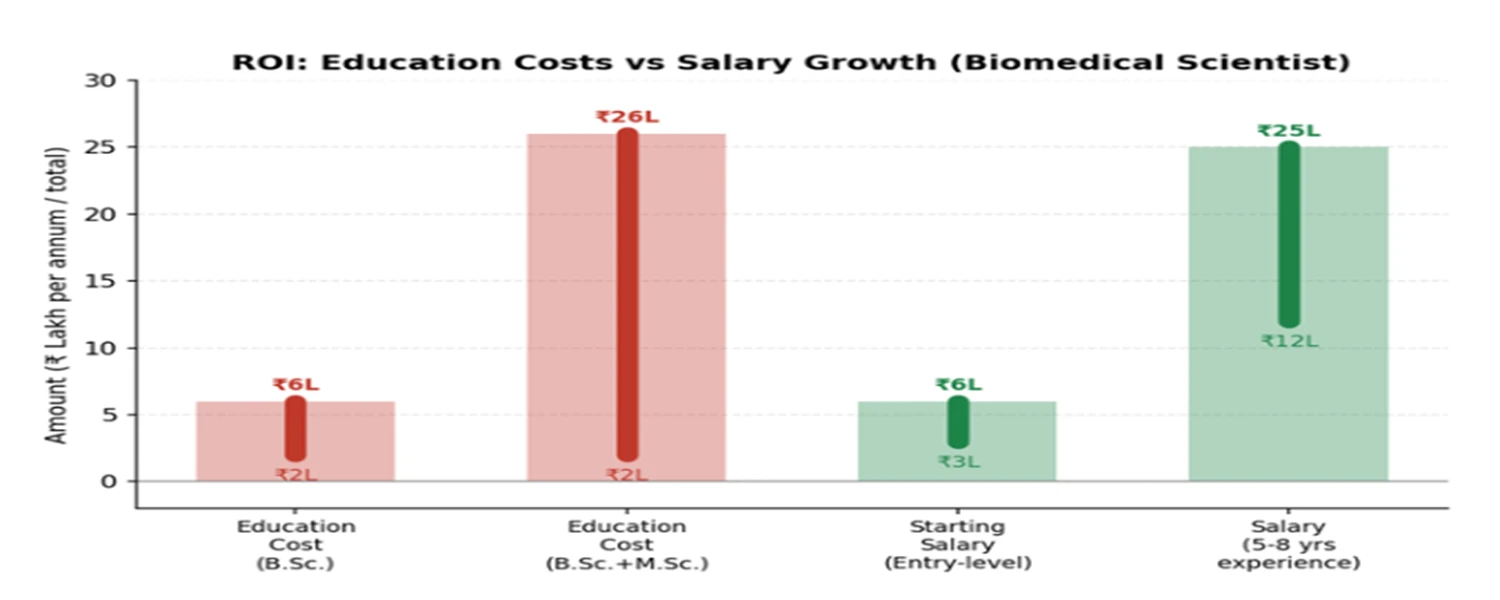
Here’s the good news—your investment in biomedical science pays off quickly. A B.Sc. costs just ₹2–6 lakh, and an optional M.Sc. or specialization (₹8–20 lakh) can boost your growth even further.
Your starting salary of ₹3–6 LPA can grow to an impressive ₹12–25 LPA within 5–8 years, especially in private or international roles. Best of all, most professionals recover their education costs in just 3–5 years—proof that this career rewards you fast.
Here’s a quick comparison table:
Career Stage | Experience | Salary (LPA) |
Entry Level | 0–2 years | ₹3–6 LPA |
Mid Level | 3–5 years | ₹6–12 LPA |
Senior Level | 5–8 years | ₹12–25 LPA |
Note: Higher figures typically apply to private-sector or international roles
Graph: ROI – Return on Investment
Return on Time (ROT):
Your time investment is refreshingly short too—just 3 years for a B.Sc., plus 1–2 more years if you pursue an M.Sc. or certifications. And within 3–5 years of graduating, you’ll typically see that time pay off through steady career growth.
Graph: ROT – Return on Time
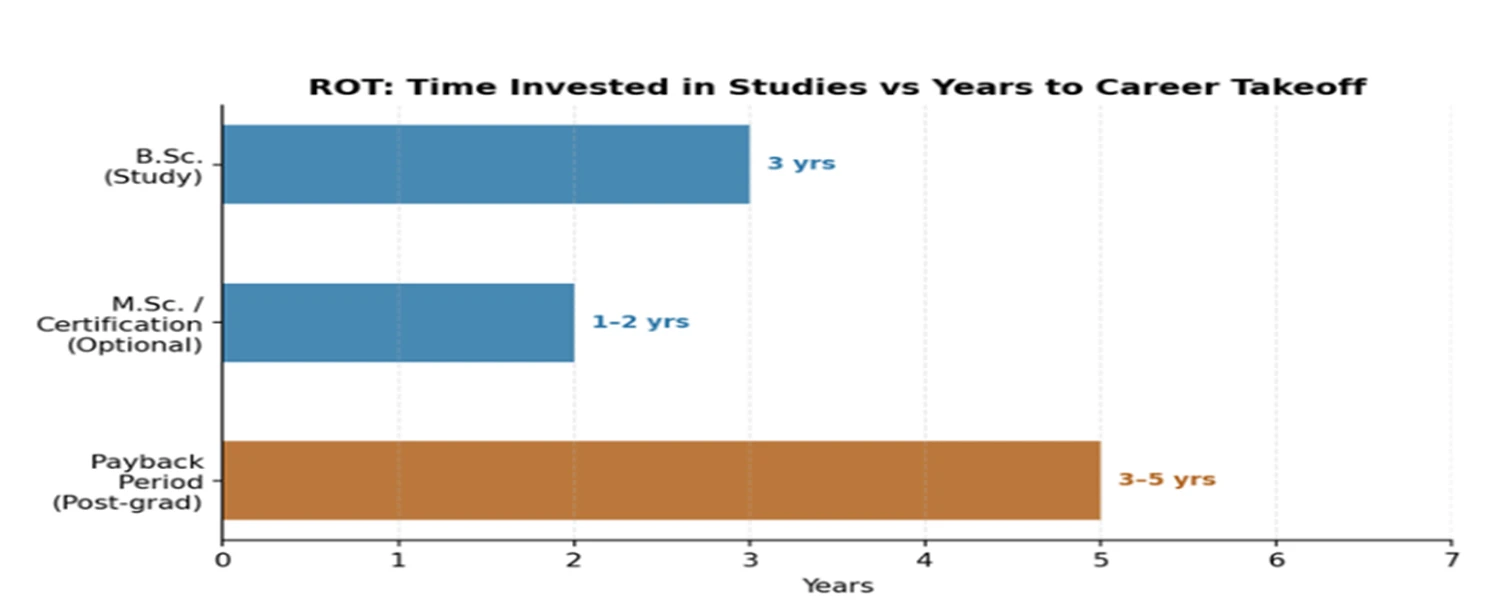
With payback in just 3–5 years, your time invested in biomedical science is truly worth every moment.
Pro Tip:
Short-term certifications (clinical trials, molecular diagnostics, bioinformatics) can fast-track your employability.
Future Prospects: The Next 20–30 Years
The future for medical scientists is bright:
- Genetics, AI-driven diagnostics, personalized medicine, and biotech are transforming the field.
- New roles in synthetic biology, CRISPR, biopharma R&D, and public health are emerging.
- India’s expanding healthcare infrastructure means more jobs, more labs, and more innovation.
If you’re ready to solve tomorrow’s health challenges, this is your time.
Final Thoughts: The Scientist Career Path
Choosing the scientist career path as a biomedical scientist offers meaning, stability, and future-readiness. You’ll work at the heart of medical breakthroughs, diagnostic innovation, and patient care.
If you’re curious, detail-oriented, and want to make a difference—take the next step. Your journey in biomedical science can shape lives (including your own).
Need guidance or have questions about how to become a biomedical scientist after 12th? Reach out—I’m here to help you map your path!
For personalized career counselling and career guidance, visit NextMovez.