

Blog written by Indu R Eswarappa, Career Coach & Education Change-Maker
Have you ever watched the Republic Day parade and felt a spark in your chest — the kind of awe and pride that makes you want to stand up straighter? That’s exactly how Kunal, one of our students from Pune, felt in Class 10. Today, he’s training at the National Defence Academy (NDA), preparing to serve the country as an Air Force officer.
If you’re seriously searching for how to join indian army after Class 12, understanding the right pathway early can make all the difference.
If you’re in Class 11 or 12 and wondering, “Can I join the Armed Forces straight after school?”, the answer is a resounding yes! This question often leads students to explore how to join the Indian Army through structured and reliable entry routes.
Exploring various army career jobs early on can help you decide which branch fits your skills best. This blog is your complete roadmap.
Educational Pathways & Required Qualifications: How to Join Indian Army
From my experience guiding students into the Armed Forces, I’ve seen that your choice of subjects in 11th and 12th plays a big role in determining which wing you can enter — Army, Navy, or Air Force. And no, it’s not just about marks; it’s about mindset and readiness.
If you’re still unsure about subject choices, eligibility, or long-term fit, our Career Counselling for School Students helps families make informed, confident decisions before committing to a defence pathway.
Here’s what you need to qualify:
1. Minimum Qualification: 10+2 Pass
Meeting this basic eligibility is the first formal step in learning how to join indian army after school.
You need to complete Class 12 to be eligible for NDA or other service entries.
Tip: This is your foundation — focus on your core subjects and start preparing early if you’re sure about joining the forces.
2. Stream Requirements
- Army: You can apply through NDA with any stream (Science, Commerce, Arts).
- Navy & Air Force: You must take Physics and Mathematics in 11th & 12th.
Example: Rahul from Chennai cracked the NDA Air Force wing because he had PCM and started NDA prep in 11th grade!
Choosing the right subjects early simplifies your journey of how to join Indian army without last-minute confusion.
3. Age Limit: 16.5 to 19.5 Years (NDA Entry)
You need to be within this age bracket when the course starts at the National Defence Academy.
Tip: Plan your NDA attempts early — you can apply while you’re still in 12th. The earlier you know your target, the better you can prepare. And trust me, when you walk into that SSB interview confident and ready, the effort feels worth it.
Army Exams After 12th: Entrance Tests You Need to Crack
From my experience guiding students into the Armed Forces, I can tell you — your journey officially begins with the right entrance exam. Whether you’re dreaming of the Indian Army’s discipline, the Navy’s precision, or the Air Force’s wings of glory, each path starts with a written test that filters the committed from the curious.
This is where most students clearly understand how to join Indian army through competitive national-level exams.
These exams don’t just test academics — they assess your stamina, logic, speed, and presence of mind. And while the NDA exam is the most popular gateway after 12th, there are other entries too depending on your interests and strengths.
Let’s break down what to expect from each one — format, subjects, schedule, and what you need to crack it.
| Branch | Exam | Conducted By | When | Format | Duration | Questions |
| Army | NDA | UPSC | Twice a year (Apr & Sep) | MCQ – 2 papers | Maths 2.5 hrs, GAT 2.5 hrs | Maths 120, GAT 150 |
| Navy | NDA | UPSC | Twice a year (Apr & Sep) | MCQ – 2 papers | Maths 2.5 hrs, GAT 2.5 hrs | Maths 120, GAT 150 |
| Navy (Technical) | 10+2 B.Tech Entry | Indian Navy | Twice a year | No written exam — JEE (Main) score | — | — |
| Air Force | NDA | UPSC | Twice a year (Apr & Sep) | MCQ – 2 papers | Maths 2.5 hrs, GAT 2.5 hrs | Maths 120, GAT 150 |
| Air Force (Technical) | X & Y Group | IAF | As per IAF notification | MCQ – 2 papers | 60–85 mins (varies) | Varies by group |
Army, Navy & Air Force entrance exams after 12th
Source: upsc.gov.in (UPSC NDA & NA exam notification); joinindiannavy.gov.in and careerindianairforce.cdac.in (Navy & Air Force technical entries)
Quick Tips
- NDA is the most prestigious route for all three branches. Final selection includes SSB Interview + Medicals.
- For Navy B. Tech Entry, scoring well in JEE (Main) is crucial.
- Air Force X/Y Groups are good options for students looking at technical and non-technical trades.
Other Pathways After 12th
- TES Entry (Technical Entry Scheme): For Army tech roles (requires PCM in 12th).
- AA & SSR (Navy): Conducted by the Indian Navy for sailors and technical roles.
- Air Force Agniveer Vayu: New scheme under Agnipath for 4-year service.
Note: These are the primary army exams after 12th that lead to a stable career.
Top Army College and Training Options in India
Once you understand the exams, the next step in how to join Indian army is selecting the right training academy. If you are looking to enter the forces, India has several prestigious institutions that act as a gateway to a commissioned rank. Depending on your current stage, you might consider:
- National Defence Academy (NDA), Khadakwasla
- Indian Military Academy (IMA), Dehradun (Direct Entry/UES)
- Officers Training Academy (OTA), Chennai/Gaya
- Rashtriya Military Schools (RMS) & Sainik Schools (feeder institutions for school-level prep)
Necessary Soft Skills & Technical Abilities

Let me share a little secret from years of mentoring defence aspirants: cracking the entrance exam is just the first hurdle. What truly shapes your success in the Indian Army, Navy, or Air Force is your mindset, discipline, and adaptability. In fact, officers who rise through the ranks aren’t always the ones with top marks — they’re the ones with the right attitude, communication, and problem-solving abilities.
And let’s not forget the technical side — modern defence roles involve advanced systems, AI, drones, and cyber warfare.
So you’ve got to be sharp, both mentally and technically. Here’s how I break it down for my students:
1. Soft Skills You Need in Uniform
- Leadership & Teamwork: You’ll lead squads, coordinate missions, and inspire others under pressure. The SSB (Services Selection Board) is designed to test this — so start early.
- Discipline & Emotional Resilience: Life in the forces is not your regular 9 to 5. It demands structure, self-control, and the ability to handle stress, isolation, and unpredictability with grace.
- Communication Skills: Whether you’re briefing troops or negotiating with officers from allied nations, clear and confident communication is non-negotiable.
- Decision-Making Under Pressure: You won’t always have time to think — sometimes, you act. Forces look for candidates who can stay calm and take calculated decisions in critical moments.
2. Technical Abilities You Should Start Developing
- Computer & Network Fundamentals: From air surveillance systems to smart weapons, the forces operate on digital networks. Basic knowledge of computers, networking, and cybersecurity is a big asset.
- Mechanical & Electrical Aptitude: Useful in aircraft maintenance, submarines, and artillery divisions — knowing how systems operate gives you a huge edge.
- Geospatial and Navigation Tools: Especially for the Air Force and Navy, using digital maps, GPS systems, and satellite data is crucial in operations.
- Drone & UAV Technology (Emerging Skill): With increasing use of drones in surveillance and combat, forces are actively training officers in UAV technology and remote command systems.
Career Progression & Growth Opportunities — The Journey from Cadet to Commander
One of the most exciting things I tell my students about joining the Indian Armed Forces is this — you don’t just get a job, you start a journey of lifelong growth. Whether you’re in the Army, Navy, or Air Force, each role comes with clearly defined ranks, responsibilities, and chances to level up. And trust me, nothing beats the pride of rising through the ranks while serving your country.
Let me walk you through what that path can look like:
Starting Rank — Your First Commissioned Role
- Indian Army: Lieutenant
- Indian Navy: Sub-Lieutenant
- Indian Air Force: Flying Officer
You’ll begin as a junior officer, often leading a small team or managing operations under a senior. Expect intense training, ground experience, and learning on the job — this is where your foundation is built.
Tip: This is the best time to soak in all the learning, ask questions, and show initiative. Your performance here sets the tone for future promotions.
Mid-Career — Gaining Command & Specialized Roles
- Army: Major to Colonel
- Navy: Lieutenant Commander to Commander
- Air Force: Squadron Leader to Wing Commander
You now handle tactical missions, lead battalions or ships, and may specialize in areas like logistics, engineering, or intelligence. You’re also eligible for foreign postings, UN peacekeeping missions, or instructional roles in academies.
Tip: This is your growth phase — network, take up staff courses, and volunteer for challenging assignments. They often fast-track your career.
Senior Leadership — Strategic & Policy Roles
- Army: Brigadier and above
- Navy: Captain, Commodore, Admiral
- Air Force: Group Captain to Air Chief Marshal
At this stage, you’re not just leading teams — you’re shaping defence strategy, national security policies, and representing India at global platforms. Very few careers offer this kind of impact.
Tip: Only the best rise to this level. It takes consistent performance, a spotless track record, and visionary thinking.
Whether your dream is to fly jets, sail submarines, or command battalions, the forces give you a clear ladder to climb — with every rank bringing greater respect, responsibility, and reward.
Return on Investment (ROI): What You Gain for What You Give

When students and parents ask me, “Is joining the Armed Forces worth it after 12th?”, I always say — few careers offer such a high return for your early commitment. Here’s what I mean:
- No College Fees: Once selected through NDA or other military academies, your training, education, boarding, lodging — everything is sponsored by the government.
- Early Earnings: You begin earning a stable, tax-beneficial salary by age 21, unlike many who are still completing their degrees.
- Perks Galore: From free medical, subsidized housing, CSD canteen, to travel allowances, the financial perks are unmatched.
- Job Security: Once commissioned, you have one of the most secure government jobs in the country.
- Post-Retirement Benefits: Pension, resettlement programs, and transition support make this a lifelong return on service.
Insight: When you compare the zero debt, early salary, and lifelong benefits, the ROI of an Armed Forces career is exceptionally high, especially for students coming from humble or middle-class backgrounds.
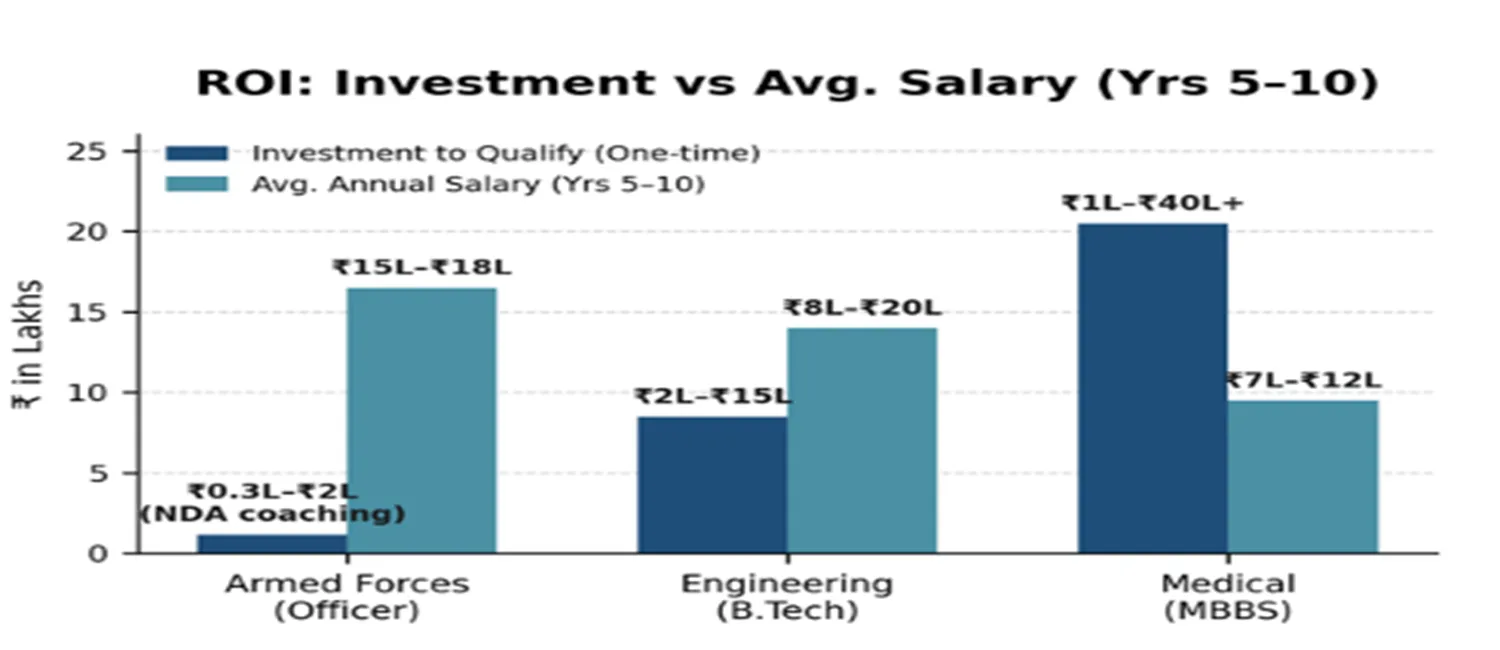
ROI – Investment to Qualify vs Average Salary (First 5–10 Years)
Sources: Indian Army salary, 2026 – mysalarycalculator.in
NDA coaching fees – centuriondefenceacademy.com & bestndacoachinginindia.com
Engineering/MBBS salary and course-cost benchmarks – instahyre.com & propelld.com
Return on Time (ROT): The Long-Term Value of Starting Early
ROT focuses on what you get out of the time you invest, and here too, the Armed Forces score high.
- Early Leadership Training: Most officers are trained in leadership, strategy, and decision-making by the time they’re 20 or 21.
- Fast Career Start: While peers are still job-hunting post-college, you’re already drawing a salary and earning promotions.
- Accelerated Life Skills: You develop discipline, confidence, and resilience that many take years to learn in the civilian world.
- Access to Elite Circles: Alumni from the NDA, IMA, INA, and AFA often become top bureaucrats, CEOs, and entrepreneurs.
| Career Path | Training Duration | Starting Monthly Salary | Perks Included |
| Armed Forces (Officer) | 3–4 yrs (NDA + IMA/INA/AFA) | ₹56,100 + MSP ₹15,500 ≈ ₹71,600 | Free housing, CSD canteen, medical, travel, pension, insurance, paid leave, MSP |
| Engineering (B.Tech) | 4 yrs + 6–12 months job search | ₹30,000–₹45,000 (typical) | Usually none formal; some MNCs offer insurance, food cards, or shuttle |
| Medical (MBBS) | 5.5 yrs incl. 1-yr internship | ₹15,000–₹30,000 (stipend) | Limited — subsidised treatment, hostel in some colleges, basic leave |
Starting salary & perks — Armed Forces vs Engineering vs Medicine
Sources: 7th CPC defence pay – mysalarycalculator.in
Engineering fresher salary – amquesteducation.com
MBBS internship/starting salary – diginerve.com
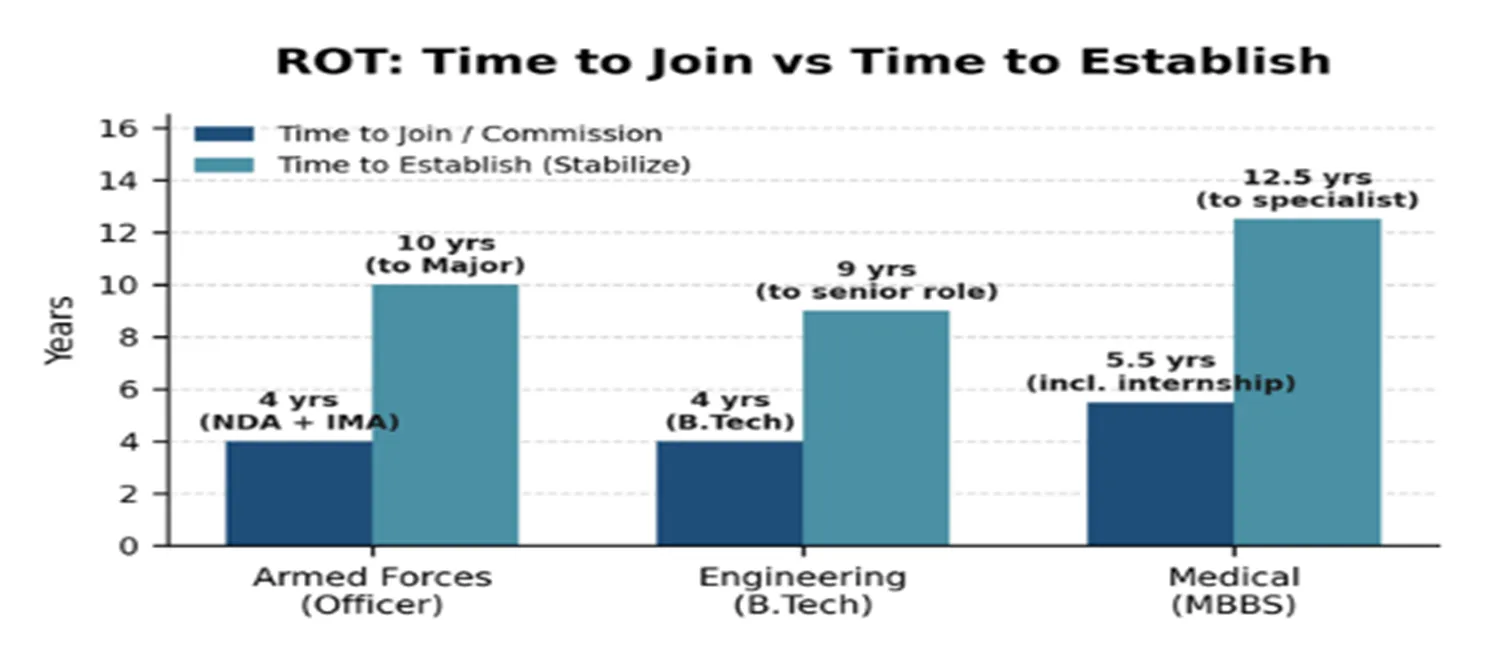
ROT – Time to Join vs Time to Establish (Stabilize)
Sources: Indian Army promotion timelines – testbook.com & ssbcrack.com
Rank structure – mapsofindia.com
B.Tech/MBBS duration and career-stabilization timelines – propelld.com & collegedekho.com
Insight: The time you invest in training pays off not just in a job, but in shaping the kind of person you become — fearless, focused, and future-ready. Knowing how to join the Indian army is just the beginning — long-term growth comes from discipline, leadership, and continuous learning.
Conclusion: Who Should Consider This Career?
If you’ve ever felt a sense of purpose beyond just making money… If your heart races at the thought of serving something greater than yourself… If you’re looking for a career that combines adventure, leadership, and lifelong respect — then the Armed Forces might just be your calling.
This is not just a job — it’s a way of life. It teaches you discipline, resilience, purpose, and patriotism in ways no corporate role can. But let’s be real — it’s also not for everyone.
Choose this path if:
- You thrive under structure and challenge.
- You want a debt-free, high-ROI education and career.
- You’re physically and mentally prepared for rigorous selection.
- You value security, leadership, and early independence.
Deciding to join the army after 12th is more than just picking a job; it’s about choosing a lifestyle that offers prestige and immense growth. With a wide variety of army career jobs available, from technical engineering to field combat, there is a place for every dedicated patriot.
A stable and rewarding career opportunities for personal growth, adventure, and lifelong learning.
References
- UPSC – NDA & NA exam notification
- Indian Navy – technical entry schemes
- Indian Air Force – X/Y Group entries
- Indian Army rank-wise salary, 2026 (7th CPC pay matrix & MSP) and Salary Blog
- NDA coaching fee benchmarks (Centurion Defence Academy) and Best NDA Coaching in India
- Indian Army promotion timelines (Testbook), SSB Crack, and Maps of India – Army Ranks
- Software engineer salary benchmarks (Instahyre) and AmQuest Education
- B.Tech course fees (Propelld)
- MBBS course fees, government vs private colleges (CollegeDekho)
- MBBS doctor salary by experience (Propelld) and DigiNerve
Source Notes
* ROI Graph — Investment to Qualify vs Average Salary (First 5–10 Years)
* Sources: Indian Army salary, 2026 – mysalarycalculator.in
NDA coaching fees – centuriondefenceacademy.com & bestndacoachinginindia.com
Engineering/MBBS salary and course-cost benchmarks – instahyre.com & propelld.com
** Career Path Table — Starting Salary & Perks (Armed Forces vs Engineering vs Medicine)
** Sources: 7th CPC defence pay – mysalarycalculator.in
Engineering fresher salary – amquesteducation.com
MBBS internship/starting salary – diginerve.com
*** ROT Graph — Time to Join vs Time to Establish (Stabilize)
*** Sources: Indian Army promotion timelines – testbook.com & ssbcrack.com
Rank structure – mapsofindia.com
B.Tech/MBBS duration and career-stabilization timelines – propelld.com & collegedekho.com