

Blog written by Indu R Eswarappa, Career Coach & Education Change-Maker
Table of Contents
- Introduction: Why the Indian Foreign Service Matters
- Key Responsibilities and Work Environment
- What an IFS Officer Actually Does
- Work Environment
- Educational Pathways and Qualification of IFS Officer
- Eligibility Overview
- UPSC Exam Process (Your Gateway to IFS)
- Stages of the Exam
- Subjects You’ll Need
- Training and Career Progression
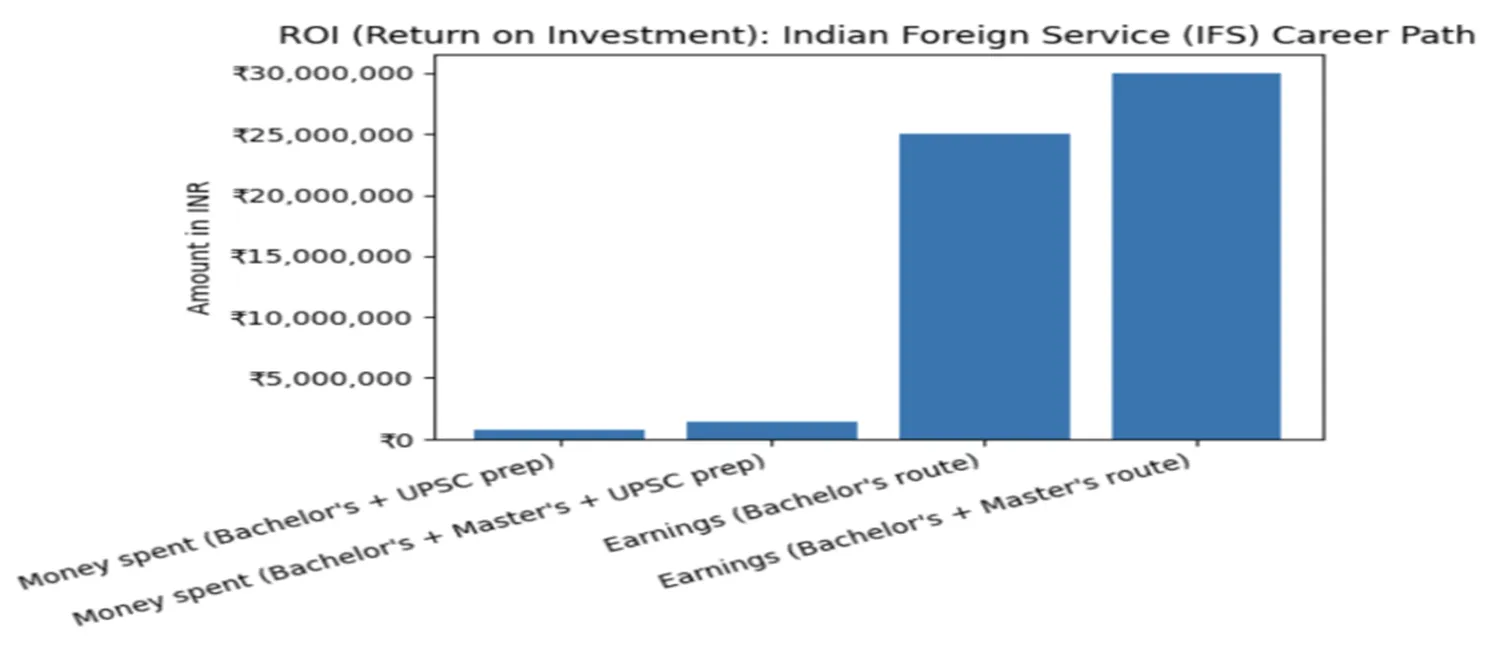
- Salary Expectations and ROI
- Average Compensation Structure
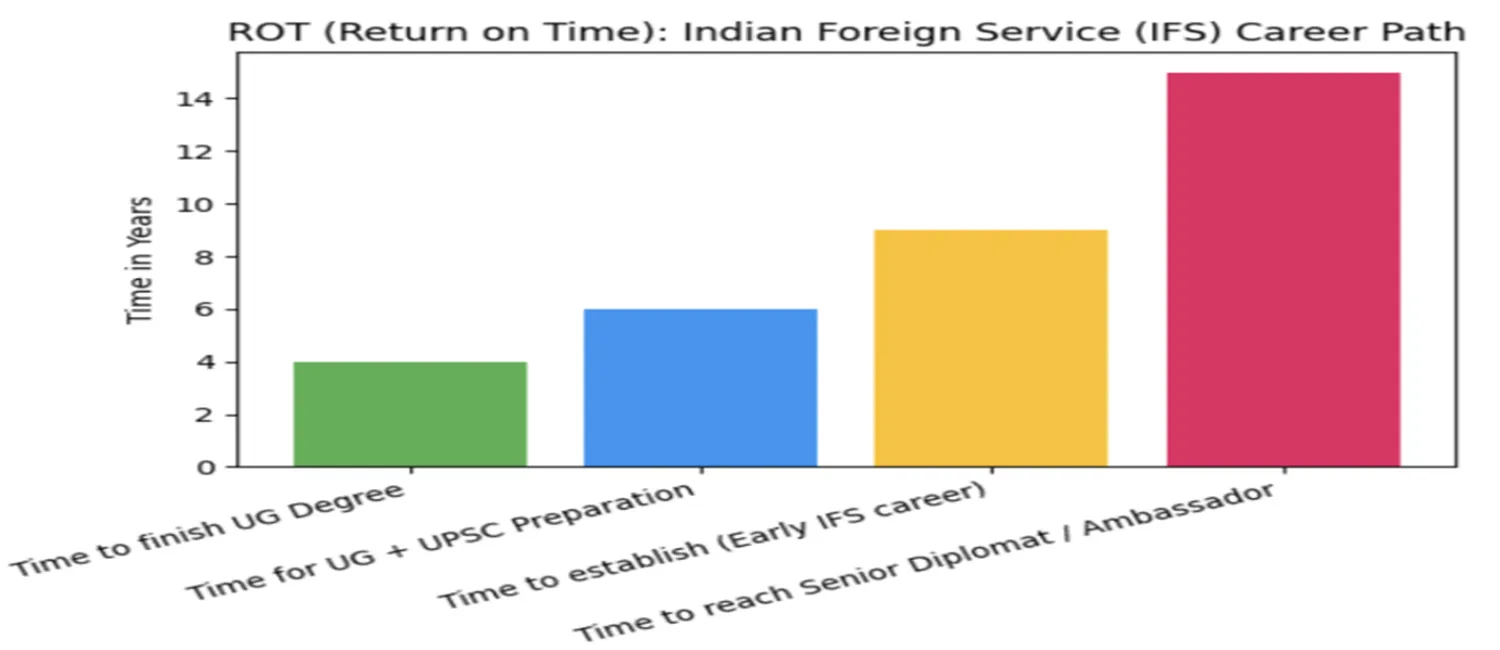
- ROT (Return on Time): Time Investment Across IFS Career Stages
- Conclusion: Is IFS Right for You?
Introduction: Why the Indian Foreign Service Matters

When I first interacted with an IFS officer during a career awareness seminar, I expected someone diplomatic, polished, and reserved. But what struck me more was the sense of purpose in their work. These are the people who represent India’s voice on the global stage—whether it’s trade negotiations, conflict resolution, cultural diplomacy, or supporting Indians abroad.
If you’ve ever wondered to become IFS officer, which exam is required, the answer lies in the prestigious UPSC Civil Services Examination. If you’ve ever dreamed of living in different countries, engaging with global leaders, and representing your nation with dignity and intelligence, then the Indian Foreign Service is one of the most meaningful careers you can pursue.
But becoming an IFS officer isn’t just about clearing an exam. It’s about developing the curiosity, resilience, cultural sensitivity, and emotional maturity required to navigate global diplomacy. In this blog, I’ll walk you through how to become an Indian Foreign Service officer, step-by-step — from eligibility and UPSC prep to training, postings, career growth, and long-term opportunities.
If you are a fresh graduate and want to know more about how to navigate your career choices, take a look at our Career Guidance Page for Graduates.
Key Responsibilities and Work Environment
A day in the life of an IFS officer is rarely predictable. When I interviewed an IFS officer posted in Europe, she shared how in one week she:
- Helped coordinate a state visit for Indian delegates,
- Mediated trade discussions,
- Organized a cultural film festival to promote Indian heritage,
- Assisted distressed Indian citizens facing passport issues abroad.
This is diplomacy in action — part administration, part negotiation, part cultural advocacy.
What an IFS Officer Actually Does
Core Area | What It Means |
Diplomacy | Building and maintaining India’s relationships with foreign governments |
Policy & Negotiation | Participating in strategic talks on defence, trade, climate, and humanitarian issues |
Consular Services | Supporting Indian citizens abroad and managing embassies |
Cultural Diplomacy | Promoting Indian languages, arts, festivals, and heritage globally |
Representation | Being the official face of India in global forums |
Work Environment
- Frequent travel and international postings
- Multicultural workplace
- High responsibility, high visibility
- Requires calm under pressure, adaptability, and clarity of communication
According to the MEA Annual Report 2024, India’s diplomatic presence is expanding rapidly to support trade alliances and global cooperation — meaning demand for IFS expertise is rising.
Educational Pathways and Qualification of IFS Officer
One common myth I hear when mentoring students is: “You must take Humanities to become an IFS officer.” But that’s not true. Regarding the qualification for IFS officer candidates, the service welcomes diverse academic backgrounds. IFS officers come from Engineering, Commerce, Arts, Law, Science, and even Medicine backgrounds.
What matters most is cracking the UPSC Civil Services Examination (CSE).
Eligibility Overview
Category | Requirement |
Nationality | Indian Citizen |
Age Limit | 21–32 years (relaxations apply for reserved categories) |
Educational Qualification | Any bachelor’s degree from a recognized university |
Attempts | 6 (General category; extensions apply to others) |
UPSC Exam Process (Your Gateway to IFS)

The UPSC CSE selects candidates for IAS, IPS, IFS, and 20+ central services.
Your rank decides your service — IFS typically requires a Top 100 All India Rank.
Stages of the Exam
Stage | Description | What to Expect |
Prelims | Objective exam | Focus on elimination strategy + current affairs |
Mains | Written descriptive papers | Demands deep conceptual clarity + articulation |
Personality Test (Interview) | Conversation with a panel | Evaluates awareness, confidence, integrity, diplomacy |
Subjects You’ll Need
- Polity & Governance
- International Relations
- History & Culture
- Economics
- Geography
- Ethics
- Optional Subject of your choice (Psychology, PSIR, Sociology, Anthropology are popular)
According to the UPSC 2024 Report, students with strong reading habits and consistent revision strategies show the highest success rates — not necessarily toppers in school.
Training and Career Progression

Career Growth Ladder
Level | Role |
Junior IFS Officer (Under Secretary / Attaché) | Embassy-based diplomatic & administrative duties |
Mid-Career (Counsellor / Deputy Chief of Mission) | Lead mission segments, negotiations, strategy execution |
Senior (Ambassador / High Commissioner) | Represents India at national leadership level |
IFS offers global career mobility and opportunities to lead change on an international scale.Once selected, you’ll undergo:
Phase | Location | Focus |
Foundation Course | LBSNAA (Mussoorie) | Leadership, administration, and public service values |
IFS Training | Sushma Swaraj Institute of Foreign Service (New Delhi) | Diplomacy, international law, language training |
Foreign Language Training | Embassies/Institutions Abroad | Mastery of one foreign language while on posting |
Salary Expectations and ROI

Average Compensation Structure
Stage | Approx. Salary (₹) | Additional Benefits |
Training | 55,000 – 70,000 | Stipend + campus facilities |
Entry-Level (Foreign Posting) | ₹2–2.5 Lakhs/month (after allowances) | Housing, travel privileges, diplomatic immunity benefits |
Ambassador Level | ₹5–7 Lakhs/month+ | Prestige + diplomatic privileges |
The real ROI of the IFS career is not just financial — it’s international exposure, influence, and lifelong learning.
ROT (Return on Time): Time Investment Across IFS Career Stages
Stage | Description | Time Investment |
UG Degree | Building academic strength | 3–4 years |
UPSC Preparation | Core phase of intense prep | 1–3 years |
Training (LBSNAA + SSIFS + Language)** | Professional and diplomatic training | 2 years |
Early Career (Embassy / Consulate Roles)** | Operational diplomatic experience | 3–5 years |
Senior Diplomat / Ambassador** | Strategic leadership roles | 15+ years |
Conclusion: Is IFS Right for You?
The Indian Foreign Service is not just a career — it is a commitment to representing India with integrity, intelligence, and empathy. At NextMovez, we use our Best-Fit Career Zone™ to assess whether your motivators align with diplomatic careers.
Ready to find out if the IFS is the right path for you?