
Blog written by Preethi Durga, a career strategist and education innovator.
- Want to Break Into AI? A Simple Prompt Engineering Roadmap & Skills That Actually Matter
- Global Trends Shaping Prompt Engineering Careers in 2026
- Trend 1: AI Is Moving From “Tool” to “Thinking Partner”
- Trend 2: Every Industry Is Hiring for AI Communication Skills
- Trend 3: Human-Centric AI Is Creating Long-Term Demand
- Job Demand & Hiring Trends: What the AI Job Market Is Actually Looking For
- Trend 1: Rising Demand for Prompt Engineering as a Core Job Skill (Not a Standalone Title)
- Trend 2: Companies Are Hiring for Human Judgment + AI Prompting (Not Just Tools)
- Skills Needed: What Actually Makes Prompt Engineering a Career (Not Just a Trend Skill)
1️⃣ Cognitive Structuring & Clear Thinking (The Core Skill)
2️⃣ Domain Knowledge + Context Design
3️⃣ Iterative Prompting & Feedback Loops
4️⃣ Communication, Instruction & Outcome Framing
5️⃣ Ethical Awareness & Bias Control
6️⃣ Emotional Resilience & Learning Discipline
- 3–5 Year Outlook: Where Prompt Engineering Careers Are Headed (2026–2030)
- Trend 1: Prompt Engineering Will Become a Core Skill Layer Across Roles
- Trend 2: Human Judgment + AI Oversight Will Drive Career Growth
- Conclusion: Prompt Engineering Is Not About Hype — It’s About Thinking Ahead
- Resources & References Used in This Blog
Introduction: When Curiosity Meets Fear at the Dinner Table
It usually starts with curiosity.
Your child says, “I want to work with AI.”
Or a professional across the table adds, “I’m thinking of switching into Prompt Engineering.”
And suddenly, the room goes quiet.
No one says no immediately — but the questions begin to stack up:
- “Is this a real career or just a tech trend?”
- “Won’t AI replace these roles anyway?”
- “Do you need to be a hardcore coder for this?”
- “What’s the stability five years from now?”
I see this moment unfold often — in conversations with parents, during career counselling for students, and even with mid-career professionals seeking career counselling for professionals.
The truth is — most families aren’t afraid of technology.
They’re afraid of irreversibility.
From a neuroscience lens, this reaction is predictable. When the brain senses uncertainty without a clear roadmap, the amygdala (our threat-detection center) overrides curiosity. Fear shows up as logic-based questions, but the emotion underneath is simple: “What if this goes wrong?”
For years, working in AI felt exactly like that — unstructured, elite, and accessible only to engineers from top institutes.
But 2026 is changing that narrative.
AI today is no longer just about building models. It’s about communicating with intelligence systems — clearly, creatively, and strategically. And that’s where Prompt Engineering enters the conversation, not as a buzzword, but as a bridge between human thinking and machine output.
What was once dismissed as “just typing prompts” is now emerging as a high-impact skill across product design, marketing, research, education, and even global roles accessed through study abroad consultants and international AI teams.
Just like data analysis evolved from spreadsheets into a structured career, Prompt Engineering AI roles are undergoing the same shift — from experimentation to employability.
This blog is not about hyping AI blindly.
It’s about helping students, parents, and professionals answer one crucial question:
“Is Prompt Engineering aligned with my strengths, learning style, risk tolerance, and long-term career vision?”
Because success in AI doesn’t come from chasing trends.
It comes from clarity, cognition, and conscious skill-building.
And that’s exactly what this roadmap will help you build.
Global Trends Shaping Prompt Engineering Careers in 2026

Prompt Engineering today is not being driven by hype —
it’s being driven by how the human brain interacts with intelligent systems.
To understand whether Prompt Engineering is a serious career path or just a passing phase, we need to look at the forces shaping it globally — and why they matter for students and professionals making long-term decisions.
Let’s break down three powerful global trends redefining the prompt engineering roadmap for beginners and experienced professionals alike.
Trend 1: AI Is Moving From “Tool” to “Thinking Partner”
Would you enjoy working with AI daily, not just occasionally? AI is no longer just executing commands.
It is co-creating, reasoning, and decision-supporting across industries. According to McKinsey’s Global AI Survey (2024–25), 65% of organizations now use generative AI in at least one core business function, up from less than 35% just two years earlier — with decision support and content reasoning being the fastest-growing use cases.
Globally, organizations are shifting from asking “What can AI automate?” to
“How can humans think better with AI?”
This shift is visible across:
- Business strategy
- Marketing & content
- Product design
- Education & training
- Research and analytics
Here’s the key change most people miss:
AI output quality is now limited less by the model — and more by the prompt.
That’s why Prompt Engineering AI skills are becoming core, not optional.
Why This Matters
This trend creates thinking-led roles, not coding-only roles.
Organizations now need people who can:
- Translate human intent into precise AI instructions
- Structure context, constraints, and logic
- Guide AI reasoning step-by-step
In short, they need Prompt Engineering professionals who understand cognition, not just commands.
Parent Insight
Many parents still assume AI careers mean:
“My child must be a hardcore engineer.”
The reality is different.
Some of the most effective prompt engineers come from:
- Psychology
- Design
- Business
- Humanities
- Education
Because the job is less about syntax — and more about how humans think, decide, and imagine.
Career Reality Check
This trend favors individuals who:
- Think clearly and sequentially
- Communicate intent precisely
- Understand how small wording changes alter outcomes
Prompt Engineering is becoming a thinking skill, not a technical shortcut.
Trend 2: Every Industry Is Hiring for AI Communication Skills
AI is no longer confined to tech companies. LinkedIn’s Jobs on the Rise Report (2025) shows that roles requiring AI interaction, prompt design, or GenAI-assisted workflows have grown by over 300% year-on-year, with hiring expanding beyond tech into marketing, HR, consulting, education, and operations.
Globally, AI adoption is accelerating across:
- Marketing & branding
- HR & talent acquisition
- Consulting & strategy
- Healthcare, law, and education
- Startups and global enterprises
This has created cross-functional demand for:
- AI prompt designers
- AI workflow specialists
- Content + AI strategists
- Domain experts with AI prompt engineering skills
This is why searches around how to become prompt engineer have spiked — not just among engineers, but among working professionals.
Why This Matters
This trend answers a common fear:
“What if AI roles disappear?”
Prompt Engineering doesn’t sit inside one industry.
It travels across industries.
A strong prompt engineering roadmap allows professionals to:
- Shift domains without restarting careers
- Add AI leverage to existing expertise
- Stay relevant as roles evolve
This dramatically lowers long-term career risk.
Parent Insight
AI careers are no longer location-bound.
Students and professionals can:
- Work with global teams
- Freelance across borders
- Access international opportunities alongside traditional paths supported by study abroad consultants
AI fluency has become a global employability currency.
Career Reality Check
This path rewards people who:
- Combine domain knowledge with AI thinking
- Are curious about workflows, not just tools
- Can learn continuously without formal degrees each time
Prompt Engineering is becoming career insurance, not career replacement.
Trend 3: Human-Centric AI Is Creating Long-Term Demand
Globally, the conversation around AI has shifted from:
“What can AI do?”
to
“How do humans stay in control of AI?”
This has accelerated demand for:
- Ethical AI use
- Bias-aware prompting
- Explainable AI outputs
- Responsible AI workflows
And at the center of this shift lies Prompt Engineering.
As per the World Economic Forum – Future of Jobs Report (2025), AI ethics, human–AI interaction, and responsible AI use rank among the top 10 fastest-growing skill clusters globally, expected to remain in demand through at least 2030.
Why?
Because prompts decide:
- What AI prioritizes
- What it ignores
- What assumptions it makes
Why This Matters
This trend creates long-life careers, not short-term tech roles.
Professionals skilled in:
- Structured reasoning prompts
- Safety-aware prompting
- Context and constraint design
will remain relevant even as AI models evolve.
The model may change.
The thinking skill will not.
Parent Insight
Unlike trend-based tech roles, human-centric AI careers:
- Age well over time
- Are respected across countries
- Align with global regulation and responsibility standards
This makes Prompt Engineering a future-facing career, not a fragile one.
Career Reality Check
This path is ideal for individuals who:
- Enjoy thinking deeply, not just executing
- Care about impact, ethics, and clarity
- Are comfortable growing steadily rather than chasing hype
Key Takeaway for Students & Professionals
Prompt Engineering in 2026 is no longer about talking to machines.
It’s about training your brain to think clearly in an AI-powered world.
For the right learner, the right mindset, and the right guidance —
Prompt Engineering is becoming a structured, globally relevant, and cognitively powerful career path.
And that’s exactly what the next section — the Prompt Engineering roadmap for beginners — will break down step by step.
Job Demand & Hiring Trends: What the AI Job Market Is Actually Looking For
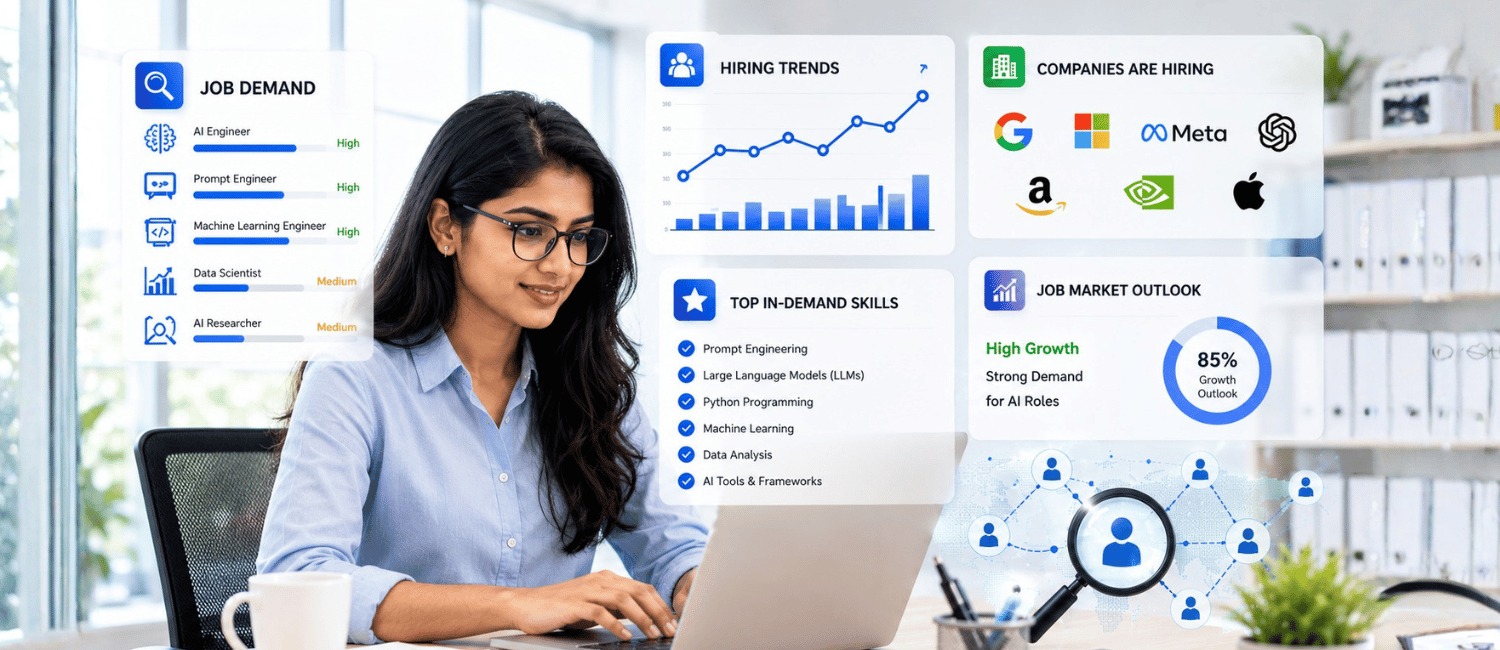
When families hear AI careers, they often imagine extreme competition, elite coders, or jobs that will vanish overnight.
But when I speak with recruiters, AI product teams, and hiring managers across startups and enterprises, a very different picture emerges.
Prompt Engineering is no longer a fringe skill or an experimental title.
It is quietly becoming one of the most demanded capability layers inside AI-enabled roles — especially for professionals who can combine thinking, clarity, and domain understanding.
What’s driving this shift?
AI adoption is accelerating across business functions, and companies are realizing one truth fast:
the quality of AI output depends on the quality of human instruction.
Let’s break down two real hiring trends shaping Prompt Engineering careers in 2026, with data-backed clarity.
Trend 1: Rising Demand for Prompt Engineering as a Core Job Skill (Not a Standalone Title)
Most companies are not hiring people with the exact title “Prompt Engineer.”
Instead, they are hiring for roles where Prompt Engineering skills are embedded.
According to LinkedIn Economic Graph data (2025), job postings that mention:
- Generative AI
- Prompt design
- AI-assisted workflows
have grown over 300% year-on-year, especially in roles like:
- Product & UX
- Marketing & content strategy
- Business analysis
- Consulting & operations
- Education & learning design
LinkedIn’s Jobs on the Rise 2025 report shows a 3x+ increase in demand for AI interaction and prompt-related skills, even when “Prompt Engineer” is not the job title.
Why This Matters
Prompt Engineering is becoming a capability, not just a designation.
Hiring managers increasingly look for professionals who can:
- Break down ambiguous problems
- Give structured instructions to AI
- Iterate prompts to improve reasoning and outcomes
This makes Prompt Engineering AI skills highly employable across roles — not locked into one career lane.
🎯 Parent Insight:
Your child doesn’t need to “wait for a Prompt Engineer opening.”
These skills layer onto existing careers and multiply employability.
🧠 Career Reality:
Those who learn how to think with AI — not just use tools — stand out fastest in hiring conversations.
Trend 2: Companies Are Hiring for Human Judgment + AI Prompting (Not Just Tools)
As AI tools become easier to use, companies are facing a new challenge:
AI can generate fast — but humans must decide what’s correct, ethical, useful, and relevant.
This has shifted hiring toward human-in-the-loop roles, where Prompt Engineering plays a central role.
According to the World Economic Forum – Future of Jobs Report (2025):
Skills related to human–AI interaction, AI oversight, and responsible AI use are among the top 10 fastest-growing skill areas globally, with strong demand projected through 2030.
Why This Matters
This trend creates long-term job demand, not short-term tool dependency.
Professionals skilled in:
- Structuring prompts for reasoning
- Reducing bias through prompt framing
- Guiding AI decision-making responsibly
are increasingly preferred over those who only “know the tool.”
This is where AI Prompt Engineering skills intersect with psychology, logic, ethics, and business judgment.
🎯 Parent Insight:
AI careers are no longer just about speed or coding.
They reward judgment, clarity, and responsibility — skills that mature with time.
🧠 Career Reality:
Prompt Engineering sits at the intersection of:
- Human thinking
- Machine capability
- Ethical decision-making
This makes it harder to automate and easier to sustain as a career skill.
Best-Fit Career Zone™ Reflection (Student / Professional Prompt)
Ask yourself:
- Do I enjoy breaking complex problems into clear steps?
- Am I good at explaining intent, context, and constraints?
- Do I like refining ideas based on feedback and results?
If yes, then Prompt Engineering — guided by the right prompt engineering roadmap for beginners — may strongly align with your Best-Fit Career Zone™.
Not as hype.
But as a thinking-led, future-stable career capability.
Skills Needed: What Actually Makes Prompt Engineering a Career (Not Just a Trend Skill)
When parents or professionals ask me, “AI sounds exciting — but what skills will actually make Prompt Engineering a real career, not just a short-term advantage?”
I usually pause — because this is where most misconceptions live.
In 2026, Prompt Engineering is no longer about clever wording or chatting with AI.
The people who succeed are those who combine how the human brain thinks with how AI systems respond.
Across our Best-Fit Career Zone™ conversations — with students, working professionals, and those exploring career counselling for students or career counselling for professionals — one pattern is consistent:
Those who treat Prompt Engineering as a thinking discipline, not a hack, build relevance faster and sustain it longer.
Let’s break down the future-ready Prompt Engineering skills that actually matter.
1️⃣ Cognitive Structuring & Clear Thinking (The Core Skill)
Prompt Engineering begins before typing.
It starts with how well you can:
- Break a vague idea into clear steps
- Sequence information logically
- Define intent, constraints, and outcomes
Strong prompt engineers can:
- Turn messy problems into structured instructions
- Guide AI reasoning step-by-step
- Anticipate how wording changes affect results
Why it matters:
AI mirrors human thinking. Clear prompts reflect clear cognition.
This is the foundation skill of Prompt Engineering AI roles.
2️⃣ Domain Knowledge + Context Design
AI is powerful — but only when given context.
High-impact prompt engineers understand:
- The domain they’re working in (marketing, HR, education, analytics, etc.)
- The audience and use case
- The limits of AI understanding
Key abilities include:
- Supplying relevant background information
- Setting realistic constraints
- Framing prompts based on real-world scenarios
Career Reality:
Prompt engineers with domain depth outperform generic users — and are hired faster.
3️⃣ Iterative Prompting & Feedback Loops
One-shot prompting is a myth.
Real Prompt Engineering involves:
- Testing outputs
- Refining prompts
- Diagnosing where AI reasoning breaks
Future-ready professionals can:
- Ask better follow-up prompts
- Improve output quality without changing tools
- Learn from failures instead of abandoning attempts
Why it matters:
Hiring managers value people who can improve systems, not just use them once.
This skill is central to any practical prompt engineering roadmap for beginners.
4️⃣ Communication, Instruction & Outcome Framing
Prompt Engineering is communication — just not with humans.
Strong practitioners can:
- Give precise instructions
- Avoid ambiguity
- Specify tone, format, and depth
They can also:
- Translate business goals into AI tasks
- Explain AI-generated insights to non-technical stakeholders
Reality Check:
Many users struggle not because AI fails — but because their instructions lack clarity.
5️⃣ Ethical Awareness & Bias Control
As AI adoption grows, responsibility grows with it.
Effective prompt engineers are conscious of:
- Bias in prompts and outputs
- Ethical framing of questions
- Responsible use of AI-generated content
This includes:
- Avoiding leading or harmful prompts
- Requesting balanced perspectives
- Applying human judgment over blind acceptance
Why it matters:
Human-centric AI roles — not tool operators — are where long-term demand lies.
6️⃣ Emotional Resilience & Learning Discipline
Prompt Engineering is evolving fast.
Those who last show:
- Curiosity without overwhelm
- Comfort with constant learning
- Patience with imperfect outputs
Early-stage frustration is common — but resilient learners:
- Keep experimenting
- Build confidence through iteration
- Stay relevant as tools evolve
Truth for parents and professionals:
Tools will change. Thinking skills will compound.
🎯 Coaching Prompt for Students & Professionals
Before committing to a Prompt Engineering path, ask:
- Do I enjoy structuring ideas, not just consuming information?
- Am I willing to refine my thinking — not just my tools?
- Can I handle ambiguity, feedback, and gradual mastery?
If the answers lean yes, Prompt Engineering may not just be a skill upgrade —
it may be a long-term cognitive career asset.
Key Insight
Courses may introduce Prompt Engineering.
Tools may popularize it.
But skills decide longevity.
Prompt Engineering rewards those who evolve their thinking, judgment, and clarity — not those who chase shortcuts.
3–5 Year Outlook: Where Prompt Engineering Careers Are Headed (2026–2030)
Whenever parents or professionals ask me to look beyond the first AI course, first project, or first paycheck and focus on where a Prompt Engineering career will stand five years from now, my answer is honest and grounded:
Prompt Engineering is not disappearing — it is reorganising.
And those who enter this space with the right skills, domain clarity, and learning discipline will grow faster than most traditional tech roles.
Between 2026 and 2030, Prompt Engineering will not be defined by catchy job titles or viral tools —
it will be shaped by how deeply humans can think with AI, not just use it.
Let’s look at what the next 3–5 years realistically hold.
Trend 1: Prompt Engineering Will Become a Core Skill Layer Across Roles
Prompt Engineering will not remain a “separate job” for long.
Just like Excel or data literacy became embedded skills, Prompt Engineering will increasingly function as a career multiplier, layered onto existing roles.
What’s changing:
- AI-assisted workflows will become default across industries
- Professionals will be expected to guide AI, not just consume outputs
- Hiring will favor candidates who can structure problems for AI systems
In practice, this means:
- Marketers with strong prompt skills will outperform generic AI users
- Analysts who can prompt for reasoning will move into strategy roles
- Educators and consultants who design effective prompts will scale impact faster
Why this matters:
Prompt Engineering skills will quietly separate average performers from high-leverage professionals.
For students asking how to become prompt engineer, the answer will increasingly be:
build thinking depth + domain expertise, not chase a narrow title.
Trend 2: Human Judgment + AI Oversight Will Drive Career Growth
As AI tools mature, companies will face a new challenge:
AI can generate content fast — but humans must ensure it is correct, ethical, relevant, and usable.
This will sharply increase demand for professionals who can:
- Frame prompts responsibly
- Catch logical gaps and bias
- Improve AI outputs through iteration and reasoning
Career reality over the next 3–5 years:
Professionals who combine:
- AI prompt engineering skills
- Domain understanding
- Ethical and critical thinking
will move into:
- AI strategy roles
- Product and decision-support positions
- Leadership tracks where AI judgment matters
Those who rely only on tools will plateau quickly.
In short:
The future belongs to human-in-the-loop thinkers, not passive AI users.
What This Means for Students & Professionals Choosing Prompt Engineering Today
For those entering this path now, the next 3–5 years can bring:
🔹 Role Evolution
From:
- AI user → prompt specialist → AI workflow designer → decision strategist
🔹 Income & Opportunity Scalability
Through:
- Cross-industry relevance
- Global remote work
- Consulting, freelancing, or hybrid career models
🔹 Career Resilience
As Prompt Engineering becomes a portable thinking skill, not a tool-dependent role
This is why Prompt Engineering is increasingly viewed not as a trend skill —
but as a future-proof cognitive capability when built consciously.
Parent & Professional Perspective Shift
Don’t just ask:
“Can my child use AI tools?”
Ask instead:
- “Can my child think clearly with AI?”
- “Will they grow as AI systems evolve?”
- “Are they learning skills that compound over time?”
That one shift changes everything.
Guidance Push: Build Clarity Before Commitment
Before choosing a Prompt Engineering path:
- Map strengths to real AI-enabled roles
- Evaluate learning depth, not just course certificates
- Decide whether this should be a primary career, hybrid skill, or career accelerator
Clarity first. Career confidence follows.
Up next:
👉 How to Build Your Prompt Engineering Roadmap (Without Overwhelm or Hype)
Step-by-Step Prompt Engineering Roadmap for Beginners
- Month 1: Understand AI + prompting basics
- Month 2–3: Practice structured prompts
- Month 3–6: Build domain-specific use cases
- Month 6+: Portfolio + real projects
Most students and professionals today don’t struggle because of lack of opportunities —
they struggle because they don’t have a structured way to decide what truly fits them.
Conclusion: Prompt Engineering Is Not About Hype — It’s About Thinking Ahead
Prompt Engineering in 2026 is not about jumping onto the latest AI trend or mastering a tool overnight.
It is about strategy, cognitive skill alignment, and long-term relevance.
For the right learner, Prompt Engineering can offer:
- High-impact thinking work at the intersection of humans and AI
- Multiple career pathways (full-time roles, consulting, freelancing, domain-led AI work)
- Strong growth aligned with global AI adoption, not one industry cycle
- High Return on Time (ROT) when core thinking skills are layered early
- Global exposure through remote work and cross-border teams — without mandatory relocation
For others, Prompt Engineering works best as:
- A hybrid career skill (AI + marketing / design / business / analytics)
- A strategic layer added onto an existing profession
- A future-facing capability supporting entrepreneurship and leadership
The difference between success and struggle is not intelligence or talent alone —
it is career clarity before commitment.
🎯 Actionable Takeaway
Before enrolling in any Prompt Engineering course or chasing a title:
- Pause
- Assess fit
- Map your thinking style, domain strengths, income expectations, and long-term growth
👉 Don’t ask, “Is Prompt Engineering a good career?”
👉 Ask instead: “How does Prompt Engineering fit into my strengths, goals, and future?”
That’s where structured guidance — not hype — changes outcomes.
Resources & References Used in This Blog
1. McKinsey & Company – The State of AI Report (2024–2025)
Covers global adoption of generative AI across business functions, decision-making, and productivity use cases.
🔗 https://www.mckinsey.com/capabilities/quantumblack/our-insights/the-state-of-ai
2. LinkedIn Economic Graph – Jobs on the Rise (2025)
Provides hiring data on fast-growing roles and skills, including AI interaction, generative AI workflows, and prompt-related capabilities across industries.
🔗 https://www.linkedin.com/business/talent/blog/talent-strategy/jobs-on-the-rise
3. World Economic Forum – Future of Jobs Report (2025)
Details emerging skill clusters, including human–AI interaction, responsible AI use, AI ethics, and cognitive skills required through 2030.
🔗 https://www.weforum.org/reports/the-future-of-jobs-report-2025
4. OpenAI & Industry Research on Human–AI Interaction
Used to understand how prompt quality, context framing, and iterative prompting impact AI output reliability and usefulness.
🔗 https://openai.com/research
5. MIT Sloan Management Review – AI & Decision-Making
Explores how organisations are shifting from AI automation to AI-supported reasoning and judgment.
🔗 https://sloanreview.mit.edu/tag/artificial-intelligence/
6. OECD – AI, Skills & the Future of Work
Referenced for long-term employability, skill portability, and the role of cognitive skills in AI-enabled economies.
🔗 https://www.oecd.org/artificial-intelligence/