

Blog written by Preethi Durga, a career strategist and education innovator.
Introduction: When Ancient Wisdom Meets Modern Anxiety at the Dining Table
It usually begins with hesitation.
Your child says,
“I want to study Ayurveda.”
And suddenly, the room feels heavier.
Parents don’t reject the idea outright — but the questions come fast:
- Is Ayurveda a good career today?
- Will there be stable income or just clinic struggles?
- Isn’t MBBS safer than BAMS?
- What are the real career options after BAMS degree?
I’ve seen this exact moment play out in counselling rooms again and again — with students, parents, and even working professionals looking for a meaningful shift.
The truth is simple —
Most parents are not against Ayurveda.
They are against uncertainty disguised as tradition.
For decades, Ayurveda was seen as:
- Deeply respected, but poorly structured
- Knowledge-rich, but income-uncertain
- Spiritually aligned, but professionally risky
And honestly?
For a long time, those fears weren’t entirely wrong.
But 2026 is changing that narrative.
Ayurveda today is no longer limited to small clinics or inherited practices.
It is becoming part of:
- Preventive healthcare systems
- Integrative medicine models
- Government health missions
- Global wellness, research, and pharmaceutical ecosystems
What was once seen as a “backup medical option” is slowly transforming into a strategic healthcare career — if chosen consciously.
Just like yoga moved from ashrams to hospitals, corporates, insurance-backed wellness programs, and global certification systems —
Ayurveda is undergoing the same structural shift.
For the right student, Ayurveda is not escapism from competition.
It is alignment with a long-term healing profession.
Ayurveda is not a shortcut career — it’s a long-game profession
And for the wrong student, it can feel frustrating, slow, and financially stressful.
This blog is not about glorifying Ayurveda blindly — just like we don’t romanticise any career based on emotion alone.
It is about helping parents and students answer one crucial question:
👉 Is Ayurveda a good career when we consider skills, mindset, income pathways, government opportunities, and future healthcare trends?
That clarity — not tradition alone — is what determines success.
This is exactly why families today are asking not just how to become ayurvedic doctor —
but whether the ayurvedic doctor degree (BAMS) truly fits their child’s strengths, patience level, and long-term vision.
Let’s break it down — with honesty, data, and guidance — so this decision is made with confidence, not confusion.
Global Trends Shaping Ayurveda Careers in 2026 and Beyond
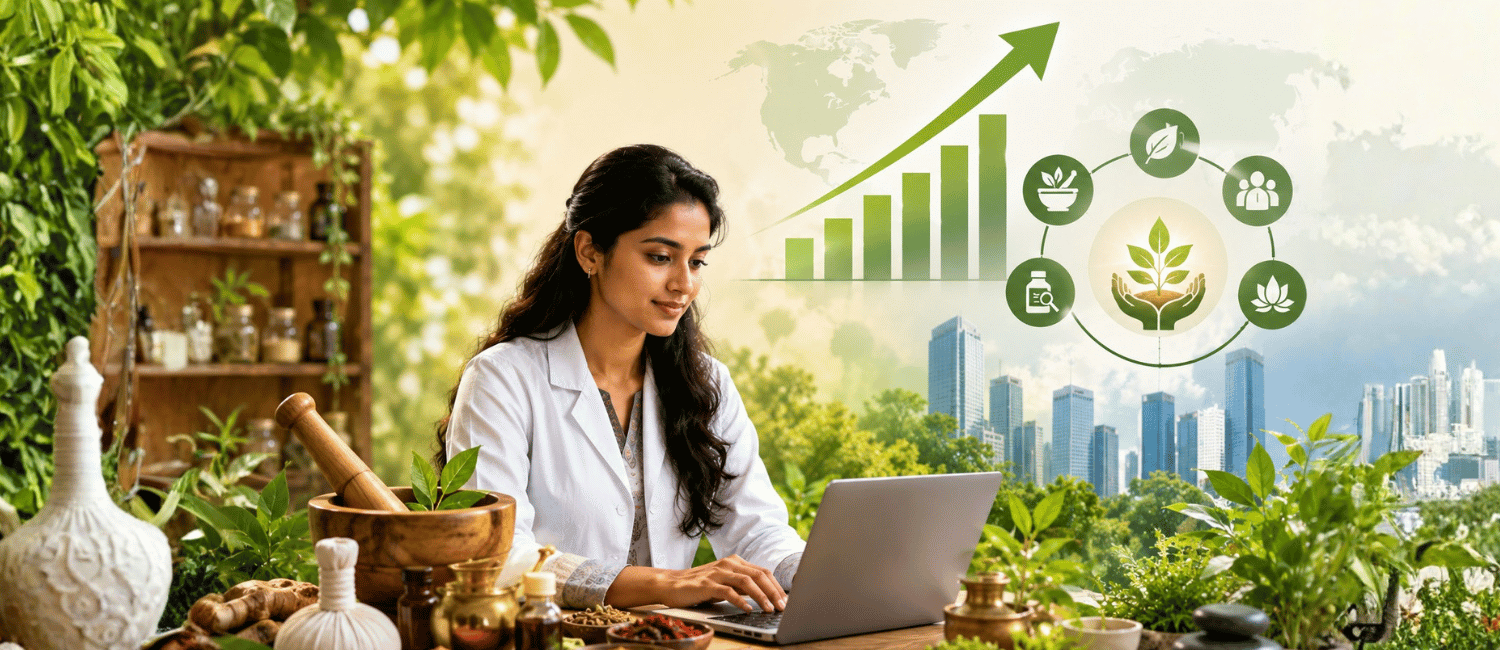
Ayurveda today is not being revived by nostalgia.
It is being validated by global health demand, government policy, and lifestyle disease economics.
To understand is Ayurveda a good career, we must look at what is changing outside classrooms and clinics — because careers grow where systems expand.
Let’s break down two powerful, data-backed trends that are reshaping the future of Ayurveda and BAMS careers.
Trend 1: Global Shift Toward Preventive & Integrative Healthcare
Modern healthcare systems are under pressure.
Rising chronic diseases, mental health challenges, and lifestyle disorders have made preventive care a global priority — and Ayurveda fits directly into this gap.
🔹 What’s changing globally:
- Hospitals are integrating traditional systems with modern medicine
- Wellness is moving from “optional” to “insurance-backed” in many countries
- Governments are recognising non-invasive, long-term health models
According to the World Health Organization (WHO):
Traditional and complementary medicine is used by nearly 40% of the global population, and WHO is actively supporting the integration of evidence-based traditional medicine into national health systems.
Why this matters for students:
This trend directly increases demand for:
- Trained Ayurvedic doctors
- Preventive health consultants
- Integrative medicine practitioners
- Research-backed Ayurveda professionals
Ayurveda is no longer positioned against modern medicine —
it is being positioned alongside it.
🧠 Neuroscience Insight:
Preventive systems reduce uncertainty — and careers grow where fear-driven healthcare shifts toward long-term wellness planning.
Trend 2: Strong Government Push & Expanding Public Healthcare Roles in India
India is no longer treating Ayurveda as an “alternative” system —
it is actively institutionalising it.
Through national missions, public hospitals, and primary healthcare integration, Ayurveda is being woven into the healthcare workforce.
What’s changing in India:
- AYUSH doctors are being appointed in public health centres
- Wellness centres under national health missions include BAMS doctors
- Research, pharma, and policy roles are expanding
According to data released by the Ministry of AYUSH (Government of India):
India has over 7.5 lakh registered AYUSH practitioners, with consistent annual recruitment across public health, education, research, and wellness programs.
Additionally, the AYUSH market in India is projected to cross USD 24 billion by 2028, driven by healthcare, wellness, and exports.
Why this matters for parents:
This directly answers a common concern:
“Are there government jobs for BAMS doctors?”
Yes — and they are expanding, not shrinking.
This includes:
- Public health appointments
- Teaching roles
- Research & regulatory positions
- Wellness and integrative health centres
This is why ayurveda doctor vacancy in government is becoming a consistent, searchable reality — not a rare exception.
Key Takeaway for Parents & Students
Ayurveda in 2026 is not surviving on belief.
It is growing on policy support, global health demand, and system-level integration.
For the right student, Ayurveda offers:
- Long-term relevance
- Structured employment pathways
- Alignment with future healthcare needs
For others, it may still feel slow — especially without patience, discipline, and clarity.
Which is why the real question is not tradition vs modernity.
👉 It is fit vs mismatch.
In the next section, we’ll explore:
👉 Job Demand & Hiring Trends: What Happens After BAMS in the Real World
Section: Industry Growth & Career Demand Trends in Ayurveda
Trend 1: Rapid Expansion of India’s AYUSH & Ayurveda Healthcare Market
Ayurveda is no longer a niche or traditional-only practice. It is becoming a mainstream healthcare and wellness industry, backed by policy support, global demand, and private investment.
In Ayurveda, clarity beats talent every time.
- According to the Ministry of AYUSH, India’s AYUSH market is projected to reach USD 70 billion by 2030, with Ayurveda being the largest contributor.
- The Indian Ayurveda market alone is growing at a CAGR of ~16%, driven by preventive healthcare, lifestyle disease management, and integrative medicine adoption.
Why this matters for students
This growth directly translates into:
- Increased career options after BAMS degree
- Higher demand for Ayurvedic doctors in hospitals, wellness chains, research, and digital health platforms
- Expanding ayurveda doctor vacancy in government and public health programs
Trend 2: Global Acceptance of Ayurveda in Integrative & Preventive Medicine
Ayurveda is gaining global legitimacy as part of integrative medicine, especially in chronic disease management, mental health, and preventive care.
- The World Health Organization launched the WHO Global Centre for Traditional Medicine in India, signaling formal global recognition.
- The global traditional medicine market, including Ayurveda, is expected to exceed USD 450 billion by 2030, with growing demand in Europe, the US, and the Middle East.
📌 Why this matters for students
- Opens international pathways for those asking how to become ayurvedic doctor with global exposure
- Expands roles in research, wellness tourism, clinical documentation, and evidence-based Ayurveda
- Makes Ayurveda a strong option even for students exploring support from study abroad consultants later in their career.
👉 When evaluating Is Ayurveda a good career, these trends clearly show that the field is moving beyond tradition into policy-backed, globally relevant healthcare careers.
This is exactly the kind of shift we map inside the NextMovez C3S Framework™ — separating emotionally appealing careers from structurally sustainable ones.
Case Snapshot: A BAMS Decision Done Right
A Class 12 PCB student approached NextMovez torn between MBBS pressure and Ayurveda curiosity.
Through the Best-Fit Career Zone™ mapping, we discovered:
- Strong interest in preventive health
- High patience for long learning cycles
- Low tolerance for high-stress emergency care
Instead of rushing into BAMS blindly, the student:
- Validated career options after BAMS degree
- Spoke to practising doctors
- Chose a college aligned with clinical exposure, not brand name
📈 Outcome:
By second year, clarity was high — no regret, no course-hopping, no comparison anxiety.
Skills Needed to Build a Successful Career in Ayurveda

Choosing Ayurveda is not just about completing an ayurvedic doctor degree. Long-term success depends on how well students blend classical knowledge with modern, human-centric skills. This is where many BAMS graduates either grow rapidly—or struggle.
1. Strong Foundation in Classical Ayurvedic Knowledge
This is non-negotiable.
A successful Ayurvedic professional must deeply understand:
- Ashtanga Ayurveda (Kaya Chikitsa, Panchakarma, Dravyaguna, Rasashastra, etc.)
- Prakriti analysis and individualized treatment planning
- Classical texts like Charaka Samhita, Sushruta Samhita, and Ashtanga Hridaya
Why this matters
Ayurveda’s strength lies in personalized medicine. Without mastery of fundamentals, graduates end up functioning only as dispensers of herbal products—not as doctors.
2. Clinical Observation & Diagnostic Thinking (Unique Neuroscience Value)
Ayurveda relies heavily on:
- Pulse diagnosis (Nadi Pariksha)
- Pattern recognition
- Long-term symptom mapping
- Mind–body correlation
These skills activate advanced observational and cognitive reasoning abilities, similar to neuroscience-based diagnostic thinking.
📌 Why this matters
This is where Ayurveda stands apart from many medical careers. Students who enjoy deep analysis, human behaviour, and holistic problem-solving thrive here.
3. Patient Communication & Emotional Intelligence (Emotional Entry Point)
Unlike fast-paced OPD models, Ayurveda requires:
- Listening deeply to patient histories
- Explaining lifestyle changes clearly
- Building long-term trust
📌 Why this matters
Patients often approach Ayurveda for chronic or unresolved conditions. Doctors who combine knowledge with empathy build:
- Higher patient retention
- Strong word-of-mouth referrals
- Sustainable private practice growth
4. Integrative & Evidence-Based Thinking
Modern Ayurveda professionals must be comfortable with:
- Reading research papers
- Understanding pathology reports
- Collaborating with allopathic doctors
- Integrating Ayurveda with nutrition, psychology, and preventive care
📌 Why this matters
This skill expands career options after BAMS degree into hospitals, wellness centres, research roles, and global integrative health platforms.
5. Entrepreneurial & Practice-Building Skills
With limited salaried roles initially, many graduates must learn:
- Clinic setup and patient acquisition
- Digital presence and ethical marketing
- Consultation pricing and scalability
- Product knowledge and compliance
📌 Why this matters
Those who combine Ayurveda with business skills earn significantly more than those relying only on jobs or government jobs for BAMS doctors.
6. Lifelong Learning & Adaptability
Ayurveda careers evolve with:
- New research
- Regulatory updates
- Global wellness trends
- Digital health platforms
📌 Why this matters
Students who seek guidance early—through career counselling for students or later via career counselling for professionals—adapt faster and avoid stagnation.
Guidance Push
Before deciding Is Ayurveda a good career, ask yourself:
- Do I enjoy long-term patient interaction?
- Am I willing to master both tradition and modern science?
- Can I commit to continuous skill-building beyond BAMS?
Ayurveda rewards clarity, patience, and skill-stacking—not shortcuts.
Skills decide entry into Ayurveda — but the next 3–5 years decide scale, stability, and status. To judge whether this path truly fits your child, we must look at where Ayurveda careers are actually heading.
Try This Today (15-Min Clarity Exercise)
Ask your child to answer these three questions in writing:
- Which part of Ayurveda excites me most — clinical healing, research, wellness, or teaching?
- Do I enjoy long study cycles and patient-based outcomes, not instant results?
- Am I willing to build credibility gradually over 5–7 years?
👉 If answers feel unclear or emotionally driven, pause the career decision and seek structured guidance.
💡 At NextMovez, this reflection is part of our Best-Fit Career Zone™ assessment — helping students decide before they commit years.
3–5 Year Outlook: What the Future Holds for Ayurveda Careers (2026–2030)
Whenever parents ask me whether choosing BAMS today will still make sense five years from now, my answer is grounded and realistic:
Ayurveda is not declining — it is being re-positioned.
And students who enter with the right skill mix will benefit disproportionately over the next 3–5 years.
Between 2026 and 2030, Ayurveda careers in India will be shaped not just by tradition, but by policy support, global demand, neuroscience-backed wellness, and preventive healthcare economics.
Let’s look at two clear trends shaping this future.
Trend 1: Government & Institutional Demand for BAMS Doctors Will Rise
Ayurveda is moving from “alternative” to institutionally integrated healthcare in India.
What’s changing:
- Expansion of AYUSH wings in government hospitals
- Increased hiring under National Health Mission (NHM)
- Integration of Ayurveda into preventive and primary care models
- Rising ayurveda doctor vacancy in government health centres, wellness clinics, and public hospitals
Latest verified insight:
- India has 9+ lakh registered AYUSH practitioners, and the government continues to expand AYUSH services under public healthcare frameworks.
- The Ministry of AYUSH budget allocation has increased steadily, signalling long-term employment creation in public systems.
Why this matters for students:
Students aiming for government jobs for BAMS doctors will see more structured recruitment, but also higher competition, making early planning and specialisation critical.
BAMS without direction leads to frustration; BAMS with strategy builds authority.
During Best-Fit Career Zone™ sessions at NextMovez, students who thrive in Ayurveda score high on patience, purpose-alignment, and long-horizon motivation.
Trend 2: Global Wellness & Integrative Medicine Is Creating New Career Pathways
Ayurveda is gaining global recognition not only as treatment—but as preventive and neuroscience-aligned wellness care.
What’s driving this shift:
- Rising chronic lifestyle disorders worldwide
- Mental health and stress-related conditions
- Demand for personalised, non-invasive healthcare
- Integration of Ayurveda with nutrition, psychology, and lifestyle medicine
Latest verified insight:
- According to the IMARC Group – Global Ayurveda Market Report, the global Ayurveda market is projected to grow at 8–9% CAGR, driven by wellness tourism, integrative medicine, and preventive healthcare demand.
- India remains the primary talent and knowledge source for Ayurveda professionals globally.
Why this matters for students:
This trend expands career options after BAMS degree beyond clinics into:
- Wellness chains
- Research & documentation
- Global health platforms
- Education, policy, and digital health roles
Often without mandatory relocation, unlike many MBBS-linked paths.
Reality Check for Parents & Students
Over the next 3–5 years:
- Ayurveda careers will reward depth, not shortcuts
- Generalists will struggle; specialists will scale
- Those with clarity early will outpace peers significantly
This is why the right question is not only
“Is Ayurveda a good career?”
—but
“Is my child prepared for where Ayurveda is going next?”
Next section will bring this together with a clear conclusion and decision framework for families.
How NextMovez Helps Students Choose Ayurveda With Clarity
At NextMovez, we don’t tell students whether Ayurveda is “good” or “bad.”
We help them answer a far more important question:
“Is Ayurveda the right long-term career for me?”
Through our structured Career Clarity & Counselling (C³S™) framework, we support students and parents in making informed decisions before committing to a demanding degree like BAMS.
What We Do Differently
🔹 Best-Fit Career Zone™ Mapping
We assess:
- Cognitive strengths & learning style
- Emotional resilience and patience levels (critical for medical careers)
- Interest alignment with clinical, research, teaching, or hybrid Ayurveda roles
This prevents students from choosing BAMS based only on tradition, family influence, or assumptions about job security.
🔹 Reality-Based Career Pathway Planning
We map out:
- Realistic career options after BAMS degree
- Income timelines (early years vs long-term growth)
- Competition for government jobs for BAMS doctors
- Private practice vs employment vs entrepreneurship paths
Parents gain clarity on what success actually looks like in Ayurveda — not just what brochures promise.
🔹 Skill & Specialisation Guidance (Beyond the Degree)
We guide students on:
- Which additional skills increase employability
- When to specialise — and when not to
- How to build credibility early through internships, exposure, and mentorship
This is especially valuable for families asking how to become ayurvedic doctor without limiting future flexibility.
Conclusion: Choosing Ayurveda With Clarity, Not Assumption
Ayurveda today is not a nostalgic return to tradition —
it is a structured, policy-backed, and globally relevant healthcare career when chosen consciously.
So, is Ayurveda a good career?
The honest answer is: yes — for the right student, with the right expectations and preparation.
For students who align well, a career in Ayurveda can offer:
- Meaningful impact through preventive, lifestyle, and mind–body healthcare
- Multiple career options after BAMS degree — clinical practice, government roles, wellness organisations, research, academia, and entrepreneurship
- Stable long-term demand, especially through government jobs for BAMS doctors and public health integration
- Growing global relevance, driven by wellness, neuroscience-aligned healing, and integrative medicine
- High Return on Time (ROT) when skills, specialisation, and credibility are layered early
For others, Ayurveda works best as:
- A hybrid career (Ayurveda + psychology / nutrition / public health / business)
- A foundation degree leading to research, education, health policy, or wellness leadership
- A supportive professional pathway for entrepreneurship rather than pure clinical practice
The difference between a fulfilling career and long-term frustration is not belief in Ayurveda alone —
it is career clarity before committing to BAMS. Choosing Ayurveda without career mapping is riskier than choosing MBBS without NEET clarity.
Actionable Takeaway for Parents & Students
What to Do Next (Before Filling Any BAMS Form)
- Map your child’s Best-Fit Career Zone™
- Understand real career options after BAMS degree
- Evaluate income timelines, government jobs for BAMS doctors, and private practice reality
Resources & References Used in This Blog
The insights, trends, and outlook shared in this blog are grounded in official government data, global health reports, and credible labour-market research.
- Ministry of AYUSH, Government of India
National policies, workforce data, BAMS scope, and institutional growth
https://www.ayush.gov.in - National Health Policy (India) – Integrative & AYUSH healthcare focus
https://www.nhp.gov.in - WHO – Global Report on Traditional & Complementary Medicine (2023–2024)
Global demand growth for Ayurveda and traditional medicine systems
https://www.who.int/teams/integrated-health-services/traditional-complementary-medicine - Press Information Bureau (PIB), Government of India
Updates on AYUSH hospitals, dispensaries, and government recruitment
https://pib.gov.in - National Commission for Indian System of Medicine (NCISM)
Education standards, BAMS curriculum, practitioner data
https://www.ncismindia.org - Invest India – AYUSH Industry & Wellness Economy Reports
Industry growth, private-sector expansion, export potential
https://www.investindia.gov.in - NITI Aayog – Health Sector Workforce Reports
Healthcare staffing gaps and rural health integration
https://www.niti.gov.in - ILO & World Economic Forum – Healthcare Workforce Outlook
Long-term healthcare demand trends
https://www.weforum.org
https://www.ilo.org