Blog written by Indu R Eswarappa, Career Coach & Education Change-Maker
When students first mention “fitness trainer” as a career choice, many parents instinctively think of gym instructors counting reps or personal trainers with unstable income. But the reality is far more layered — and far more professional — than most people realise.
Fitness trainers today are not just workout supervisors. They are movement specialists, health educators, behaviour coaches, rehabilitation support professionals, and wellness entrepreneurs. From injury prevention and strength conditioning to lifestyle transformation and mental well-being, fitness professionals play a critical role in modern healthcare and preventive wellness.
If you enjoy biology, human movement, health sciences, discipline-driven work, and helping people improve their quality of life, then fitness training can be a structured, scalable, and sustainable career — provided it is pursued the right way.
In this guide, I’ll walk you through how to become a fitness trainer in India, covering certifications, eligibility, entrance routes, skills, career options, salary expectations, and long-term growth — so you can decide whether this path aligns with your strengths and goals.
Key Responsibilities and Work Environment of a Fitness Trainer

When parents ask me what a fitness trainer actually does all day, I often smile — because this is where most assumptions quietly fall apart. A fitness trainer’s role is not about standing beside machines or counting repetitions. It is about responsibility, judgement, and trust.
In every training session, a fitness trainer is accountable for someone’s physical safety, health progress, and motivation. They work with bodies that are different, goals that are personal, and limitations that must be respected. This makes fitness training a profession that blends science, observation, communication, and ethics — not just physical strength.
Understanding the real responsibilities and work environment is crucial for families evaluating this career. It helps answer an important question early:
Is this a casual job based on enthusiasm — or a structured profession that demands skill, discipline, and accountability?
Once this distinction is clear, the role of a fitness trainer begins to look far more professional, specialised, and future-ready than most people expect.
Key Responsibilities of a Fitness Trainer
A professional fitness trainer is responsible for:
- Assessing clients’ physical condition, posture, mobility, and fitness levels
- Designing personalised workout and training plans
- Teaching correct exercise techniques and movement patterns
- Preventing injuries through safe training protocols
- Monitoring progress and modifying programs accordingly
- Educating clients on recovery, mobility, and basic nutrition
- Motivating and coaching clients through behaviour change
- Maintaining client records and progress data
- Staying updated with fitness science and certifications
- In advanced roles, collaborating with doctors, physiotherapists, and nutritionists
Work Environment of a Fitness Trainer
Fitness trainers work across multiple professional settings:
1. Gyms & Fitness Centres
- Commercial gyms, boutique studios, chains
- Fixed shifts or flexible schedules
2. Personal Training (Home / Online)
- One-on-one training
- Hybrid online coaching models
3. Sports & Performance Centres
- Strength & conditioning roles
- Athlete-focused environments
4. Corporate Wellness & Institutions
- Schools, colleges, corporate offices
- Preventive health programs
5. Rehabilitation & Wellness Clinics
- Support roles alongside physiotherapists
- Corrective exercise and mobility training
6. Entrepreneurship & Digital Platforms
- Online coaching
- Fitness content creation
- Personal brand-led training businesses
Educational Pathways and Required Qualifications

Fitness training does not follow a single university route like engineering or medicine — but it does require structured certification and scientific understanding.
Below is a clear roadmap parents and students can rely on.
Complete Education & Certification Roadmap for Becoming a Fitness Trainer
Entrance Exams for Fitness Trainer Careers
Unlike engineering, fitness careers do not require national entrance exams, but certification assessments are mandatory.
Certification Assessment Details
- Conducted by: NASM, ACE, ISSA, ACSM, Indian Fitness Academies
- When: Multiple intakes annually
- Format: Online / Offline
- Subjects: Anatomy, physiology, biomechanics, training principles
- Duration: 2–3 hours
- Total Questions: 100–150 (MCQs)
- Mode: Offline / Online (Institute-dependent)
👉 Certification quality matters far more than institute brand names.
Necessary Soft Skills & Technical Abilities
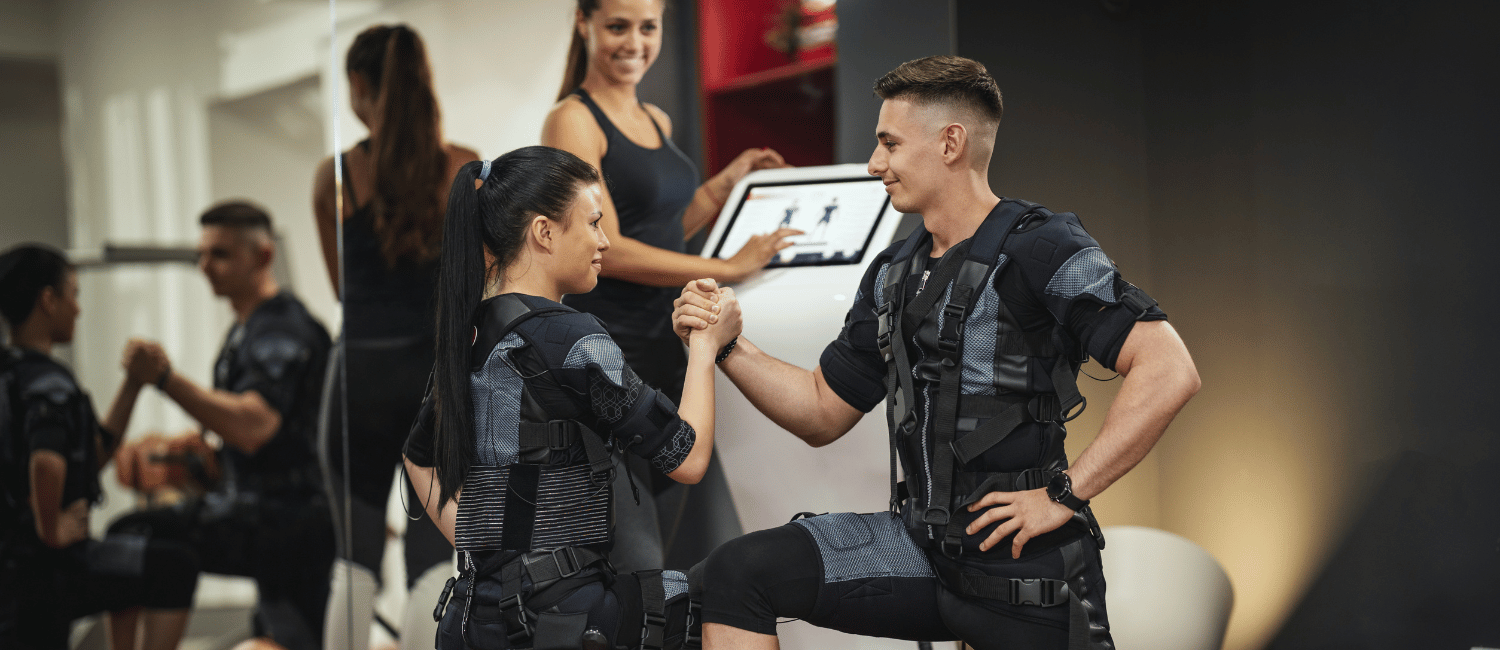
Success as a fitness trainer isn’t defined by physique alone — it’s shaped by how well a trainer understands people, bodies, and responsibility. While technical knowledge ensures safe and effective training, soft skills determine trust, consistency, and long-term client results.
This profession demands a balance: the ability to apply exercise science accurately and communicate with empathy, clarity, and motivation. Trainers who master both don’t just retain clients — they build credible, sustainable careers.
Technical Skills Every Fitness Trainer Must Build
- Human anatomy & exercise physiology
- Biomechanics and movement assessment
- Strength training & functional training principles
- Injury prevention and corrective exercises
- Program design and progression planning
- Basic nutrition and recovery concepts
Soft Skills That Shape a Successful Fitness Trainer
- Communication and motivation skills
- Empathy and emotional intelligence
- Discipline and consistency
- Observation and adaptability
- Ethical responsibility and safety awareness
- Entrepreneurial thinking
Career Progression & Growth Opportunities

One of the most common concerns parents raise is, “What comes after the first few years?” — and it’s a valid question. A fitness career is not meant to stay static. While many people see fitness training as a short-term or side profession, the reality is that clear progression paths exist for those who plan consciously and upgrade their skills over time.
Career growth in fitness depends less on age and more on expertise, credibility, and client impact. Trainers who invest in certifications, specialisations, and professional development can move beyond hourly sessions into leadership, consulting, and entrepreneurial roles. Understanding this progression early helps students and families see fitness training not as a temporary job, but as a scalable, long-term career with multiple growth avenues.
Career Path Progression
1. Entry-Level (0–2 Years)
- Gym trainer
- Assistant coach
- Group class instructor
2. Mid-Level (3–6 Years)
- Certified personal trainer
- Strength & conditioning coach
- Online fitness coach
3. Advanced Roles (7+ Years)
- Master trainer / Head coach
- Fitness consultant
- Corporate wellness expert
- Gym owner / Fitness entrepreneur
Alternative Growth Tracks
- Sports conditioning
- Rehabilitation support
- Yoga therapy
- Fitness content & digital coaching
- International fitness roles
Salary Expectations, ROI & ROT

Average Salary of Fitness Trainers in India
1. Entry-Level (0–2 Years)
₹15,000 – ₹30,000 per month
2. Mid-Level (3–6 Years)
₹40,000 – ₹80,000 per month
3. Experienced & Specialised Trainers
₹1 – 2.5 lakhs per month
4. Entrepreneurs / Online Coaches
₹3 – 6+ lakhs per month (brand-dependent)
ROI – Return on Investment

ROI answers one core parent question:
“How much money do we put in — and how soon does it come back?”
In a fitness trainer career, ROI is calculated by comparing:
- Total money spent on becoming employable
- Time taken to earn that money back through professional income
What Counts as Investment
These are one-time or early-stage expenses, usually incurred before or during the first year of work:
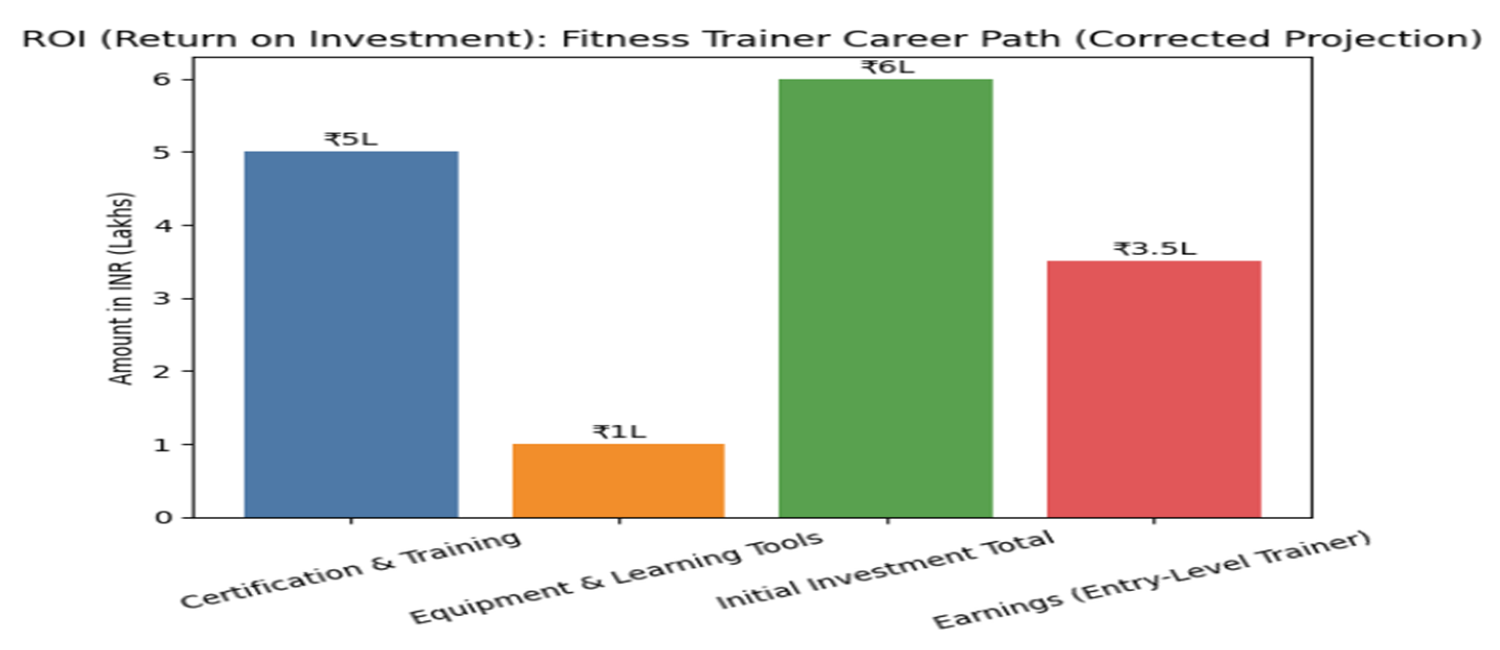
- Certification & Professional Training (₹1–5 lakhs)
- Recognised fitness trainer certifications
- Specialisations (strength training, rehab, nutrition basics)
- Workshops and assessments
- Equipment & Learning Tools (₹50,000–1 lakh)
- Personal equipment (bands, mats, monitoring tools)
- Learning resources, online platforms
- Initial branding or portfolio setup (optional)
- Total Initial Investment (₹1.5–6 lakhs)
- This becomes the total cost.
Break-Even Period (ROI Outcome)
Break-even means:
“When cumulative earnings = total investment”
For committed trainers:
- Entry-level monthly earnings often start at ₹30,000–60,000
- With 6–10 consistent clients, income rises steadily
- Most trainers recover their initial investment within 12–24 months
📌 Key Insight for Parents:
Unlike long academic degrees, fitness careers allow earning while learning, accelerating ROI.
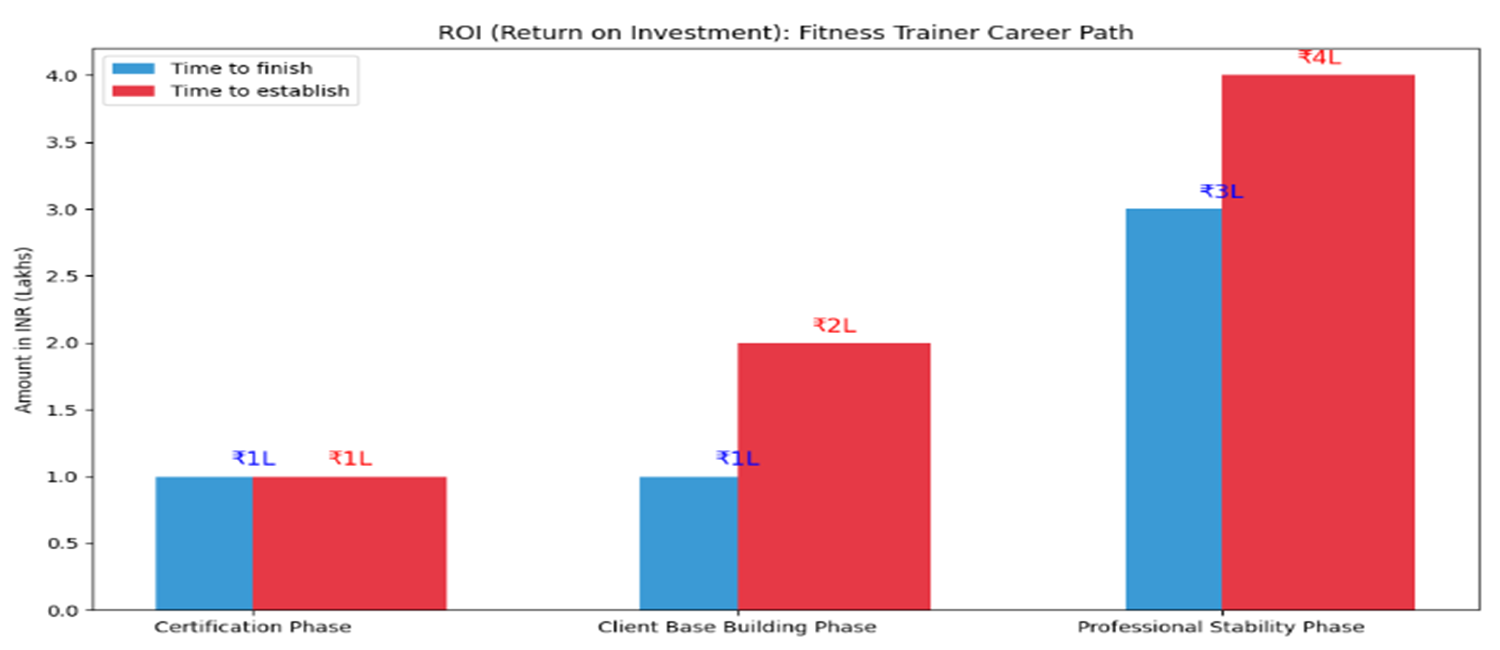
ROT – Return on Time

ROT answers a different question:
👉 “How many years of effort before my child becomes professionally stable?”
ROT focuses on time invested, not money.
What Counts as Time Investment
ROT can be shown as career stages over time:
- Certification Phase (6–12 months)
- Learning fundamentals
- Practical exposure
- Internship or supervised training
- Client Base Building Phase (1–2 years)
- Establishing credibility
- Retaining clients
- Gaining referrals and consistency
- Professional Stability Phase (3–4 years total)
- Predictable monthly income
- Strong reputation
- Option to specialise, scale, or go independent
Why ROT Is Strong in Fitness Careers
Compared to many professions:
- No long unpaid apprenticeship
- Early income generation
- Skill improvement directly increases earning capacity
Key Insight for Parents:
Fitness careers reward consistency faster than credentials alone. Time invested shows visible returns much earlier.
Conclusion: Who Should Consider This Career?
Fitness training is ideal for students who:
✔ Enjoy health, movement, and human biology
✔ Are disciplined and patient
✔ Like working closely with people
✔ Want a performance-based income model
✔ Are comfortable with continuous learning
It is not suitable for those seeking instant stability without effort.
If approached strategically, how to become a fitness trainer is not a vague idea — it’s a clearly structured professional journey with strong long-term potential.
👉 Connect with NextMovez career experts to assess whether this path fits your aptitude, personality, and long-term goals.
Resources & References Used
- NASM Official Portal – https://www.nasm.org
- ACE Fitness India – https://www.acefitness.org
- ISSA Global – https://www.issaonline.com
- Ministry of Youth Affairs & Sports – https://yas.nic.in
- Sports Authority of India – https://sportsauthorityofindia.nic.in