

Blog written by Preethi Durga, a career strategist and education innovator.
If your child loves science but feels lost between biology, coding, and physics pathways, let me share a truth I’ve seen repeatedly in my counselling sessions:
Chemical engineering is one of the rare STEM fields that never goes out of demand — it only evolves.
Every time a parent asks me which careers will actually survive automation, or remain globally employable, or offer strong salary growth, I find myself returning to this:
Chemical engineers don’t just work with chemicals — they build the systems that run the world.
From vaccines to electric vehicle batteries, from clean water to climate tech, from cosmetics to space fuels — chemical engineers are shaping 21st-century life quietly but powerfully.
And the best part?
Your child doesn’t need to love chemistry.
They need to love problem-solving, systems thinking, patterns, optimisation, and innovation — the core traits we decode through our Best-Fit Career Zone™ assessment.
Welcome to the parent’s guide to why chemical engineering still leads STEM careers in 2026 and beyond.
Introduction: Why Chemical Engineers Are the “System Architects” of Modern Industries
Whenever a new technology transforms the world — AI, EV batteries, cancer drugs, green hydrogen — I always ask myself:
“Who makes this scalable, safe, predictable, and efficient?”
The answer is almost always: a chemical engineer.
Most people imagine chemical engineers working only in factories. The truth is much bigger.
Chemical engineering today powers:
✔ Clean energy
✔ Food and nutrition innovation
✔ Pharma and biotech
✔ Space propulsion fuels
✔ Climate solutions
✔ Water desalination
✔ Battery technology and EV materials
✔ Cosmetic and personal care science
In fact, global demand for chemical engineers is rising due to rapid expansion in energy, biotech and advanced materials.
According to the U.S. Bureau of Labor Statistics 2024 update, chemical engineering jobs are projected to grow steadily with demand highest across energy, pharma, materials, and environmental sectors (BLS Employment Projections, 2024).
And in India, the chemical and petrochemical industry is projected to reach USD 300 billion by 2026 (Ministry of Chemicals & Fertilizers, India 2024).
Chemical engineers don’t just participate in the future —
they build it.

Global and Indian Demand Outlook
Whenever I guide students who lean toward STEM careers, I tell them this:
Chemical engineering isn’t a single career — it’s a global movement driven by megatrends.
Here are the forces shaping the chemical engineering future scope today.
- Clean Energy & Sustainability Are Booming
Green hydrogen, carbon capture, biodegradable polymers, solar cell materials — all of these depend heavily on chemical engineers.
A 2024 International Energy Agency report shows that clean-energy material demand is set to triple by 2030 (IEA Critical Minerals Market Review, 2024).
Parent Insight
If your child cares about the planet, chemical engineering allows them to create impact at scale.
- Pharma & Biotech Are Scaling Faster Than Ever
Vaccines, mRNA drugs, gene therapy, cancer therapeutics — none of these can reach the world without chemical process engineers.
India’s pharmaceutical market alone is expected to reach USD 130 billion by 2030 (India Brand Equity Foundation, 2024).
This means your child enters a field with unmatched job security.
- Advanced Materials Are the Future of Every Industry
EV battery components
Aerospace materials
Smart polymers
Heat-resistant composites
The global advanced materials market is expected to grow at over 6.2% CAGR through 2030 (Grand View Research, 2024).
Chemical engineers build the materials of the future — quite literally.
- The World Needs 10x More Water Engineers
UN Water’s 2024 report highlights severe shortages in desalination and purification experts.
Chemical engineers are urgently required in:
✔ water treatment
✔ desalination
✔ wastewater recycling
✔ membrane technology
Parent Insight
Stability + global mobility + purpose = a rare combination in STEM.
- AI + Chemical Engineering = A New Hybrid Career
Process AI, digital twins, computational modelling — industries hiring chemical engineers now prefer hybrid skill sets.
According to Businesswire report 2026, This strategic research report shows how AI is expanding across the chemical industry with strong growth and operational impact through 2030. This is where students enter the Tech–Process Fusion Pathway™ — a proprietary phrase mapping how chemical engineers blend computational and physical sciences.
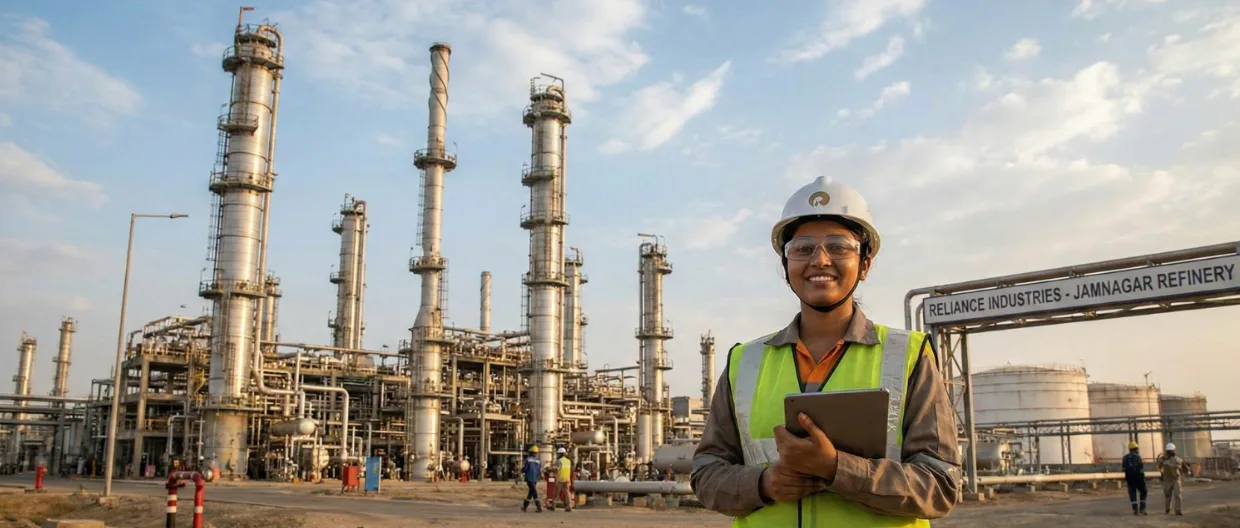
Industries Hiring Chemical Engineers in 2026 (Far Beyond Oils & Chemicals)
Parents are often shocked when I show them the full ecosystem.
Chemical engineers work in:
- Pharmaceuticals & Biotech
Pfizer, Serum Institute, Biocon
- Energy & Petrochemicals
ONGC, Reliance, Shell, BP, Adani, Indian Oil
- Food & Nutrition Tech
Nestlé, Mondelez, Amul, ITC
- EV & Battery Materials
Tata Motors, Exide, Panasonic
- Environmental & Water Engineering
VA Tech Wabag, Suez, Veolia
- Materials Science & Nanotechnology
3M, Dow, BASF
- Fertilizers & Agriculture Tech
IFFCO, Yara, Coromandel
- Cosmetics & Personal Care
L’Oréal, Unilever, Procter & Gamble
No other STEM degree opens doors to so many sectors simultaneously.
Skills Required for Chemical Engineering (and How They Map to Best-Fit Career Zone™)
Parents often tell me:
“My child is good at science — but how do I know if chemical engineering fits their brain?”
This is where our proprietary frameworks help.
Chemical engineering demands a specific cognitive DNA — and we decode this through the Best-Fit Career Zone.
Here are the must-have skills and their Career-DNA mapping:
- System-Thinking & Process Logic
Chemical engineers think in “flows” and “systems.”
Mapped to:
✔ Applied Problem-Solving DNA™
✔ Pattern Architecture Strength
- Math + Physics + Chem Integration Ability
This is not about scoring high — it’s about blending concepts.
Mapped to:
✔ Analytical Depth Index™
- Cognitive Endurance & Accuracy Under Pressure
They monitor processes that run 24×7.
Mapped to:
✔ Engineer’s Cognitive Endurance Signature™
- Curiosity + Innovation
From new battery materials to eco-friendly plastics.
Mapped to:
✔ Creative Scientific Thinking Profile™
- Tech Adaptability (AI + simulation + modelling)
This is what puts students on the Tech–Process Fusion Pathway™.
Parent Coaching Prompt #1
Ask your child:
“Do you enjoy improving things — not just solving them?”
If yes, that’s a strong chemical-engineer trait.
Emerging Skills & Career DNA Fit
When I speak to students who aspire to become automobile engineers, they often say, “I love cars and machines.” That’s a good starting point—but in my experience, succeeding in this field takes much more than just an interest in vehicles.
Think of an automobile engineer today as a problem-solver and innovator—someone who blends mechanical knowledge with technology, data, and sustainability. To thrive in this career, students need a mix of technical depth, analytical thinking, and adaptability.
Case Study: “How Ananya Found Her STEM Home”
When Ananya came to me in Class 12, she was torn between biotechnology, computer science, and chemistry.
During her assessment, one pattern stood out clearly:
✔ exceptional systems reasoning
✔ deep curiosity
✔ high endurance
✔ strong math-process integration
To test her career alignment, I showed her a real chemical process flow diagram.
She immediately said:
“This looks complicated, but it makes sense. I can totally break this down.”
Her mother looked at me with relief —
“For the first time, this feels like her true zone.”
Today, Ananya is applying to top chemical engineering colleges because the career chose her back.
This is what we call the Best-Fit Career Zone™ — where your child’s brain wiring aligns with real-world career success.
The Real Challenges in Chemical Engineering (That Parents Must Know)
Chemical engineering is rewarding — but demanding.
Here are the realities:
- Heavy workloads during college
- Mathematics + thermodynamics rigor
- Industry roles may initially involve plant shifts
- High responsibility for safety and precision
- Fast-changing technology requiring upskilling
Parent Insight
Students who enjoy structured problem-solving thrive; those who dislike complexity may feel overwhelmed.
That’s why clarity before choosing is essential.
Chemical Engineering Careers 2026: What the Next 3–5 Years Look Like
Here’s the part parents care about most:
Is chemical engineering still worth it?
Does it have future scope?
Is it globally relevant?
The answer — confidently — is YES.
Industry expansions (2026–2030):
✔ India’s chemical industry growing to USD 300B by 2026
✔ Pharma manufacturing booming
✔ Green hydrogen & clean energy scaling
✔ EV and advanced materials growing
✔ Food & cosmetic chemistry evolving
✔ Water treatment becoming critical
Global chemical market is set to grow to USD 6 trillion by 2030 (Statista Chemicals Market Outlook 2024).
Parent Insight
Chemical engineering is one of the most future-proof STEM degrees in the world — stable, versatile, and globally mobile.
Key Takeaways for Parents
✔ Chemical engineering powers the world’s largest industries
✔ Demand rising across clean energy, pharma, EV, water, materials
✔ AI is amplifying (not replacing) engineering roles
✔ Skills required map strongly to Career DNA traits
✔ Career has high global mobility and strong salaries
✔ Choosing this pathway requires clarity — not pressure
Try This Today
- Ask Your Child These Questions
- Do you enjoy improving systems?
- Do you like solving multi-step problems?
- Do you enjoy logic more than memorisation?
- Do you like experimenting, building, optimising?
If yes → strong alignment.
- Show Them a Real Chemical Process Simulation
Watch their curiosity activate instantly.
- Book a Best-Fit Career Zone™ Assessment
We decode:
✔ Systems intelligence
✔ Applied Problem-Solving DNA™
✔ Analytical Depth
✔ Cognitive Endurance
✔ Tech Adaptability
So families choose degrees with confidence — not guesswork.
Conclusion: Beyond Equations — Toward Engineering Leadership
Chemical engineering in 2026 is not just about factories or formulas —
it’s about building the technological, environmental, and industrial backbone of the future.
For students, it offers:
✔ intellectual depth
✔ innovation
✔ global relevance
✔ multi-industry access
✔ long-term job security
For parents, it provides:
✔ stability
✔ respect
✔ upward mobility
✔ future-proof relevance
If you’re unsure whether chemical engineering truly aligns with your child’s cognitive strengths, a 30-minute conversation can offer clarity many parents say they wish they had years earlier.
At NextMovez, we help families move beyond assumptions — and understand whether the chemical engineering future scope truly matches their child’s natural abilities.
Because success doesn’t come from choosing the most popular career —
it comes from choosing the career that fits your child at the deepest level.
Resources and References
- Chemical Industry Growth India (2024–2026)
Ministry of Chemicals & Fertilizers, Government of India — Industry Overview 2024
https://chemicals.gov.in - Clean Energy Materials Demand Increase
International Energy Agency — Critical Minerals Market Review 2024
https://www.iea.org - Advanced Materials Market Forecast 2024–2030
Grand View Research — Advanced Materials Market Report 2024
https://www.grandviewresearch.com - Pharma Industry Growth India (2024 Update)
India Brand Equity Foundation (IBEF) — Pharma Industry Report 2024
https://www.ibef.org - Chemical Engineering Job Outlook
U.S. Bureau of Labor Statistics — Chemical Engineers Employment Projections 2024
https://www.bls.gov - Global Chemicals Market Outlook
Statista — Chemicals Market Worldwide 2024
https://www.statista.com