
By Preethi Durga, a career strategist and education innovator.
Is a Physician Career Really as Rewarding as It Looks? Here’s the Reality
A student recently watched a documentary featuring a young physician. She was walking through the buzzing corridors of a top hospital, and she found herself in absolute awe of healthcare professionals.
The crisp white coat, the confident stride, the quiet heroism of saving lives — it all felt inspiring and almost cinematic.
But that admiration quickly shifted when the scenes moved to what truly defines a medical career.
Sleepless nights, emotionally heavy diagnoses, relentless study schedules, and the immense responsibility of holding someone’s life in your hands.
This is a Career Trends & Reality Check edition, not a “how to become a doctor” guide.
And for thousands of Indian students preparing for NEET 2025–26, this contrast between glamour and reality has never been more important.
Introduction: Reality Check
With rising cut-offs, limited government seats, and escalating private medical college fees, the decision to pursue medicine is no longer just about passion. It’s about understanding the real journey ahead.
That’s when a deeper question emerges for every parent and student. Is a physician’s career as rewarding in real life as it appears, or is there far more behind the stethoscope than what we imagine?
Interestingly, according to a Scroll Report of 2025, India is the biggest source of trained physicians exported to high-income countries. Research shows that 4.9% of American physicians and 10.9% of British physicians were trained in India.
Will my child burn out before they even finish residency?
Case Study: Manish – Reexamining Medicine Through His Own Lens
Manish was 17 and confident that medicine was his future. Coming from a family that valued academic success in science, his parents believed his path was already set. Like many teenagers, Manish thought that choosing medicine would make his family proud, as it was seen as a prestigious and stable career.
However, during his career coaching session with NextMovez, Manish’s results painted a different picture. While he had excellent communication skills, he wasn’t as well-suited for the high-stress, long hours of medical training. The realization came as a shock to his parents, who had never stopped to consider whether medicine was truly the best fit—they had only focused on its prestige.
Manish, too, understood that his motivations had been more about meeting expectations than aligning with his natural strengths. This insight helped him realize that healthcare analytics, a field where his analytical mind and problem-solving abilities could shine, would be a better match for him.
By reevaluating his options with the help of NextMovez, Manish discovered a path that was not only more suited to his personality and skills but also offered him a sense of personal fulfillment.
Parent Lens:
This is where NextMovez makes a real difference—helping students and parents move beyond societal pressures and assumptions about what’s “prestigious” or “successful.” Through personalized career coaching, we uncover the reality of the medical profession and assess whether it aligns with a student’s true strengths. Understanding the realities of a career, especially one as demanding as medicine, is crucial for making an informed, sustainable choice.
Is your child ready to explore their true career path? Career coaching can help clarify whether medicine is truly the right fit or if there’s a more suitable, rewarding alternative.
According to the OCAcademy Blog of 2025, many Indian doctors are increasingly turning to non-clinical career paths. It is because of the growing demand in fields like medical writing, healthcare administration, and public health.
The truth is: a physician is far more than the heroic snapshot.
When you ask “is being a doctor worth it?”The answer isn’t just about prestige or salary. It’s also about aligning with the rewards of being a physician and accepting the challenges that go with it.
For instance, according to a report published by JAPI (Journal of Association of Physicians of India) on July 01st, 2025, Burnout among Indian doctors can stem from multiple sources. It includes personal pressures (47%), work-related stress (31%), or patient-related challenges (35%).
What’s more alarming is that one in four doctors may be experiencing all three forms of stress simultaneously.
So, when parents ask: “What does a physician actually do day-to-day? Is it only about saving lives and respect — or is there more beneath?”
From clinical rounds to patient conversations, from research papers to team-lead meetings, the role expands in unexpected directions.
And if you prepare for the full spectrum, the physician career pros and cons become part of your map — not just surprises along the way.
Does my child truly have the emotional strength to handle patient suffering
If this raises doubts about your child’s readiness for medicine, that’s the right moment to pause.
Career coaching helps you find answers before Class 12 decisions lock in their future.
Global & Indian Trends
When I speak with students and parents, I always emphasise that being a doctor is not static — it’s evolving rapidly thanks to global shifts and emerging trends.
1.Health Workforce Shortage & Rising Demand
According to the World Health Organization report of 2025, there is a projected shortfall of 11 million health workers by 2030, mostly in low- and lower-middle-income countries.
What it signals: More roles opening up worldwide; greater demand for physicians in diverse settings.
What this means for your child: The physician career reality includes vast opportunity — especially for those willing to work in underserved areas or international settings.
2.Changing Employment Models for Physicians
According to a recent report by the Indian Express, published in September 2025, Indian doctors also have lucrative opportunities. That is why many of them settle abroad, earning well with good career progression.
What it signals: The traditional idea of a doctor entering private practice may be giving way to employment in large hospitals and health-systems.
What this means for your child: Prepare for a career that may involve complex organisational roles, collaborative teams, and systems-based medicine — not just solo consultancy.
3.Technology, Data & Digital Care on the Rise
The latest survey by WTW of global medical trends, dated November 10, 2025, reports major increases in technology adoption, telemedicine and data-driven care.
What it signals: The next generation of physicians will need more than clinical knowledge — they’ll need digital literacy, data-interpretation skills, empathy for remote patients and comfort with change.
What this means for your child: Encourage early development of skills like tele-health communication, digital records fluency, and adaptability to tools like AI-enhanced diagnostics.
Parent Insight: A physician career isn’t just about clinching the prestigious title of “Doctor” — it’s about being ready for a world where healthcare delivery, patient expectations and technology converge.
According to a recent report published by The Economic Times on November 27, 2025, on PG NEET rankers, there is now a noticeable shift away from traditional surgical specialties toward medicine-based fields.
These specialities include radiology, dermatology, internal medicine, paediatrics, psychiatry, and anaesthesia.
When I sit with students and parents, one question always comes up:
“Is becoming a doctor too demanding to be realistic — or is being a doctor worth it?”
The answer: yes, it’s demanding — but also incredibly rewarding when aligned with the right interests and mindset.
Medical seats — especially government MBBS seats — are limited, and competition remains extremely high every year.
According to a report published on Medical Dialogues in 2025 on September 24, 2025, the Union Cabinet has approved Phase-III of the Centrally Sponsored Scheme to add over 10,000 new medical seats. It includes 5,023 MBBS seats and 5,000 PG medical seats — in government-run institutes by 2028–29.
Why it matters: This selectivity means preparation must begin early, with consistent effort across academics, aptitude, and resilience.
Parent Insight: Help your child build discipline, curiosity in science, and emotional strength — not just focus on marks.

Emerging Skills & Seven-Day Plan
When I talk with students dreaming of becoming doctors, they often say, “I want to save lives!” And that’s a beautiful starting point — but thriving in the medical field requires a much wider set of abilities.
According to the American Medical Association’s 2025 report, physicians who build strong professional connections at their workplace are the ones most likely to remain in their roles. This underscores the importance of: clear communication, collaboration, and networking
Likewise, according to the 2025 Deloitte Global Health Care Outlook report dated January 29, 2025, 65% of healthcare leaders identify chronic disease management as their top public health challenge for the year
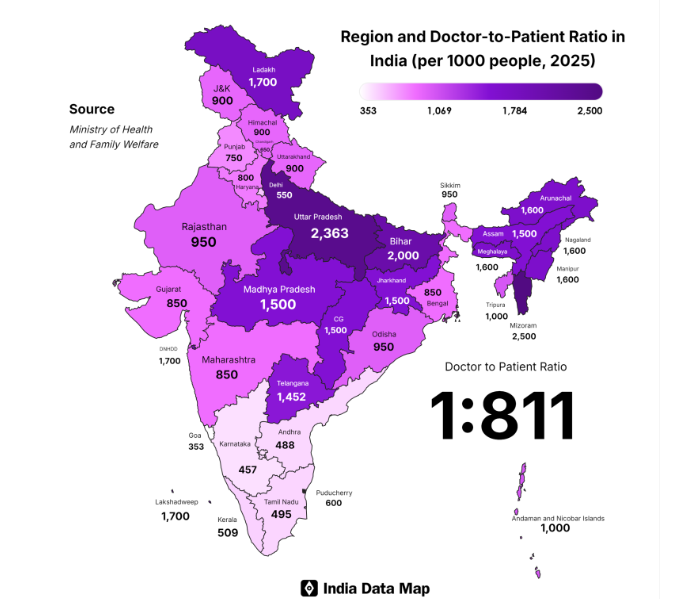
Image source: Ministry of Health and Family Welfare
Key Skills Needed Today
- Analytical & Clinical Problem-Solving
Diagnosing illnesses, interpreting test results, connecting symptoms, and making evidence-based decisions. - Communication & Patient Interaction
Explaining conditions, delivering tough news with empathy, and building trust — the core of patient-centred care. - Emotional Resilience & Stress Management
Long hours, emergencies, and emotionally heavy cases require steady composure and mental strength. - Adaptability & Continuous Learning
Medicine evolves constantly — new research, treatments, technologies, and global health challenges. - Digital Literacy & Tech-Comfort
Using digital records, telemedicine tools, AI-assisted diagnostics, and data-driven decision support systems. - Teamwork & Cross-Functional Collaboration
Coordinating with nurses, technicians, specialists, and care teams to deliver holistic care. - Empathy & Ethical Judgment
Understanding patient needs, respecting boundaries, maintaining ethical standards, and practicing humane care.
Curious which of these 7 skills is your child’s superpower? Take our free 2-min Career DNA snapshot here.
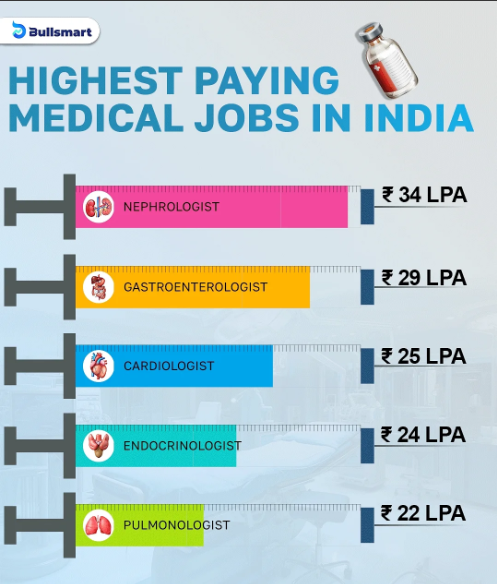
Image source: https://www.instagram.com/p/DQUMfNIgS2i/ (Bullsmart.in)
Try This Today
Day 1 — Communication Boost
Watch a medical communication video (e.g., breaking bad news) and write down three techniques doctors use effectively.
Day 2 — Analytical Skills Practice
Solve a basic medical case study available online (for students: try simple symptom-to-diagnosis exercises).
Day 3 — Emotional Resilience Check
Journal about a stressful moment and reflect on how you responded. Identify one healthy coping strategy.
Day 4 — Digital Awareness
Explore how AI or telemedicine is used in hospitals today. Note two tools physicians commonly use.
Day 5 — Empathy Builder
Have a conversation with a family member about a time they visited a doctor — observe what made them feel heard or ignored.
Day 6 — Adaptability Exercise
Learn one new healthcare trend or breakthrough (example: wearable tech, robotic surgery, predictive analytics).
Day 7 — Teamwork Practice
Participate in a group activity at school/college and observe your role — leader, contributor, listener? Make one improvement.

Doctor’s Burnout Strategy
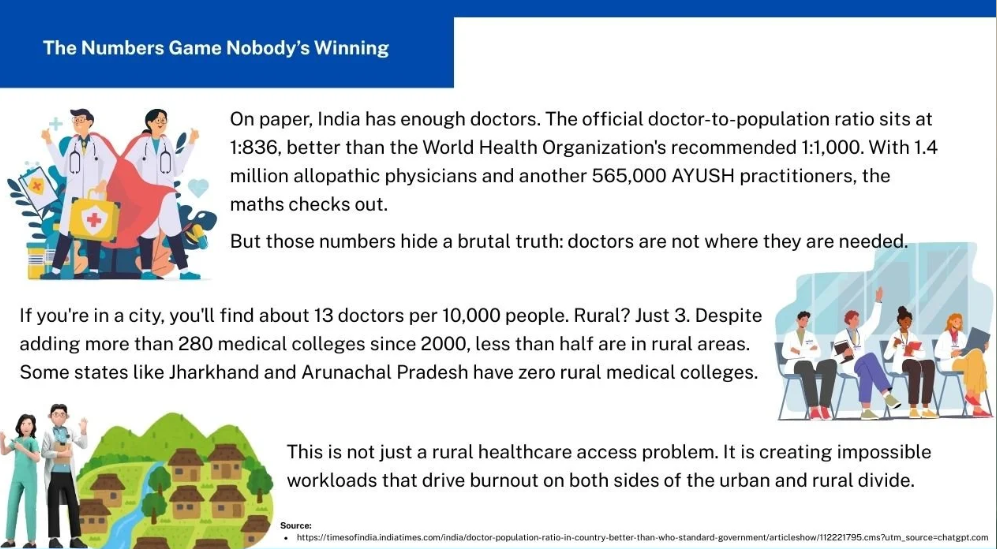
India doesn’t have a doctor shortage problem — it has a doctor distribution and burnout problem.
Reflective Prompt
“Which of these skills do you feel most confident in — and which one will you start developing this month?”
According to an OC Academy blog published on June 25, 2025, several top skills are essential for emergency medicine physicians.
Among the most important are Point-of-Care Ultrasound, ACLS and PALS (advanced life support mastery), comprehensive trauma management, and other critical emergency care competencies.
5-10 Year Outlook
Curious whether the role of a physician will still hold relevance a decade from now?
The answer: absolutely — perhaps more than ever.
Because healthcare will always matter, even as the tools, technologies, and patient expectations evolve.
According to the AAMC (Association of American Medical Colleges) report on the complexities of physician supply and demand, published in March 2024, the U.S. is projected to face a shortage of 20,200 to 40,400 primary care doctors by 2036.
Likewise, according to the India Today Report of 2025, India’s doctor-to-population ratio currently stands at 1:854, technically surpassing the WHO’s recommended benchmark of 1:1000. But this figure can be deceptive.
The real challenge lies in the uneven distribution of medical professionals across the country. Nearly 80% of doctors are clustered in urban areas, while vast rural regions struggle with acute shortages.
From Traditional Clinics → To Hybrid, Tech-Enabled Care:
Doctors will increasingly work through telemedicine, AI-assisted platforms, remote monitoring systems, and cross-hospital collaborations.
From Treating Illness → To Managing Holistic Health:
Lifestyle diseases, mental health concerns, preventative care, and personalised medicine will dominate future medical practice.
From One-Patient Focus → To Population & Community Health:
Physicians will play key roles in public health, epidemiology, digital disease surveillance, and community-wide health improvement.
From Siloed Work → To Multi-Disciplinary Teams:
Future medical care will involve collaboration with data scientists, mental health professionals, geneticists, nutritionists, and AI technologists.
From National Healthcare Roles → To Global Medical Leadership:
With rising global health challenges, Indian physicians are increasingly contributing to international research, humanitarian missions, and global health policies.
According to a New Indian Express Report, dated July 10, 2025, Kerala retained the top position in five key health categories. It includes maternal mortality ratio, under-5 mortality rate, HIV incidence, life expectancy, and health-worker density.
But the situation in many other states is very different, with significant gaps in healthcare access and outcomes.
This means that doctors and healthcare professionals today have tremendous scope to create meaningful, long-term change.
These include improving public health, strengthening communities, and helping India move toward a healthier, brighter future.
Parent Insight:
Help your child build scientific curiosity, empathy, adaptability, and comfort with technology.
These traits will make them future-ready — no matter which medical specialty or title they eventually choose.
Furthermore, according to the IBEF Blog India Adda – Perspectives on India 2025 published on September 25, 2025, India’s healthcare sector is undergoing rapid digital transformation, and doctors who are fluent in telemedicine and remote-care technologies will hold a strong advantage in the future of medical practice.
Takeaways
The role of a doctor is evolving rapidly — but students who blend medical knowledge with digital comfort, emotional intelligence, and strategic problem-solving will be the ones truly future-ready.
Case Study: Aryan – The Prestige of Medicine vs. Personal Fulfillment
When 17-year-old Aryan walked into his career coaching session at NextMovez, he was fully convinced that medicine was his calling. With strong academic success in science, his parents had always seen him as a future doctor. They would frequently tell him, “Medicine is the most respected career. It’s the best option for your future.”
However, after using the Best-Fit Career Zone™, a different picture emerged. Aryan’s personality and skills didn’t align as strongly with the demands of a traditional medical career as he had thought. While he excelled in communication, analysis, and problem-solving, his results revealed lower scores in areas like high-pressure decision-making and resilience under academic stress. These were key areas for success in medicine.
When his parents saw these results, they were initially taken aback. “We never questioned whether medicine suited him—we just assumed it was the best path because of its prestige,” his mother admitted. Aryan, too, realized that his desire to make others proud had led him down a path that didn’t suit his true strengths.
With this clarity, Aryan shifted his focus toward healthcare analytics, a field that combined his love for science with his natural abilities. This change allowed him to pursue a career that was both fulfilling and aligned with his personal strengths.
And that’s exactly where NextMovez steps in. We help students and parents look beyond assumptions, uncover the best fit career zone, and align ambition with clarity through personalised career guidance.
Conclusion
At NextMovez, we help families move past the glamourised image of “saving lives dramatically” to understand the real skills, mindset, and sacrifices behind an effective and rewarding physician career.
Still wondering whether a medical career is the right fit for your child? Our expert career coaches use the Best-Fit Career Zone™ to map strengths, interests, aptitude, personality, and values to healthcare pathways.
Curious where medicine really falls on your child’s unique Career DNA? Take our free 2-minute snapshot or DM us — we’re here when you’re ready.
Resources & References
- World Health Organization: Global health workforce shortage projections
- DocWire news Report
- WTW Survey of global medical trends
- IBEF Blog India Adda – Perspectives on India 2025
- American Medical Association’s 2025 report
- Medical Dialogues in 2025
- AAMC (Association of American Medical Colleges) report on the complexities of physician supply and demand
- OC Academy blog
- The New Indian Express Report
- 2025 Deloitte Global Health Care Outlook Report
- India Today Report of 2025,