

When I first started exploring engineering careers, chemical engineering stood out for one powerful reason — chemical engineers don’t just work in labs; they quietly shape the world around us. From the fuel that runs our vehicles and the medicines that save lives to clean water, food processing, batteries, semiconductors, and sustainable materials — chemical engineers are behind it all.
If you enjoy chemistry, problem-solving, large-scale processes, mathematics, and applying science to real-world challenges, then this career could be a perfect fit. In this blog, I’ll walk you through how to become a chemical engineer in India with complete clarity — from Class 12 subject choices to entrance exams, degree pathways, skills, job roles, salary expectations, and long-term growth.
By the end, you’ll have a clear chemical engineer job path to decide whether this profession aligns with your strengths, interests, and long-term goals.
Key Responsibilities and Work Environment of a Chemical Engineer

Chemical engineering is far more than mixing chemicals in a lab. It is about designing, scaling, optimizing, and safely managing chemical processes that operate on an industrial level.
Key Responsibilities of a Chemical Engineer
Chemical engineers apply chemistry, physics, mathematics, and engineering principles to convert raw materials into valuable products. Their core responsibilities include:
- Designing and optimizing chemical processes for large-scale production
- Developing methods to improve efficiency, safety, and sustainability
- Conducting experiments and analyzing data to improve product quality
- Selecting raw materials and evaluating production costs
- Ensuring compliance with safety, environmental, and quality regulations
- Troubleshooting plant operations and resolving process failures
- Working on energy efficiency, waste reduction, and emissions control
- Collaborating with mechanical, electrical, and civil engineers
- Using simulation software and process modeling tools
Scaling lab-level reactions to full industrial production
Work Environment of a Chemical Engineer
A chemical engineer’s work environment varies widely depending on the industry and role.
- Manufacturing Plants & Industrial Facilities
- Core workplace for most chemical engineers
- Hands-on involvement with reactors, pipelines, distillation columns
- Shift-based work in some sectors (refineries, fertilizers)
- Research & Development (R&D) Labs
- Focus on innovation, product development, and experimentation
- Common in pharmaceuticals, polymers, specialty chemicals
- Corporate & Design Offices
- Process design, modeling, optimization, and project management
- Extensive use of simulation tools and data analysis
- Energy & Sustainability Sectors
- Renewable energy, battery tech, hydrogen fuel, carbon capture
- Growing demand due to climate and sustainability goals
- Quality, Safety & Environmental Compliance Roles
- Ensuring plants meet legal, safety, and environmental standards
- Academia & Research Institutions
- Teaching, publishing research, and mentoring students
Educational Pathways and Required Qualifications

Understanding chemical engineering eligibility early makes decision-making much easier. The pathway is structured, but competitive.
Below is a clear roadmap covering every major academic step.
Complete Education & Exam Roadmap for Becoming a Chemical Engineer
Technical Skills & Personal Qualities You’ll Need
Chemical engineering blends analytical thinking with real-world execution. It shapes how you think, solve problems, and work in teams.
Technical Skills Every Chemical Engineer Must Build
- Strong foundation in Chemistry, Mathematics, and Physics
- Process calculations and material & energy balance skills
- Understanding of thermodynamics, fluid mechanics, and kinetics
- Data analysis and simulation skills (Aspen, MATLAB, HYSYS)
- Knowledge of safety systems and industrial standards
- Ability to optimize processes for cost and efficiency
Soft Skills That Shape a Successful Chemical Engineer
- Logical thinking and problem-solving mindset
- Attention to detail and safety awareness
- Ability to work under pressure in plant environments
- Strong communication and teamwork skills
- Adaptability to evolving technologies
- Discipline, patience, and resilience
- Lifelong learning attitude
Career Progression: From Chemical Engineering Student to Industry Expert
Your journey doesn’t end with a degree — it begins there.
1. Career Path After Graduation (Step-by-Step Progression)
- a) Chemical Engineering Graduate (B.Tech/B.E.)
- Industrial training and internships
- Exposure to plant operations, quality, or R&D
- Entry-level engineering roles
- b) Choose Between 4 Main Career Routes
Core Industry Roles
- Process engineer, production engineer, plant engineer
Higher Studies (M.Tech / MS / PhD)
- Specialization in process design, polymers, energy, materials
Public Sector (PSUs via GATE)
- IOCL, ONGC, BPCL, GAIL, NTPC, BARC
Non-Core & Emerging Roles
Data analytics, sustainability, consulting, management
2. Growth Opportunities at Each Stage
- a) Entry-Level Roles
- Graduate Engineer Trainee
- Process Engineer
- Quality Engineer
- Production Engineer
- b) Mid-Level (5–8 Years)
- Senior Process Engineer
- Plant Manager
- Project Engineer
- R&D Lead
- c) Advanced Roles
- Technical Director
- Operations Head
- Sustainability Consultant
- CTO in chemical startups
3. Alternative Growth Tracks
- MBA after engineering (Operations, Strategy, Consulting)
- Energy transition & green hydrogen roles
- Patent law and technical consulting
- Teaching & academic research
Chemical engineering careers evolve as industries evolve — offering long-term stability and adaptability.
Salary Expectations
Understanding earning potential helps plan realistically.
Average Salary Structure for Chemical Engineers in India
- Entry-Level (0–3 Years)
- ₹4–7 lakhs per year
- Mid-Level (5–8 Years)
- ₹8–15 lakhs per year
- Senior-Level (10+ Years)
- ₹18–30 lakhs per year
- PSU & Global Roles
- ₹12–35 lakhs per year
- International roles can exceed ₹50 lakhs annually
Understanding ROI and ROT in a Chemical Engineering Career
ROI – Return on Investment
When parents ask about ROI in chemical engineering, the real question is:
“How much will the education cost, and how soon will the salary cover it?”
Let’s break it down step by step.
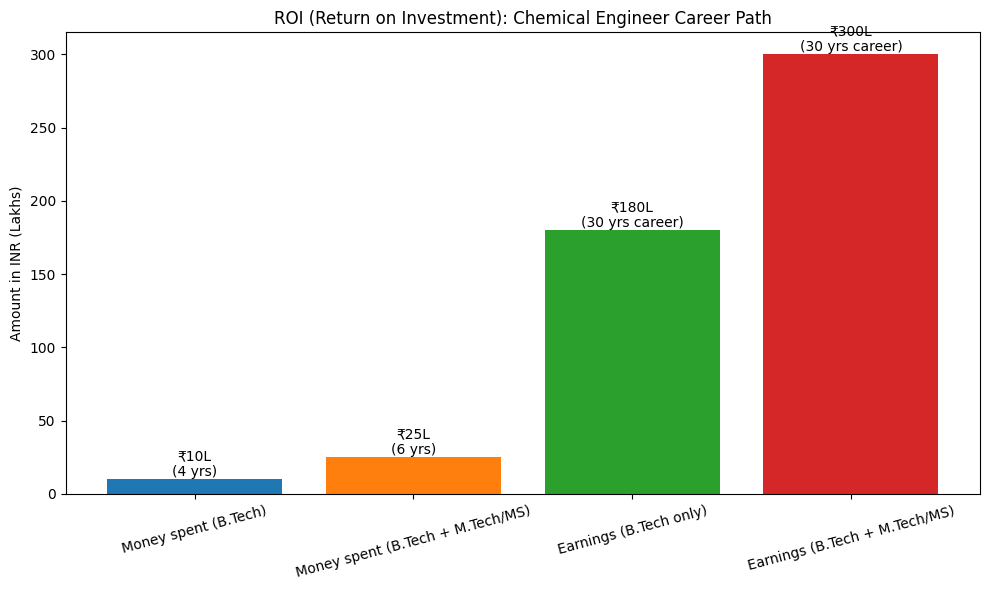
1. Total Money Spent on Education (Approx.)
Total Investment Range
- Only B.Tech: ₹7–20 lakhs
- B.Tech + M.Tech/MS: ₹10–40 lakhs
2. Earnings After Graduation
Chemical engineers start earning immediately after B.Tech, unlike medicine.
3. ROI Break-Even Point (Very Important for Parents)
👉 This means:
Most chemical engineers recover their entire education cost before the age of 30, especially those entering core industries, PSUs, oil & gas, specialty chemicals, or process engineering roles.
ROT – Return on Time
- 2 years (Class 11–12 PCM)
- 4 years (B.Tech)
- 1–2 years to gain industry confidence
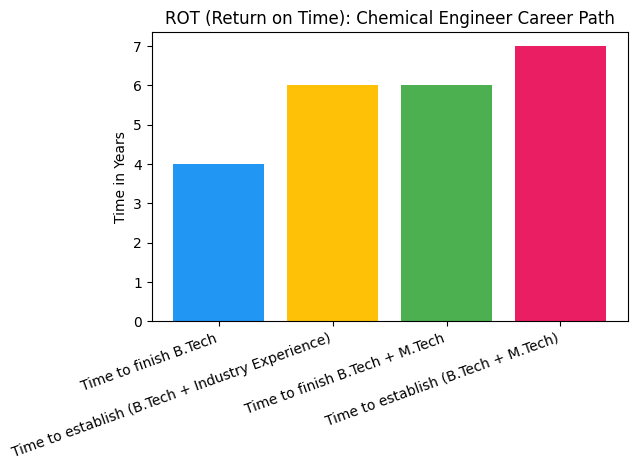
Most chemical engineers become professionally stable within 6–7 years, with steady long-term growth.
Conclusion: Is Chemical Engineering the Right Career for You?
If you enjoy chemistry, large-scale problem-solving, industrial processes, and building solutions that impact millions of lives, then chemical engineering can be an incredibly rewarding career.
Ensure you meet chemical engineering eligibility, prepare well for chemical engineering entrance exams, and commit to continuous learning. With the right planning and guidance, how to become a chemical engineer becomes a clear, achievable journey — not a confusing one.
Connect with our expert counsellors at NextMovez today and get a personalized roadmap tailored to your strengths, interests, and career goals.
Let’s turn your engineering ambition into a confident, well-planned reality.
Resources and References
- National Testing Agency (NTA) – JEE Main & GATE updates
https://nta.ac.in - IITs & NITs Official Portals – Curriculum & admissions
- AICTE – Engineering education standards
- Ministry of Education – Higher education policies
https://www.education.gov.in