Blog written by Indu R Eswarappa, Career Coach & Education Change-Maker
- How To Become a Fashion Designer : Complete Career Path After 12th
- Introduction: Is Fashion More Than Just a Passion for You?
- Key Responsibilities and Work Environment of a Fashion Designer
- Work Environment of a Fashion Designer
- Educational Pathways and Required Qualifications
- Minimum Qualification to Start
- Entrance Exams
- Necessary Soft Skills and Technical Abilities
- Essential Soft Skills for a Fashion Designer
- Required Technical Abilities for a Fashion Designer
- Career Progression & Growth Opportunities
- Typical Career Progression in Fashion Design
- Salary Expectations, ROI & ROT (Explained Simply for Students & Parents)
- Understanding ROI (Return on Investment)
- Final Thoughts: Is Fashion Design the Right Career for You?
- Your Next Action Step (Don’t Skip This)
- Resources and References
Introduction: Is Fashion More Than Just a Passion for You?
I’ve met so many students who tell me, “I love fashion… but I don’t know if it’s a real career.”
And every time, I smile—because fashion is a real, powerful, and evolving career when you understand how to become a fashion designer the right way.
Fashion isn’t just about glamorous ramp walks or celebrity outfits. It’s about creativity with purpose, understanding fabrics, trends, consumers, sustainability, and business. From luxury couture to everyday wear, from styling to digital fashion—today’s fashion designer career path offers more opportunities than ever before.
If you’re someone who:
- Sketches designs in the margins of notebooks
- Gets excited by fabrics, colours, and silhouettes
- Follows fashion weeks, designers, or even Instagram creators
- Or is confused after 12th and wondering whether fashion is a “safe” career choice
—this blog is for you.
In this complete pathway guide, I’ll walk you through:
- The right fashion designing course after 12th
- Skills you truly need (beyond talent)
- Offline and online fashion designing courses
- Realistic fashion designer salary in India
- And the wide range of fashion designer career opportunities most students don’t even know exist
This is not a dreamy overview. This is a clear, practical career roadmap—so you can decide confidently whether fashion design fits your strengths, goals, and future.
Let’s start building clarity, step by step.
Key Responsibilities and Work Environment of a Fashion Designer

When students tell me, “I love fashion, but what does a fashion designer actually do every day?”—I know they’re trying to understand whether this career matches their personality, not just their passion.
Fashion design is a hands-on, detail-driven, and fast-evolving profession. It blends creativity with technical skills, market awareness, and constant learning. Let’s break it down clearly.
Key Responsibilities of a Fashion Designer
A fashion designer’s work goes far beyond sketching outfits. Core responsibilities include:
- Researching trends and consumer preferences: Studying fashion trends, fabrics, colours, sustainability practices, and customer behaviour.
- Concept creation & design development: Creating design concepts, mood boards, sketches, and digital designs based on themes or collections.
- Fabric and material selection: Choosing suitable fabrics, textures, trims, and accessories that align with design intent and budget.
- Pattern making & garment construction coordination: Working with pattern makers and tailors to convert designs into wearable garments.
- Sampling, fitting & quality checks: Reviewing prototypes, making corrections, and ensuring fit, finish, and comfort.
- Collaboration with teams: Coordinating with merchandisers, production teams, stylists, photographers, and marketers.
- Costing & production planning: Balancing creativity with practicality—pricing, timelines, and manufacturing feasibility.
Keeping up with industry changes: Adapting to new technologies, digital fashion tools, sustainability norms, and global trends.
Work Environment of a Fashion Designer
One of the most exciting aspects of this profession is the variety of work settings available across the fashion designer career path.
Fashion designers may work in:
- Fashion houses & design studios – luxury, couture, or prêt collections
- Export houses & manufacturing units – large-scale garment production
- Retail brands & apparel companies – fast fashion, ethnic wear, lifestyle brands
- Textile & fabric companies – surface design, prints, and material innovation
- Media & styling spaces – fashion shoots, editorials, celebrity styling
- Start-ups & independent labels – building personal brands or boutique labels
- Freelance & online platforms – custom orders, digital fashion, global clients
Work hours can be intense during fashion weeks, launches, or deadlines—but the creative satisfaction and career growth often outweigh the pressure.
If you enjoy creative problem-solving, working with your hands, visual storytelling, and evolving trends, the fashion designer career path can be incredibly fulfilling.
Educational Pathways and Required Qualifications
One thing I always tell students is this: talent opens the door, but the right education keeps you moving forward.
If you’re serious about understanding how to become a fashion designer, your journey after 12th needs to be structured, skill-based, and industry-aligned.
Fashion design is not limited to natural creativity. You need training in design fundamentals, textiles, garment construction, technology, and business. That’s where formal education and entrance pathways play a crucial role in shaping a strong fashion designer career path.
Minimum Qualification to Start
- After Class 10: Foundation or diploma-level fashion courses
- After Class 12 (any stream – Science / Commerce / Arts):
- Bachelor’s degree in Fashion Design
- Diploma or Advanced Diploma programs
- Certificate and online fashion designing courses (as skill add-ons)
Most reputed institutes admit students through entrance exams, portfolio reviews, or aptitude tests.
Entrance Exams
Necessary Soft Skills and Technical Abilities
One question I often ask students is this: “If I take away your sketchbook, what skills do you still bring to fashion?”
Because succeeding in fashion design is not just about creativity—it’s about how you think, communicate, adapt, and execute. The strongest designers are those who balance artistic vision with professional skills.
Let’s break this into two clear parts: soft skills and technical abilities—both equally essential on the fashion designer career path.
Essential Soft Skills for a Fashion Designer
Soft skills shape how you work with people, handle pressure, and grow in a competitive industry.
Key soft skills include:
- Creativity & imagination: Ability to think beyond trends and create original concepts.
- Observation & trend awareness: Understanding what consumers want today—and what they’ll want next.
- Communication skills: Explaining ideas clearly to clients, tailors, production teams, and marketers.
- Adaptability & learning mindset: Fashion trends, tools, and consumer preferences change constantly.
- Time management : Meeting strict deadlines during collections, launches, and production cycles.
- Problem-solving ability : Handling design limitations, fabric issues, or production challenges calmly.
- Resilience & patience : Accepting feedback, reworking designs, and staying motivated in a competitive field.
Required Technical Abilities for a Fashion Designer
Technical skills turn ideas into wearable, market-ready designs. These are usually developed through fashion designing courses after 12th, internships, and hands-on practice.
Important technical abilities include:
- Fashion sketching & illustration : Manual and digital drawing of garments and silhouettes.
- Pattern making & garment construction : Understanding how designs translate into actual clothing.
- Textile knowledge : Fabrics, fibers, dyeing, printing, and sustainability aspects.
- Computer-aided design (CAD) : Tools like Adobe Illustrator, Photoshop, CLO 3D, or CorelDRAW.
- Sewing & finishing techniques : Basic to advanced stitching and quality control.
- Trend forecasting & research : Analysing global fashion movements and market demands.
- Costing & production basics : Understanding pricing, sourcing, and manufacturing constraints.
When students combine strong soft skills with solid technical abilities, they don’t just design clothes—they build sustainable careers with long-term fashion designer career opportunities.
Career Progression & Growth Opportunities

One thing I often remind students is that the fashion industry rarely follows a straight line. When you begin your journey and start exploring how to become a fashion designer, your first role might be small—but the growth potential in this industry can be enormous.
Many successful designers began as interns or junior assistants, learning everything from fabric sourcing to fittings. Over time, as your portfolio strengthens and your industry network grows, the fashion designer career path can lead to leadership roles, entrepreneurship, or even global recognition.
Let’s understand how this progression typically unfolds.
Typical Career Progression in Fashion Design
Salary Expectations, ROI & ROT (Explained Simply for Students & Parents)
Whenever I speak to students and parents, this question always comes up:
“Fashion sounds interesting—but what about money, stability, and returns?”
That’s a very valid concern. So let’s break this section very simply, without jargon, so you can clearly understand salary growth, Return on Investment (ROI), and Return on Time (ROT)—and even convert this information into easy graphs later.
Fashion Designer Salary in India (Reality Check)
Fashion salaries grow with skills, portfolio, and experience, not just degrees.
Key insight:
Income increases sharply when designers:
- Specialise (luxury, sustainable fashion, styling, export houses)
- Build a strong portfolio
- Work with known brands or start their own label
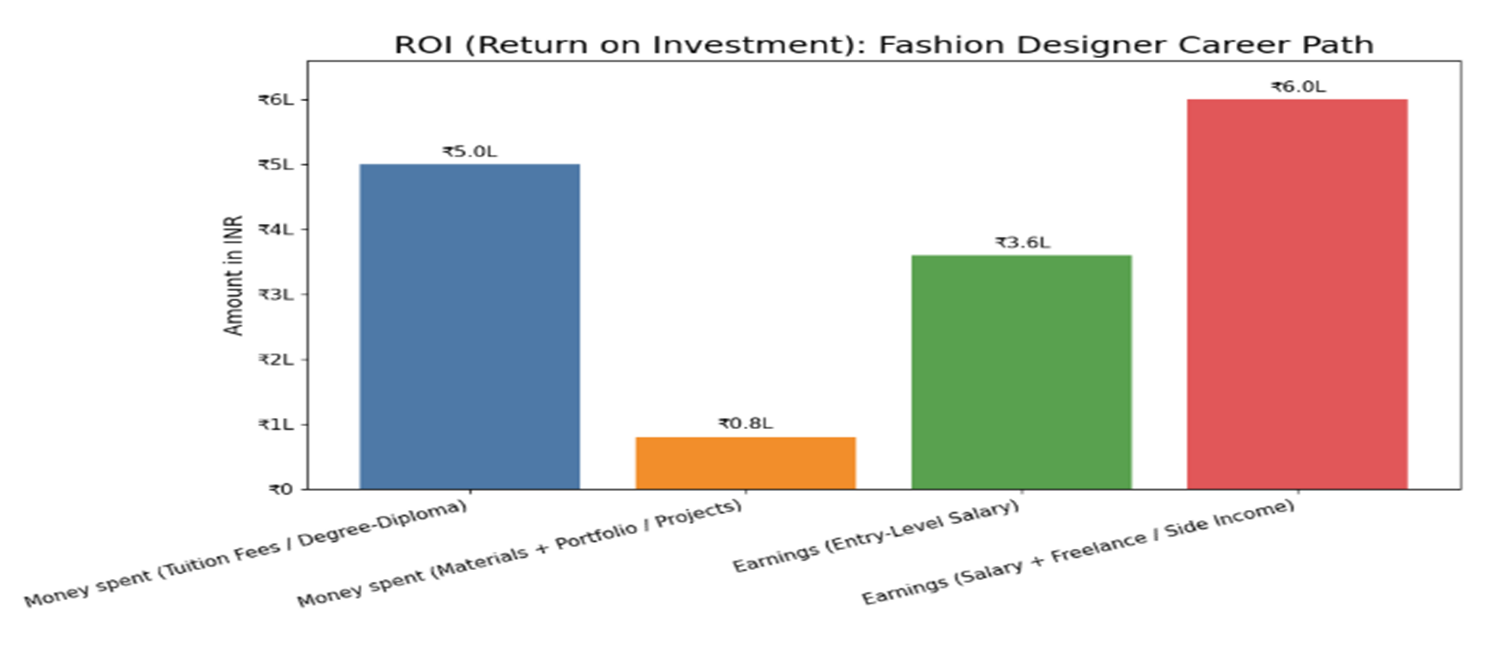
Key Insight
ROI in fashion design is not just about salary. Students who build strong portfolios, internships, and side projects during college often start earning sooner and grow their income faster.
Understanding ROT (Return on Time)
ROT simply answers this question:
“If I spend time learning fashion design, how quickly will that time turn into real skills, income, and career growth?”
Unlike ROI, which focuses on money invested, ROT focuses on how efficiently your time pays off.
Fashion design generally has a high ROT because skills learned during training can often start generating opportunities even before graduation.
Why Fashion Design Has High ROT
Several factors make the time investment in fashion education productive:
- Skills Can Be Monetised Early
- Portfolio Matters More Than Marks
- Online Skills Can Boost Income During College
Key Insight
Fashion design rewards consistent practice and portfolio-building. Students who actively work on projects, internships, and freelance opportunities often see their time investment convert into real career progress within the first year itself.
The Big Takeaway (For Students & Parents)
- Fashion design is not a “slow-return” career if approached strategically
- ROI improves with the right institute, internships, and skill focus
- ROT is high because talent + effort show results early
- Long-term income grows with specialisation, branding, and experience
Final Thoughts: Is Fashion Design the Right Career for You?
If there’s one thing I want you to take away from this guide, it’s this:
Fashion design is not a “backup career” or a hobby—it’s a serious, skill-driven profession. But like any creative career, success depends on clarity, preparation, and right guidance.
If you love creating, observing trends, working with fabrics, and telling stories through design—and you’re willing to learn continuously, accept feedback, and build your skills patiently—then the fashion designer career path can offer creativity, income growth, and long-term fulfillment.
Your Next Action Step (Don’t Skip This)
Before you choose any course or college, ask yourself:
- Do I understand my strengths, interests, and learning style?
- Am I choosing fashion out of passion or clear career alignment?
- Do I have a step-by-step roadmap, not just a college name?
This is where professional career guidance makes all the difference.
At NextMovez, we help students and parents:
- Identify the right-fit fashion design pathway
- Choose between degree, diploma, or online learning
- Plan internships, portfolios, and skill development early
- Build a realistic roadmap with ROI and growth clarity
Resources and References
- National Institute of Fashion Technology (NIFT)
Course details, entrance exams (NIFT Entrance Exam), specialisations, eligibility
🔗 https://www.nift.ac.in
- National Institute of Design (NID)
Design education pathways and creative aptitude requirements
🔗 https://www.nid.edu
- Pearl Academy
Fashion designing courses after 12th, industry-oriented programs
🔗 https://pearlacademy.com
- National Testing Agency (NTA)
Official examination authority for national-level entrance tests
🔗 https://nta.ac.in
- Careers360 – Fashion Designer Career Guide
Skills needed, career path, job roles, and growth opportunities
🔗 https://www.careers360.com/careers/fashion-designer
- Shiksha – Fashion Designing Courses After 12th
Course types, fees, colleges, eligibility
🔗 https://www.shiksha.com/design/fashion-design-chp
- Indeed India – Fashion Designer Job Descriptions
Real-world job responsibilities and skill expectations
🔗 https://in.indeed.com/career/fashion-designer
- AmbitionBox – Fashion Designer Salary in India
Entry-level to senior salary ranges
🔗 https://www.ambitionbox.com/profile/fashion-designer-salary
- Glassdoor India – Fashion Designing Careers
Salary trends, career growth, employer insights
🔗 https://www.glassdoor.co.in
- India Brand Equity Foundation (IBEF)
Indian textiles & fashion industry growth, exports, employment data
🔗 https://www.ibef.org/industry/textiles
- McKinsey & Company – State of Fashion Reports
Global and India-specific fashion industry trends
🔗 https://www.mckinsey.com/industries/retail/our-insights
- World Economic Forum – Future of Jobs Report
Creative careers, human-centric skills, future job relevance
🔗 https://www.weforum.org/reports/the-future-of-jobs-report-2023
- Coursera – Online Fashion Designing Courses
Fashion design, sustainability, fashion business programs
🔗 https://www.coursera.org - Udemy – Fashion Design & Illustration Courses
Skill-based short courses for beginners
🔗 https://www.udemy.com