

By Preethi Durga, Career Strategist & Education Innovator
Table of Contents
- Best Financial Analyst Courses in India for Beginners: Complete Career Guide
- Key Responsibilities and Work Environment of a Financial Analyst
- Educational Pathways and Required Qualifications for Financial Analysts (Beginners)
- Technical Skills and Soft Skills Required for a Financial Analyst
- Career Progression: From Beginner to Industry-Ready Financial Analyst
- ROI of a Financial Analyst Career
- Conclusion: Building a Strong Financial Analyst Career with the Right Guidance
- Resources and References Used in This Blog
Introduction: Are Financial Analyst Courses the Right Starting Point for You?
Over the years, I’ve spoken to many students who say,
“I’m good with numbers, I like finance… but I don’t know where to start.”
Some hear about CFA, others about MBA Finance, some Google endlessly for the best financial analyst courses in India for beginners—and end up more confused than confident.
That’s exactly why this guide exists.
A career as a financial analyst is no longer limited to investment banks or big corporate offices. Today, financial analysts work across corporate finance, equity research, fintech, consulting, startups, and even global remote roles. But the key is choosing the right financial analyst courses at the right stage—especially if you’re a beginner.
If you’re someone who:
- Enjoys analysing data, trends, and numbers
- Is curious about markets, companies, and money decisions
- Is wondering how to become a chartered financial analyst
- Is searching for clarity on how to become a CFA after 12th
- Wants a structured, skill-based finance career instead of guesswork
—then this blog is for you.
In this complete career guide, I’ll walk you through:
- What financial analyst courses actually prepare you for
- The difference between beginner courses, degree programs, and CFA
- How students in India should plan their journey step by step
- Career outcomes, growth potential, and long-term relevance
- And how the right guidance can save you years of confusion
This is not just a list of courses.
This is a career-aligned roadmap to help you decide whether financial analysis fits your strengths, goals, and future plans.
Let’s start by understanding what a financial analyst really does—and why the right course matters more than ever.
Key Responsibilities and Work Environment of a Financial Analyst

A financial analyst helps individuals, businesses, and institutions make informed financial decisions by analysing data, trends, and performance. For beginners entering this field, understanding the day-to-day responsibilities and typical work settings is crucial to know what the role truly involves beyond numbers.
Key Responsibilities of a Financial Analyst
- Financial Data Analysis – Collecting, organising, and analysing financial statements, market data, and economic trends to identify patterns and insights.
- Financial Modelling and Forecasting – Building models to project revenues, expenses, profits, and cash flows to support decision-making.
- Budgeting and Cost Analysis – Assisting in preparing budgets, monitoring spending, and identifying areas to reduce costs or improve efficiency.
- Investment Evaluation – Analysing stocks, bonds, mutual funds, or business opportunities to assess risks and returns.
- Report Preparation and Presentation – Creating financial reports, dashboards, and presentations for management, clients, or stakeholders in a clear, actionable manner.
- Market and Industry Research – Studying industry trends, competitor performance, and economic indicators to support strategic planning.
- Compliance and Risk Assessment – Ensuring financial practices align with regulations and identifying financial risks that may impact business decisions.
Work Environment of a Financial Analyst
- Corporate Offices – Working within finance, strategy, or planning teams of companies
- Banks and Financial Institutions – Supporting lending, investment, and risk decisions
- Investment Firms & Asset Management Companies – Analysing portfolios and market opportunities
- Consulting Firms – Providing financial insights to multiple clients across industries
- Remote / Hybrid Settings – Increasingly common, especially for research and reporting roles
The role typically involves structured desk work, use of tools like Excel, financial software, and data platforms, along with regular collaboration with senior managers, accountants, and business leaders.
Educational Pathways and Required Qualifications for Financial Analysts (Beginners)

Financial analysis is a beginner-accessible career with multiple entry routes. Students can start with basic commerce, finance, or analytics education and gradually build advanced skills through certifications and specialised courses.
Below is a detailed overview of educational pathways, exams, and courses suitable for beginners.
Educational Pathways, Exams, and Courses for Financial Analysts
Technical Skills and Soft Skills Required for a Financial Analyst
To succeed in financial analysis—especially for beginners—you need a balanced mix of technical expertise and human-centric skills. While technical skills help you work with numbers and data, soft skills ensure your insights actually influence decisions.
Technical Skills Required for a Financial Analyst
These are the core hard skills taught across most financial analyst courses and expected by employers:
- Financial Accounting & Reporting
Ability to read and interpret balance sheets, income statements, and cash flow statements. - Financial Modelling & Valuation
Creating models for forecasting, budgeting, company valuation (DCF, comparables), and scenario analysis. - Advanced Excel & Spreadsheets
Proficiency in formulas, pivot tables, VLOOKUP/XLOOKUP, macros, and data cleaning. - Data Analysis & Interpretation
Analysing large datasets to identify trends, risks, and opportunities. - Investment Analysis Basics
Understanding equities, bonds, mutual funds, risk-return trade-offs, and portfolio concepts. - Market & Economic Analysis
Knowledge of macroeconomic indicators, industry trends, and market movements. - Financial Software & Tools
Exposure to tools like Power BI, Tableau, SQL, Bloomberg, or ERP systems (SAP, Oracle) is an added advantage. - Regulatory & Compliance Knowledge
Understanding basic financial regulations, reporting standards, and ethical practices.
Soft Skills Required for a Financial Analyst
Technical skills alone aren’t enough. These soft skills make a financial analyst effective, trusted, and promotable:
- Analytical & Critical Thinking
Ability to question assumptions, evaluate multiple outcomes, and solve complex financial problems. - Attention to Detail
Small errors can lead to big financial mistakes—precision is non-negotiable. - Communication Skills
Explaining complex financial data in simple terms to non-finance stakeholders. - Business Acumen
Understanding how financial insights connect to real-world business decisions. - Problem-Solving Mindset
Approaching challenges logically and offering actionable solutions, not just data. - Time Management & Prioritisation
Handling multiple reports, deadlines, and projects efficiently. - Ethical Judgement & Integrity
Maintaining confidentiality and ethical standards in financial reporting. - Adaptability & Learning Agility
Staying updated with changing markets, tools, and financial regulations.
Why Skills Matter More Than Degrees Alone
Many beginners assume a degree is enough—but in reality, employers hire for skills, not just qualifications. This is why well-structured financial analyst courses focus on:
- Practical tools
- Real-world case studies
- Hands-on financial modelling
- Communication and presentation skills
Developing both technical and soft skills early gives you a strong competitive edge and smoother career growth.
Career Progression: From Beginner to Industry-Ready Financial Analyst

One of the biggest advantages of choosing financial analyst courses is the clear, structured career growth they offer. With the right skills, certifications, and experience, beginners can steadily move from entry-level roles to strategic, high-impact positions across industries.
Stage 1: Beginner / Entry-Level Financial Analyst
Experience: 0–2 years
This is where most learners start after completing financial analyst courses for beginners or a finance-related degree.
Typical Roles
- Junior Financial Analyst
- Business Analyst (Finance)
- Finance Executive
- Investment Research Assistant
Key Focus Areas
- Financial reporting and data analysis
- Excel-based modelling and dashboards
- Budget tracking and variance analysis
- Market and company research
Salary Expectation (India)
- ₹4 – ₹7 LPA (depending on skills, city, and organisation)
Stage 2: Intermediate Financial Analyst
Experience: 2–5 years
At this stage, professionals begin taking ownership of analysis and influencing decisions.
Typical Roles
- Financial Analyst
- Equity Research Analyst
- FP&A Analyst
- Risk Analyst
Key Focus Areas
- Advanced financial modelling and forecasting
- Investment and performance analysis
- Stakeholder presentations
- Business strategy support
Certifications That Add Value
- CFA Level I / II
- Advanced financial modelling programs
- Domain-specific finance certifications
Salary Expectation (India)
- ₹8 – ₹14 LPA
Stage 3: Senior / Industry-Ready Financial Analyst
Experience: 5–8+ years
This is the stage where professionals become decision influencers rather than just data providers.
Typical Roles
- Senior Financial Analyst
- Investment Analyst
- Corporate Finance Manager
- Strategy & Planning Lead
Key Focus Areas
- Strategic decision-making support
- High-level forecasting and risk management
- Mentoring junior analysts
- Cross-functional leadership
Salary Expectation (India)
- ₹15 – ₹25+ LPA
Stage 4: Leadership & Specialised Finance Roles
Experience: 8–12+ years
With deep expertise, analysts move into leadership or niche specialist roles.
Typical Roles
- Finance Manager / Director
- Portfolio Manager
- CFO (long-term progression)
- Head of FP&A or Strategy
Salary Expectation (India)
- ₹30 LPA to ₹1 Cr+ (role, industry, and organisation dependent)
What Accelerates Career Growth in Financial Analysis?
- Choosing the right financial analyst courses early
- Strong Excel, modelling, and data interpretation skills
- Globally recognised certifications (like CFA)
- Real-world projects and internships
- Clear career planning and mentorship
Why Career Guidance Matters at This Stage
Many beginners struggle not because of lack of ability—but due to unclear career direction. Career counselling or career coaching helps by:
- Mapping the right finance specialisation (investment, corporate finance, analytics)
- Avoiding random certifications with low ROI
- Planning certifications and courses in the right sequence
- Aligning strengths, interests, and long-term goals
With structured guidance, students and professionals move from confusion to clarity, and from learning to earning, much faster.
At NextMovez, career guidance goes beyond choosing a course—it helps learners map the right finance specialisation, certification sequence, and ROI-driven pathway so they become industry-ready financial analysts faster and with confidence.
ROI of a Financial Analyst Career

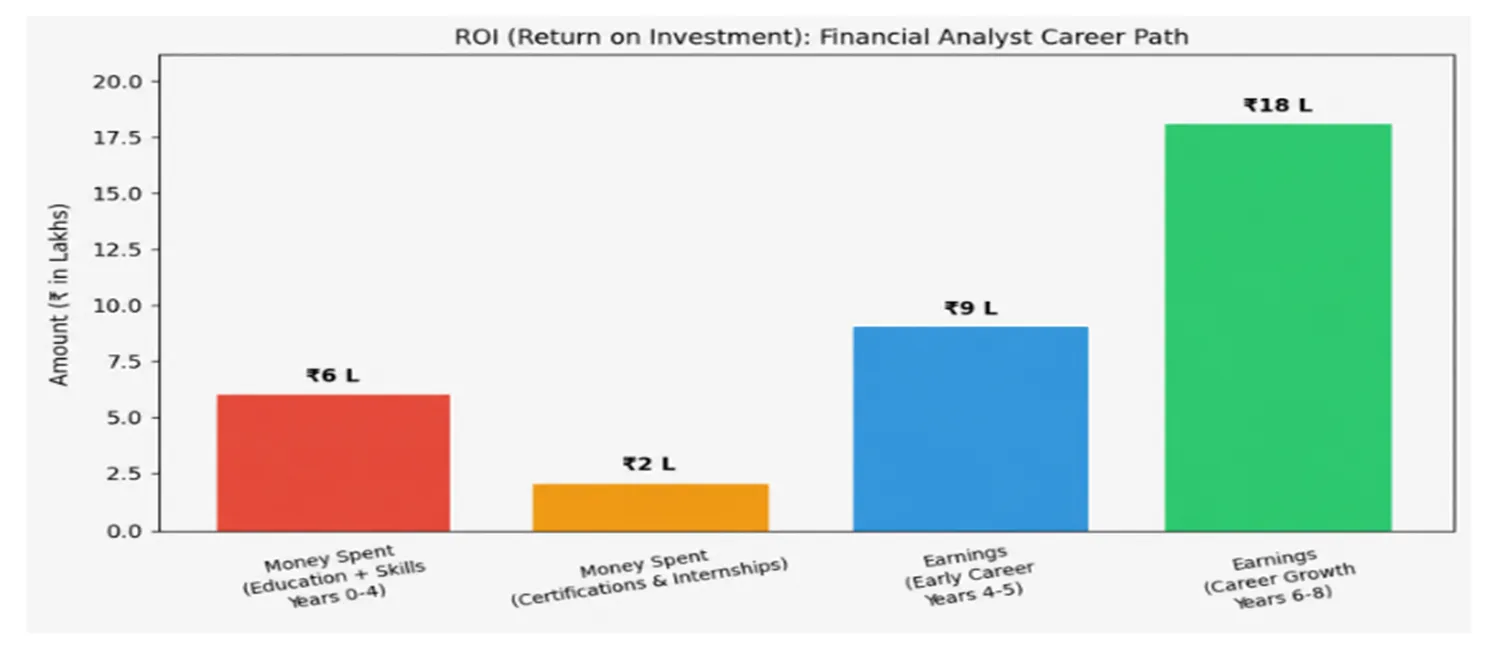
Initial Investment: Years 0–3/4
A beginner usually invests in:
Education: B.Com, BBA, BAF, BMS, MBA basics, or finance-related degree
Cost: ₹1–6 lakhs
Skills & certifications: Excel, financial modelling, accounting, Power BI, CFA/NISM basics, internships
Cost: ₹50,000–₹3 lakhs
Total Investment
₹2–9 lakhs approx.
This is usually spread over 3–4 years.
Earnings & Payback
Entry Level: Year 4/5
Salary: ₹3.5–6 lakhs per year
Savings toward ROI: ₹1–2.5 lakhs
After 1–2 Years of Experience
Salary: ₹5–9 lakhs per year
Savings toward ROI: ₹2–4 lakhs
After 2–3 Years of Experience
Salary: ₹8–14 lakhs per year
Savings toward ROI: ₹4–6 lakhs
Simple Understanding
A financial analyst career gives a good return on investment because the starting cost is not very high. Most of the investment is in education, Excel, finance skills, certifications, and internships.
Payback Period
Usually 2–4 years after graduation.
With strong skills and experience, beginners can grow into roles like Senior Financial Analyst, FP&A Analyst, Credit Analyst, or Equity Research Associate.
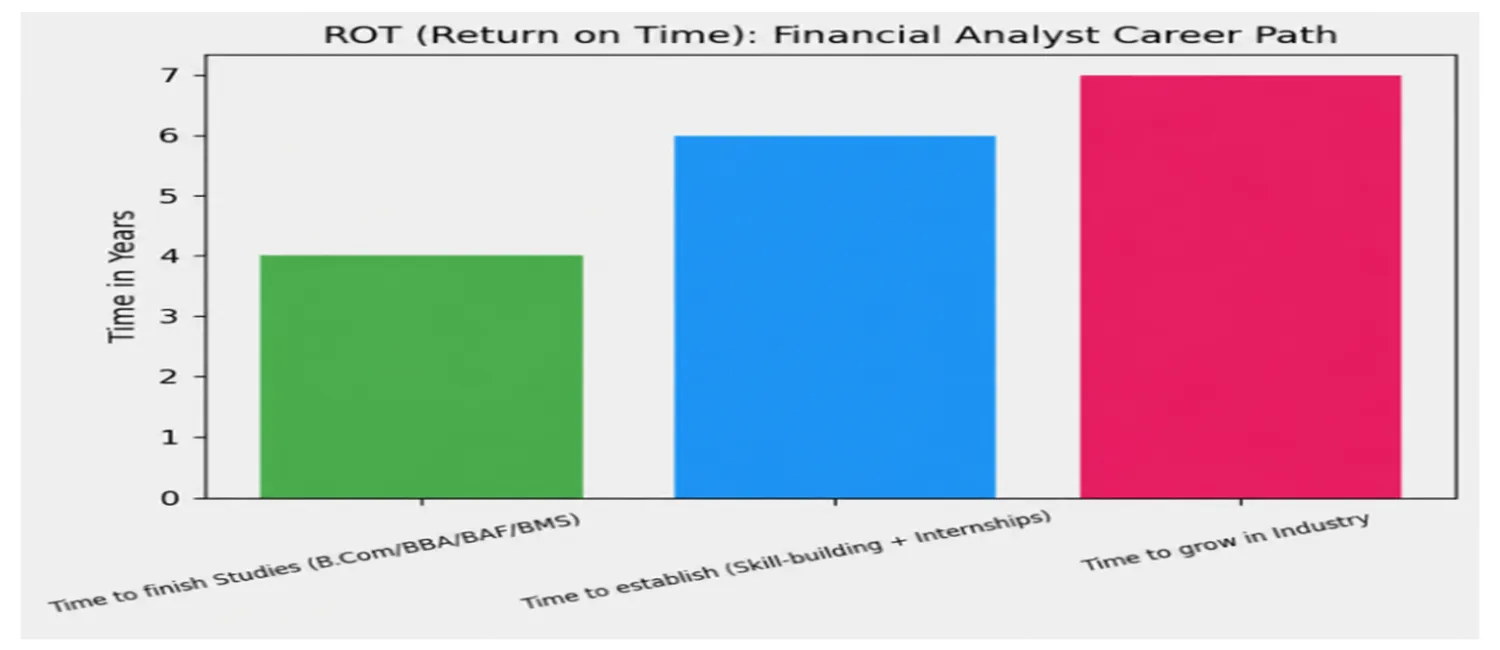
ROT – Return on Time
Skill-Building Phase: 2–4 years
Includes: Completing a finance-related degree like B.Com, BBA, BAF, or BMS, learning accounting basics, Excel, financial modelling, Power BI, and doing internships or small finance projects.
Timeframe: Usually 2–4 years, depending on the degree and certifications chosen.
Industry Credibility Phase: 4–6 years
Includes: Gaining work experience as a financial analyst, improving reporting, budgeting, valuation, data analysis, and business understanding. This is when a beginner becomes more confident and job-ready.
Timeframe: Around 4–6 years, including early job experience after graduation.
Long-Term Growth Phase: After 6 years
Includes: Moving into higher roles like Senior Financial Analyst, FP&A Analyst, Finance Manager, Equity Research Analyst, or Strategy Analyst.
Timeframe: Usually 6+ years, depending on skills, certifications, company exposure, and career growth.
Conclusion: Building a Strong Financial Analyst Career with the Right Guidance
A career in financial analysis offers structured growth, strong earning potential, and global opportunities—but only when approached strategically. While financial analyst courses provide the technical foundation, long-term success depends on choosing the right pathway, building relevant skills, and making informed decisions at each stage.
This is where career counselling and career coaching play a critical role. With expert guidance, students and early professionals can:
- Avoid low-ROI or misaligned courses
- Choose the right certifications (including CFA) at the right time
- Align strengths, interests, and market demand
- Build a clear roadmap from beginner to industry-ready analyst
At NextMovez, we help learners move from confusion to clarity by combining aptitude insights, market intelligence, and personalised mentoring—so every step taken in finance education leads to meaningful career outcomes.
Because in finance, clarity compounds—just like smart investments.
Resources and References Used in This Blog
- CFA Institute – Chartered Financial Analyst Program
(Global CFA curriculum, eligibility, career outcomes) - National Stock Exchange (NSE) Academy
(Beginner and advanced finance certifications in India) - National Institute of Securities Markets (NISM)
(SEBI-backed certifications for financial markets) - Investopedia – Financial Analyst Career Guide
(Role responsibilities, skills, and career progression) - Coursera – Finance & Financial Analysis Courses
(Beginner-friendly finance and analyst programs) - edX – Business & Finance Programs
(University-backed finance learning pathways) - Glassdoor India – Financial Analyst Salaries
(Salary benchmarks and career insights)