

By Preethi Durga, a career strategist and education innovator.
When Aarav first decided to pursue law, he was filled with excitement and a bit of uncertainty. Armed with his textbooks, a highlighter, and an unshakeable ambition, his days were consumed with lectures, mock trials, and endless reading.
However, as the months went by, Aarav found himself increasingly overwhelmed by the vast number of legal specializations. He was unsure whether to focus on corporate law, intellectual property, or perhaps a more niche area.
His mother, Priya, noticed his growing stress. “Aarav, are you sure this is the right path? What if there aren’t enough opportunities in the field you choose?” she asked, her voice filled with concern. Priya worried about the competitive job market, unsure if Aarav would land a stable job after graduation.
Aarav, torn between his interests and his mother’s worries, felt even more uncertain about his future. That’s when they decided to reach out to a career coach. Through their sessions, the coach helped Aarav explore his passions and gain a clearer understanding of the job market.
Little did he know that his journey would soon lead him to courtrooms in New York, meetings with top legal minds, and partnerships with influential clients across the globe. What started as a quest for justice quickly evolved into something far greater—a career that opened doors to global influence, intellectual challenges, and the chance to make a real impact in society.
And that’s the beauty of a career in law. In today’s world, lawyers aren’t just legal advisors—they are advocates for change, negotiators of progress, and champions of justice on a global stage. With the right knowledge and skills, this career doesn’t just offer success, it allows you to influence the world on a much grander scale.
As a parent, you may be wondering—will a law career remain relevant and fulfilling in the age of automation and AI, or is it all about courtroom drama?
The reality is that the legal profession has transformed—becoming more tech-savvy, data-driven, and globally interconnected. According to the National Jurist – Fastest‐growing and most in‑demand legal specialties in 2025, Health law, energy law, labour & employment law, intellectual property, data privacy and cybersecurity are fast‑growing fields.
Let’s explore why a career in law remains one of the most timeless and powerful choices your child can make.
Global Trends Affecting a Legal Career
If your child dreams of becoming a lawyer, it’s important to understand that this isn’t just a job—it’s a career path that opens doors to a world of opportunities.
Wondering which legal specialty aligns with your teen’s strengths? Our coaches use the C3S – Career Success Strategy System (for deeper guidance)™ to answer questions you can’t solve alone.
Types of Law Career
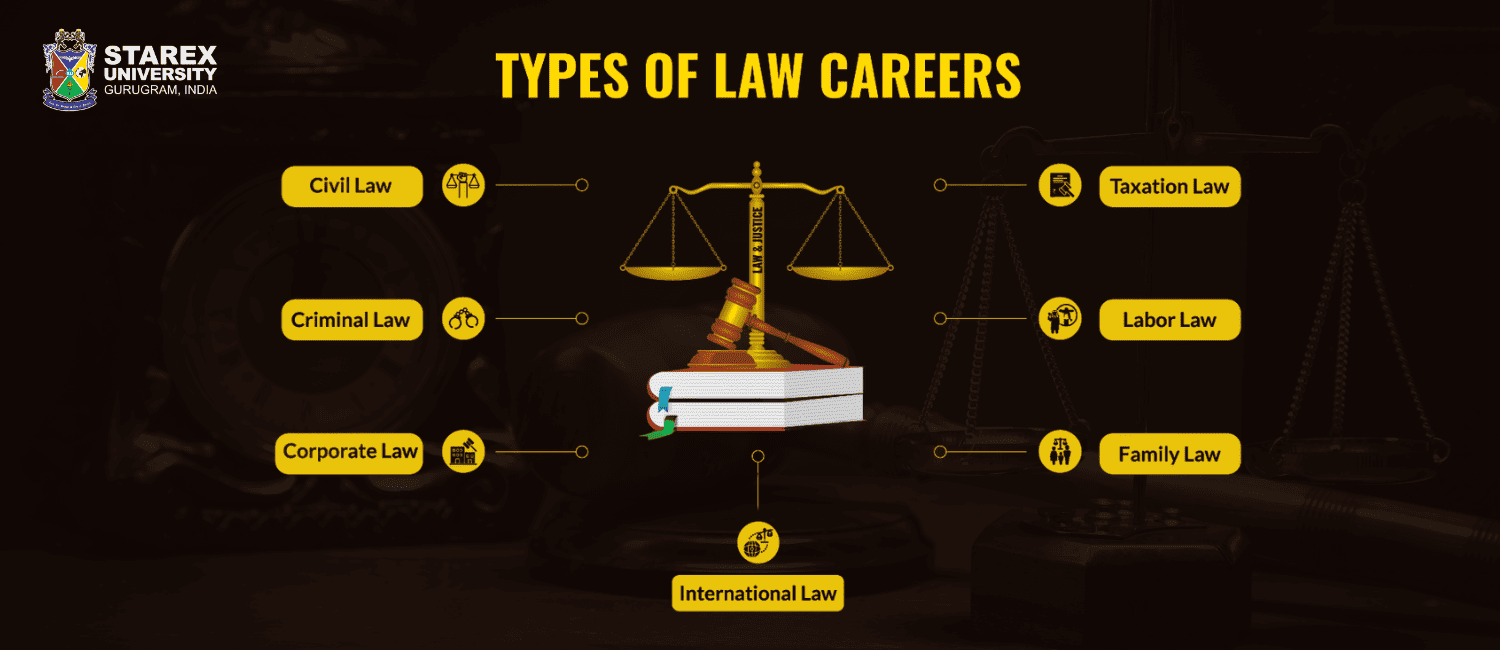
Image Courtesy: Starex University, India
From legal tech tools to global litigation, today’s lawyers navigate an ever-evolving landscape that demands adaptability, critical thinking, and tech-savviness.
Let’s explore the top trends shaping the legal profession—backed by facts and insights for parents who want more than just the basics.
Trend: According to the U.S. Bureau of Labor Statistics (Occupational Outlook Handbook, 2024), On average, approximately 83,800 job openings are expected annually in these fields, driven by both employment growth and the retirement. (Source: US Bureau of Labor Statistics, 2025)
Imagine this: Your child starts as a legal associate in a small firm and within a few years, they’re advising multinational companies or working in high-stakes cases. Instead of worrying about “Are there enough jobs?”, they’ll be riding a wave of demand in the growing legal market.
What This Means for Your Child: The demand for lawyers is not just cyclical—it’s steady. As the legal landscape becomes more complex, professionals with specialized skills in fields like corporate law, intellectual property, and environmental law will continue to be in high demand.
Global Legal Opportunities
Trend: According to the Indian Business Law Journal, 2023, Intellectual Property (IP) is seeing the greatest increase in work—receiving 23% of the votes in a recent survey.
Corporate & Commercial and Dispute Resolution both garnered 18%, while Mergers & Acquisitions (M&A) accounted for 14%. Areas like Labour & Employment, Data Protection & Privacy, and Real Estate received less than 10% of the votes.
In India, aspiring advocates have clear pathways: either a five-year integrated law programme after 12th or a three-year LLB after graduation from a recognised university. (Source: Upgrad, 2025)
After your law degree, you must enrol with a State Bar Council and pass the All India Bar Examination (AIBE) conducted by the Bar Council of India (BCI) to practise in Indian courts. (Source: Bar Council of India).
Imagine this: Picture your child representing clients in international arbitration, navigating complex IP cases across borders from New York to Dubai, or advising a tech firm on M&A in Silicon Valley. This isn’t just a dream—it’s the reality for today’s global legal professionals, where expertise in areas like IP and corporate law offers significant international career opportunities.
What This Means for Your Child: Whether your teen dreams of handling high-profile M&A deals or advising on data privacy in the ever-evolving tech world, a career in law offers unparalleled global mobility, cultural exposure, and professional growth. As demand for specialized legal services in IP and Corporate & Commercial law continues to rise, the legal profession remains a dynamic and rewarding career path with vast global prospects.
Tech-Driven Legal Practice
Trend: According to the American Bar Association (ABA) – Legal Technology Adoption Report (2023), there has been a notable rise in the adoption of artificial intelligence tools among law firms, with 30% of respondents now using AI technology, up from just 11% in 2023.
Imagine this: Instead of poring over stacks of legal documents, your child could be using AI tools to quickly analyze contracts, spot risks, and focus on strategy. This technology allows them to spend more time on high-level legal work and client relations.
What This Means for Your Child: Legal tech isn’t replacing lawyers—it’s enhancing their capabilities. Students proficient in legal AI will stand out as future-ready professionals, capable of handling complex tasks with speed and precision.
The lawyers who win tomorrow will be those who combine legal reasoning with data, tech and human understanding — not those who memorise the most sections.
When I talk to parents about a career in law, the image that often comes to mind is one of traditional courtrooms, thick law books, and intense debates. While that’s still part of the picture, the reality is that the legal field is being reshaped by technology, data, and global connectivity.
What’s Changing Right Now?
Lawyers today aren’t just legal experts—they’re tech-savvy professionals who use artificial intelligence for legal research, blockchain for contract management, and predictive analytics to assess case outcomes.
According to ABA Cybersecurity Report 2025, 60% of firms have established formal cybersecurity policies, yet phishing and ransomware continue to pose significant threats.
And here’s the exciting part: children who are curious, adaptable, and passionate about justice will find a legal career not only relevant but deeply fulfilling. Why? Because while tech can handle some of the routine work, it’s the lawyer’s ability to think critically, empathize with clients, and navigate complex issues that truly makes them invaluable.
According to a research report of Lexis Nexis in 2024, most litigators now conduct their legal research online and on specific tools or specialised software. So, every lawyer needs to be well-versed with technical knowledge, besides other skills.
Job Demands and Hiring Trends in Law
When I sit with students and their parents, one question that always arises is: “Is law a stable career, or does it come with unpredictability?” The truth is, the legal profession is evolving rapidly, but the demand for skilled lawyers is higher than ever. Let’s look at the trends shaping the future of legal careers.
The need for legal professionals is growing across various sectors—from corporate law and intellectual property to data privacy and environmental regulations.
This growth is fueled by an increase in cross-border transactions, the swift expansion of alternative legal service providers, and the growing integration of generative-AI platforms within law firms.
Remote & Freelance Legal Careers
The legal profession is increasingly embracing remote and freelance opportunities. Many lawyers now manage their careers from anywhere, offering services like legal consulting, contract drafting, and intellectual property advising on a flexible basis. This shift allows legal professionals to work with a variety of clients across different industries while maintaining control over their schedules.
According to a report published by Live Mint, in India, nearly 100,000 law students graduate every year, with approximately 69,000 passing the All India Bar Exam and becoming eligible to practice law nationwide.
However, despite having over 1,700 law schools, only graduates from the top 25-30 institutions consistently land jobs in corporate or mid-tier law firms. Graduates from lower-ranked colleges often struggle with employability due to a lack of essential skills like legal research and communication.
Why it matters: Freelance or contract-based legal work offers the flexibility to build a diverse portfolio, gain experience across multiple industries, and maintain a healthy work-life balance.
Parent Insight: If your child values independence and a flexible work schedule, a remote or freelance legal career could be an excellent fit, offering both autonomy and a broad range of professional experiences.
Necessary Soft Skills and Technical Abilities in Law
When I guide aspiring lawyers, I often remind them—being a lawyer isn’t just about knowing the law; it’s about connection. A successful lawyer today is both a legal expert and a communicator. Beyond their legal acumen, they need the emotional intelligence to understand clients, the adaptability to evolve with legal trends, and the technical fluency to leverage tools that make their work more efficient.
Skills That Set Future Lawyers Apart
The right blend of soft skills and technical abilities doesn’t just make your child employable—it makes them a standout in an ever-evolving legal landscape. Let’s take a look at the key skills that set successful lawyers apart—and how parents can help nurture them.
Reflection for Teens: Which part of law attracts you more: arguing cases, drafting deals, or solving tech/privacy issues?
Do you enjoy deep reading and long-form thinking, or do you prefer fast, transactional tasks?”
💭 Reflection for Parents: When have you seen your child naturally enjoy debate, research, or standing up for fairness?”
Emotional Intelligence & Client Empathy
Why it matters: Legal work often involves high-stakes, emotional cases—be it family law, criminal defense, or corporate negotiations. A lawyer who understands and empathizes with clients will foster stronger relationships and earn their trust.
Parent tip: Encourage your child to participate in activities that enhance empathy, like volunteering or community work. Learning to understand diverse perspectives will help them connect with clients in meaningful ways.
Legal Tech Proficiency
Why it matters: With the rise of AI, machine learning, and data analytics, legal professionals must adapt to new tools that help streamline research, case management, and document review.
Parent tip: Introduce your child to legal research databases like Westlaw and encourage them to learn how technology can make legal practices more efficient. The earlier they get familiar with tech tools, the better equipped they’ll be in the future.
Critical Thinking & Problem-Solving
Why it matters: Lawyers are often tasked with resolving complex problems and providing solutions in high-pressure situations. Critical thinking allows them to evaluate legal situations, find creative solutions, and present them clearly in court.
Parent tip: Encourage your child to engage in activities that challenge their reasoning skills, such as puzzles, debating, or participating in mock trials. This helps build the sharp, logical mind essential for a successful legal career.
Communication & Negotiation Skills
Why it matters: Whether drafting contracts, presenting cases, or negotiating settlements, communication is at the heart of every legal matter. Strong negotiation skills can often mean the difference between winning and losing a case.
Parent tip: Encourage your child to practice public speaking or debate, where they can hone their ability to present and argue points clearly and persuasively. These skills will be invaluable in law school and beyond.
Attention to Detail & Organizational Skills
Why it matters: Law is a profession where small details matter. Being thorough in research, reviewing contracts, or managing multiple cases is crucial to preventing mistakes that can cost clients.
Parent tip: Teach your child to prioritize and manage their time effectively—whether it’s through schoolwork or extracurricular activities. A strong organizational foundation will help them handle complex legal cases later on.
Ethics & Integrity
Why it matters: Lawyers are entrusted with sensitive information and are expected to uphold the highest ethical standards. Integrity not only helps build a good reputation but is also central to maintaining trust in the legal system.
Parent tip: Talk to your child about the importance of ethics, responsibility, and doing the right thing. A strong ethical compass will guide them through challenging decisions in their legal career.

Here’s how a lawyer’s career typically evolves:
Junior Associate / Intern – Lays the Foundation
This is where it all starts. At this stage, young lawyers assist senior attorneys with research, drafting legal documents, and preparing case files. It’s a time for learning the ropes—understanding the nuances of law, courtroom procedures, and legal language.
Why it matters: These early years build critical legal skills, discipline, and an understanding of the law’s application in real-world scenarios—essential traits for long-term success.
Associate Attorney / Legal Specialist
At this level, lawyers handle cases and legal matters independently, working with clients directly and leading legal strategies. They start specializing in areas like criminal law, corporate law, or family law, gaining in-depth knowledge in a particular field.
Why it matters: This stage builds confidence and expertise—helping them build a niche and a strong reputation in their area of specialization, which is critical for career advancement.
Senior Associate / Counsel – Shapes Legal Strategies and Mentors Others
Lawyers at this stage often move into leadership roles, managing complex cases, advising clients on legal strategy, and mentoring junior associates. Some also begin to handle firm management or client relations, depending on the firm’s size and structure.
Why it matters: This is where leadership begins. Lawyers at this stage influence legal outcomes, guide junior staff, and develop a strategic vision, moving beyond casework to shape firm direction and success.
Partner / Managing Counsel – Leads Teams and Defines Strategy
Partners are often responsible for managing teams of lawyers, building relationships with clients, and ensuring the firm meets its business goals. They lead large cases, negotiate deals, and oversee the financial health of the firm.
Why it matters: It’s a transition from practitioner to decision-maker. Lawyers at this level shape firm policy, client relationships, and legal strategies at a larger scale.
Legal Expert – Creates Impact at Scale
At the top of the ladder, lawyers may become heads of legal departments, general counsel for major corporations, or even start their own legal practices. They might influence public policy, become thought leaders in legal communities, or specialize in high-profile sectors.
Why it matters: This is where legal expertise translates into influence. Lawyers at this stage shape global policies, head legal divisions, and leave a lasting impact on the legal landscape.
Future Outlook and Predictions in Law
As a parent, it’s natural to wonder — will law still be relevant in 10 years?
The short answer: absolutely. The law will always be essential — but the tools and the areas of focus will continue to evolve. Whether it’s navigating international regulations, advising on AI ethics, or managing legal risks in digital spaces — law remains the framework that governs societies and businesses alike.
However, the next decade will belong to lawyers who can adapt to technology, global shifts, and emerging industries. Let’s take a look at what’s changing in the legal profession and how you can help your child get future-ready.
Long-term exposure to case reading and argument building strengthens your teen’s focus and working memory networks—law naturally trains the brain for deep thinking and complex problem-solving.
From Traditional Law Practices → To Tech-Integrated Legal Services
Current Trend:
Today’s lawyers often focus on litigation, legal advice, and contract review, relying on traditional methods and paper-based processes.
Emerging Future:
Tomorrow’s legal professionals will work hand-in-hand with AI, blockchain, and legal tech platforms. From contract automation to using AI for legal research, technology will drive efficiency in the legal sector.
How it’s evolving:
Lawyers who embrace technology will not only enhance their efficiency but also have the opportunity to redefine legal practice by offering more personalized, tech-driven services. Lawyers proficient in tech will lead in areas like intellectual property, cybersecurity law, and fintech.
Parent Insight:
Encourage your child to familiarize themselves with emerging legal tech tools early. Law is becoming more tech-centric, and those who stay ahead will shape the future of the profession.
Try This Today:
Have your teen spend 15 minutes exploring Westlaw’s free trial to understand legal research tools.
This will give them a practical look at how modern tech integrates into legal practice. By building tech fluency now, they’re setting themselves up for success in a rapidly changing profession.
From Legal Texts → To Client-Centered Communication
Current Trend:
Legal work is heavily centered on research, case law, and legal jargon. Many lawyers communicate with clients through formal documents and lengthy legal texts.
Emerging Future:
Legal communication is shifting toward clearer, more client-centered approaches. Lawyers who can simplify complex legal concepts for their clients, while still maintaining precision, will stand out. Additionally, client relationships are increasingly digital, with video consultations and virtual meetings becoming the norm.
How it’s evolving:
Lawyers who master the art of communication and can distill intricate legalese into easily digestible advice will be highly sought after. The ability to use technology, such as video conferencing and collaborative legal platforms, will be key to maintaining strong client relations.
Parent Insight:
Help your child develop strong communication skills—both written and verbal. Clear, effective communication is at the heart of successful legal careers, and it’s a skill that will set them apart in the future.
From Traditional Law Firms → To Flexible Legal Careers
Current Trend:
Lawyers often work in large, traditional law firms with a rigid structure. This path offers stability, but can also be limiting in terms of flexibility and specialization.
Emerging Future:
The rise of the gig economy and flexible work arrangements is also reshaping the legal profession. Many lawyers are now opting for freelance legal work, consulting roles, or starting their own practices.
How it’s evolving:
Lawyers who value flexibility can build careers that combine private practice, consulting, teaching, and even legal tech entrepreneurship. The rise of remote work means your child could work with clients from around the globe without leaving home.
According to the Mordor Intelligence Report, the global legal services market, valued at USD 1.05 trillion in 2025, is expected to grow to USD 1.30 trillion by 2030, reflecting a compound annual growth rate (CAGR) of 4.39%.
Parent Insight:
Encourage your child to build a versatile skillset that allows them to work across various legal domains. The ability to juggle different projects and collaborate remotely will be crucial to success in the future.
From Case-Based Legal Work → To Predictive & Data-Driven Law
Current Trend:
Legal work has traditionally been about reviewing cases, drafting contracts, and attending court hearings. The focus has been on past precedents and legal arguments.
Emerging Future:
AI and big data will play an increasing role in predicting legal outcomes and guiding strategic decisions. Tools like predictive analytics will help lawyers assess case risks, optimize litigation strategies, and offer more precise legal counsel.
Usage of artificial intelligence among legal professionals has surged from 19% in 2023 to 79% in 2024, according to the ninth edition of Clio’s Legal Trends Report, released at the Clio Cloud Conference in Austin.
How it’s evolving:
Lawyers who are data-savvy and capable of using analytics tools will gain a competitive edge. They’ll be able to use data to predict legal outcomes, streamline case management, and offer more efficient legal services.
Parent Insight:
Introduce your child to the intersection of law and technology. Encourage them to take courses in data analytics or AI applications in law. The ability to analyze data and predict legal trends will make them more effective and adaptable.
From Narrow Legal Roles → To Multi-Disciplinary Legal Experts
Current Trend:
Traditionally, lawyers specialize in one area—corporate law, criminal defense, family law, etc. These roles have been highly structured within specific domains.
Emerging Future:
The future of law will demand multi-disciplinary expertise. Lawyers will increasingly combine their legal knowledge with expertise in fields like business, technology, or environmental science. For example, a tech lawyer who understands cybersecurity or an environmental lawyer focused on climate change will be more competitive in the evolving legal landscape.
How it’s evolving:
Tomorrow’s lawyers will be experts in both law and other industries, working in sectors like environmental law, tech law, health law, or even social justice. Their ability to navigate both legal and industry-specific issues will make them invaluable.
Parent Insight:
Encourage your child to explore subjects beyond law—whether it’s technology, business, or the environment. A broad skillset will help them thrive as legal professionals with a unique, multidisciplinary perspective.
Conclusion
A career in law is no longer just about defending clients in courtrooms—it’s about influencing industries, shaping global policies, and adapting to an ever-changing legal landscape. From navigating complex legal challenges to leveraging technology for innovative solutions, today’s lawyers are tomorrow’s thought leaders and legal strategists.
For students, law offers intellectual challenges, the opportunity to make a tangible impact, and a globally relevant skillset. For parents, it means guiding a child toward a future where their legal expertise can lead to societal change, policy development, and leadership in the legal field.
Struggling to know if corporate law or IP law suits your teen? Our coaches help uncover their unique Career DNA. NextMovez’s Career Success Strategy System™ guides students to align their passions with high-demand legal fields, ensuring confident career decisions.
At NextMovez, we don’t just explain the law career path—we help every student discover their unique strengths, connect with the right legal niche, and shape a law career that reflects their personal ambitions and values.
If your teen is unsure whether corporate, IP, tech or litigation suits them best, our coaches can help map their strengths into their Best-Fit Career Zone™ — and create a clear, future-aligned roadmap through C3S. No pressure, no rush. Just clarity.
By Preethi Durga, Career Strategist & Education Innovator, Co-founder of NextMovez
References and Resources
U.S. Bureau of Labor Statistics (Occupational Outlook Handbook, 2024)
Indian Business Law Journal, 2023
American Bar Association (ABA) – Legal Technology Adoption Report (2023)
LexisNexis (2024) – Legal Tech in Law Firms Report
National Jurist – Fastest‐growing and most in‑demand legal specialties in 2025