

Blog written by Indu R Eswarappa, Career Coach & Education Change-Maker
Table of Contents
- How to Become Data Scientist: Complete Guide After 12th & Entry-Level Jobs in India
- What Does a Data Scientist Actually Do?
- Key Responsibilities
- Work Environment
- Skills You Actually Need to Become a Data Scientist
- Educational Pathways and Required Qualifications
- Typical Career Path: How to Become a Data Scientist
- Entry-Level Stage (0–3 Years)
- Mid-Level Stage (3–7 Years)
- Senior-Level Stage (7–15+ Years)
- Return on Investment (ROI) in Data Science as a Career
- Learning Investment (Time + Money)
- Undergraduate Degree
- Certifications and Skill Development
- Postgraduate Education (Optional)
- Earning Potential in India
- Entry-Level (0–3 Years)
- Mid-Level (3–7 Years)
- Senior-Level (7+ Years)
- Return on Time (ROT) for a Data Scientist
- Break-even Point: When Do You Start Seeing Results?
- Future Prospects: The Next 20–30 Years in Data Science
- Conclusion
Earlier, students would come to me asking about engineering, medicine, or government jobs. Today, many of them walk in with a different question — “Is Data Science a good career, Ma’am?” or “How can I become a data scientist?”
Everywhere you look, people are talking about Artificial Intelligence, Machine Learning, Big Data, and the growing demand for data professionals. Students hear stories of high salaries, exciting projects, and global opportunities, which naturally makes the field attractive.
Some are genuinely interested in working with data, solving problems, and finding patterns. Others are attracted mainly because they hear that the field has good scope or because someone told them it is the “career of the future.” The challenge is that these are two very different reasons for choosing a career.
In this guide, I’ll explain the educational path, skills required, eligibility after Class 12, career opportunities, and the reality of data scientist jobs in india. We’ll also look at how to become data scientist after 12th, including options available for students from different academic backgrounds.
Because the goal is not just to learn how to become data scientist. The real goal is to understand whether this career aligns with the way you think, learn, and solve problems—so that the decision you make today continues to make sense years from now.
If you are a working professional facing challenges in planning your next career move, visit our Career counselling for Working Professionals page to learn how we can help.
What Does a Data Scientist Actually Do?
Now before we go deeper into how to become data scientist, I want you to understand what this career actually looks like in real life.
Because this is where many students get the wrong picture.
From the outside, Data Science often looks like a high-paying tech job where people sit in front of computers and work with numbers all day.
But according to my experience, that’s only a small part of the story.
A Data Scientist’s real job is to solve business problems using data. They collect information, identify patterns, make predictions, and help organisations make better decisions. Whether it’s an e-commerce company predicting customer behaviour or a hospital analysing patient trends, data is used to answer important questions.
Let’s look at what the role involves on a day-to-day basis.
Key Responsibilities

1. Collecting and Understanding Data
Every project starts with data.
Before any analysis happens, a Data Scientist needs to understand where the data comes from and whether it is reliable enough to use.
This often involves:
- Collecting data from multiple sources
- Organising large datasets
- Identifying missing or incorrect information
- Understanding the business problem behind the data
One thing I often tell students is this: good analysis starts with asking good questions. Data alone doesn’t provide answers unless someone knows what to look for.
2. Finding Patterns and Insights
Once the data is organised, the next step is analysis.
This is where Data Scientists look for trends, relationships, and insights that may not be obvious at first glance.
Their work may include:
- Identifying customer behaviour patterns
- Studying market trends
- Analysing performance metrics
- Comparing different outcomes and scenarios
This is why analytical thinking is such an important part of learning how to become data scientist.
3. Building Predictive Models
One of the most exciting parts of Data Science is prediction.
Using statistical methods and machine learning techniques, Data Scientists build models that help organisations forecast future outcomes.
For example:
- Predicting product demand
- Detecting fraud risks
- Estimating customer preferences
- Forecasting sales trends
The goal is not just to understand what happened in the past, but to make smarter decisions about the future.
4. Communicating Findings to Teams
Many students are surprised when I mention this responsibility.
A Data Scientist doesn’t work in isolation.
After analysing data, they need to explain their findings in a way that managers, business leaders, and other teams can understand.
This often involves:
- Creating reports and dashboards
- Presenting insights
- Explaining recommendations
- Supporting business decisions with evidence
So communication skills are just as important as technical skills.
Work Environment
As a Data Scientist, your work environment can vary depending on the industry and role you choose.
You could be:
- Working in technology companies
- Joining banks and financial institutions
- Supporting healthcare organisations
- Working with e-commerce companies
- Contributing to research and analytics firms
- Joining startups that rely heavily on data-driven decisions
Many professionals also work in hybrid or remote setups, especially in analytics-focused roles.
Most of your day will involve solving problems, analysing information, collaborating with teams, and using data to answer real-world questions.
And honestly, this is something I encourage students to think about carefully. Before focusing on data scientist jobs in india, ask yourself whether you genuinely enjoy investigating problems, working with data, and finding logical solutions. Because that’s what the role involves far more often than what social media or salary discussions may suggest.
Skills You Actually Need to Become a Data Scientist
Many students start researching courses, certifications, and salary packages before they understand the skills required for how to become data scientist.
Data Science is not just about technology or coding. It is a combination of analytical thinking, curiosity, business understanding, and technical expertise. The people who succeed in this field are usually those who enjoy solving problems, working with data, and making decisions based on evidence rather than assumptions.
Before you decide whether this career is right for you, take a look at the skills that are commonly seen in successful Data Scientists.
Soft Skills
- Curiosity and Problem-Solving Mindset
- Analytical Thinking
- Communication Skills
- Critical Thinking
- Attention to Detail
- Patience and Persistence
- Business Understanding
- Team Collaboration
Technical Skills
- Mathematics and Statistics
- Data Analysis
- Programming (Python, R, SQL)
- Data Visualization
- Machine Learning Basics
- Database Management
- Data Cleaning and Processing
- Predictive Modelling
Educational Pathways and Required Qualifications
Now this is where many students start looking for a clear roadmap.
When someone asks me how to become data scientist, one of the first questions they usually have is whether there is a single degree or fixed educational path for this career.
The answer is no.
Unlike professions such as medicine or law, Data Science does not have one mandatory degree that everyone must follow. However, there are certain academic paths and skills that can make the journey much smoother.
The good news is that students from different educational backgrounds can enter this field, provided they build the right technical and analytical foundation.
Typical Career Path: How to Become a Data Scientist

Now we’ll discuss something that many students don’t think about when they start exploring how to become data scientist.
They spend a lot of time researching degrees, certifications, and courses.
But they rarely think about what happens after learning those skills—how the career actually develops over time.
And according to my experience, this is where many students get surprised.
Because there’s a common assumption that once you complete a degree or Data Science course, you’ll immediately become a Data Scientist.
In reality, that’s rarely how the journey works.
Like most professional careers, Data Science grows in stages. You build technical skills first, then practical experience, and eventually develop the ability to solve larger and more complex business problems.
Let’s break it down realistically.
Entry-Level Stage (0–3 Years)
Typical Roles:
- Data Analyst
- Junior Data Analyst
- Business Analyst
- Reporting Analyst
- Junior Data Scientist
- Data Associate
What You’ll Actually Do:
At this stage, your focus should be on learning and applying your skills in real-world situations.
You’ll typically be:
- Cleaning and organising datasets
- Creating reports and dashboards
- Working with Excel, SQL, and visualization tools
- Assisting senior analysts and Data Scientists
- Understanding how businesses use data for decision-making
This is where you learn how data works in the real world—not just in classroom projects.
Growth Tip:
Don’t focus only on job titles.
Instead, focus on:
- Building strong technical foundations
- Working on real projects
- Learning SQL, Python, and data visualization tools
- Understanding business problems
A strong foundation here can accelerate your career later.
Mid-Level Stage (3–7 Years)
Typical Roles:
- Data Scientist
- Analytics Consultant
- Machine Learning Engineer
- Senior Data Analyst
- Business Intelligence Specialist
What Changes Here:
At this stage, you’re expected to work more independently.
You may:
- Build predictive models
- Handle larger datasets
- Work directly with business teams
- Lead analytics projects
- Solve complex business challenges using data
This is usually the stage where professionals begin seeing significant career growth and stronger compensation opportunities.
Growth Tip:
Specialization can help you stand out.
You may choose to focus on areas such as:
- Machine Learning
- Artificial Intelligence
- Business Analytics
- Financial Analytics
- Healthcare Analytics
- Marketing Analytics
The deeper your expertise becomes, the more valuable you can be in the market.
Senior-Level Stage (7–15+ Years)
Typical Roles:
- Senior Data Scientist
- Lead Data Scientist
- Principal Data Scientist
- Analytics Manager
- Head of Data Science
- Chief Data Officer
What Your Role Looks Like:
At this stage, your responsibilities go beyond technical analysis.
You may:
- Lead large analytics teams
- Design data strategies for organizations
- Mentor junior professionals
- Drive business decisions through data insights
- Work closely with leadership teams
Some professionals also move into consulting, entrepreneurship, research, teaching, or AI-focused leadership roles.
And honestly, this is something I always tell students who ask me about data scientist jobs in india. The long-term opportunities are excellent, but the growth doesn’t happen because of a degree alone. It happens because you continuously build skills, solve real problems, and stay curious enough to keep learning throughout your career.
Return on Investment (ROI) in Data Science as a Career

If you’re seriously trying to understand how to become data scientist, you also need to look at the investment side of the decision.
Compared to some careers that require many years of specialized education, Data Science offers multiple entry pathways. However, that doesn’t mean it’s an easy career.
The real investment here is not just your degree. It’s the time you spend developing technical skills, building projects, and continuously learning as technology changes.
Learning Investment (Time + Money)
Unlike careers that follow a single educational route, Data Science allows flexibility.
Undergraduate Degree
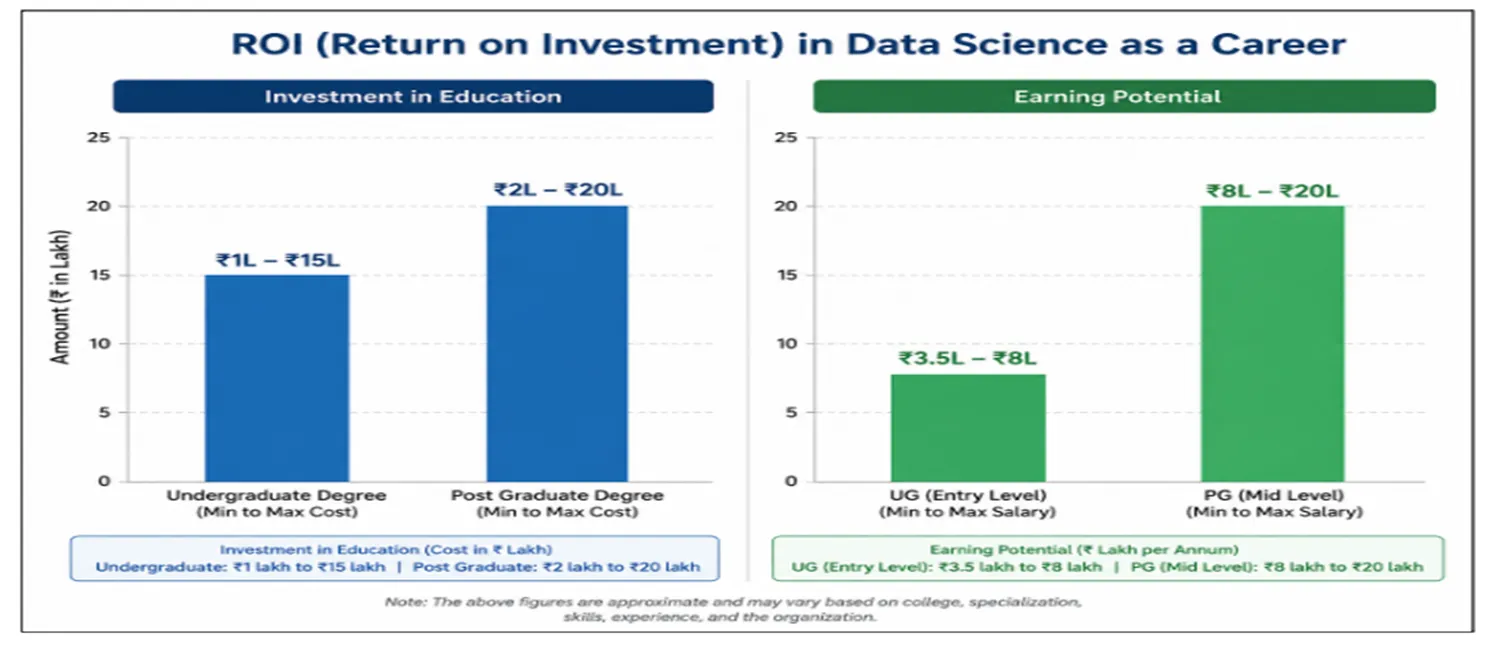
₹1 lakh to ₹15 lakh+ (depending on the college and program)
3–4 years
Common degree options include:
- B.Tech Computer Science
- B.Tech AI & Data Science
- B.Sc Data Science
- BCA
- B.Sc Mathematics or Statistics
During this phase, you’ll build your foundation in programming, mathematics, databases, and analytics.
Certifications and Skill Development
₹10,000 to ₹2 lakh+
3 months to 1 year
Students often pursue certifications in:
- Python
- SQL
- Machine Learning
- Data Analytics
- Data Visualization
- Artificial Intelligence
These programs can strengthen your practical skills and improve employability.
Postgraduate Education (Optional)
₹2 lakh to ₹20 lakh+
1–2 years
Common options include:
- M.Sc Data Science
- M.Tech Data Science
- MCA
- MBA Business Analytics
Many professionals pursue advanced education to deepen expertise or move into leadership roles.
👉 So the real investment is not just money. It’s your willingness to keep learning, because Data Science is a field where technology keeps changing and professionals need to keep upgrading their skills.
Earning Potential in India
Entry-Level (0–3 Years)
₹3.5 lakh to ₹8 lakh per annum
Typical roles:
- Data Analyst
- Junior Data Analyst
- Business Analyst
- Data Associate
Freshers from Tier-1 colleges or with strong internships/projects may earn more, but many graduates start in the ₹4–6 LPA range.
Mid-Level (3–7 Years)
₹8 lakh to ₹20 lakh per annum
Typical roles:
- Data Scientist
- Machine Learning Engineer
- Analytics Consultant
- Senior Data Analyst
At this stage, skills, domain expertise, and project experience start influencing salary significantly.
Senior-Level (7+ Years)
₹20 lakh to ₹50 lakh+ per annum
Typical roles:
- Senior Data Scientist
- Lead Data Scientist
- Analytics Manager
- Head of Data Science
In large product companies, global firms, and AI-focused organizations, compensation can go much higher.
Professionals at this level are often responsible for leading teams, driving organizational strategy, and solving large-scale business challenges through data.
Return on Time (ROT) for a Data Scientist
Now this is something many students and parents don’t really think about when exploring how to become data scientist.
They usually focus on the degree, certifications, tools, or even salary packages.
But they don’t pause and ask—how long will it actually take to start earning and seeing real career growth?
And honestly, this is where expectations need to stay practical.
Break-even Point: When Do You Start Seeing Results?
According to my experience, the Data Science journey can start showing returns faster than some long-duration professional careers, but only when the student builds practical skills along with academic learning.
Most students start seeing initial returns after:
👉 3 to 4 years — if they build skills during graduation and enter through entry-level roles like Data Analyst or Junior Data Analyst.
For students pursuing postgraduate specialization, stronger returns may usually begin after:
👉 5 to 6 years — especially if they move into mid-level Data Science, Machine Learning, or Analytics roles.
But here’s the catch.
This timeline depends on:
- Whether you learn Python, SQL, statistics, and data visualization early
- Whether you build real projects during college
- Whether you complete internships or freelance analytics work
- Whether you understand business problems, not just coding
- Whether you keep upgrading your skills as the field changes
If you start early exposure—like online certifications, portfolio projects, internships, and practical case studies—you can build confidence faster and move into better roles more smoothly.
So yes, Data Science can give good returns. But it is not a shortcut career.
It rewards students who are consistent, curious, and willing to keep learning even after getting the first job.
Future Prospects: The Next 20–30 Years in Data Science
The future of Data Science looks incredibly promising, and honestly, this is one of the reasons so many students are interested in understanding how to become data scientist today.
Over the next 20–30 years, data is expected to become even more important across almost every industry. Businesses, hospitals, banks, governments, educational institutions, and technology companies are increasingly relying on data to make decisions, improve services, and predict future outcomes.
The role of a Data Scientist is also likely to expand significantly. While today’s professionals focus heavily on data analysis, machine learning, and predictive modelling, future roles may involve deeper integration with Artificial Intelligence, automation, business strategy, healthcare innovation, cybersecurity, climate research, and many other emerging fields.
At the same time, the field will become more competitive.
Simply learning a few tools or completing a certification may not be enough. Employers will increasingly look for professionals who can combine technical expertise with business understanding, communication skills, creativity, and problem-solving ability.
According to my experience, the professionals who will thrive in the future won’t necessarily be those who know the most coding languages. They will be the ones who can understand complex problems, ask the right questions, and use data to create meaningful solutions.
So yes, the opportunities are likely to grow. But success will depend on continuous learning, adaptability, and a genuine interest in working with data-driven decision-making.
Conclusion
Choosing Data Science as a career can feel exciting—especially when you hear about Artificial Intelligence, growing demand, and attractive salary packages.
But I’ve seen many students make the mistake of choosing a field simply because it is popular or because someone told them it has “good scope.”
The truth is that understanding how to become data scientist is only one part of the decision.
The more important question is whether the work itself suits you.
Do you enjoy solving problems?
Are you curious enough to explore patterns and ask questions?
Do you enjoy working with numbers, logic, and technology?
These are the questions that matter just as much as salary, demand, or job titles.
This is where career guidance, career coaching, or structured career counselling can be extremely valuable.
At NextMovez, we believe career decisions should not be based only on trends, marks, or external opinions. They should be based on a deeper understanding of how you think, learn, perform, and make decisions. A field having scope does not automatically mean it is the right fit for you. The goal is to find a career that aligns with your strengths, interests, work style, and long-term aspirations.