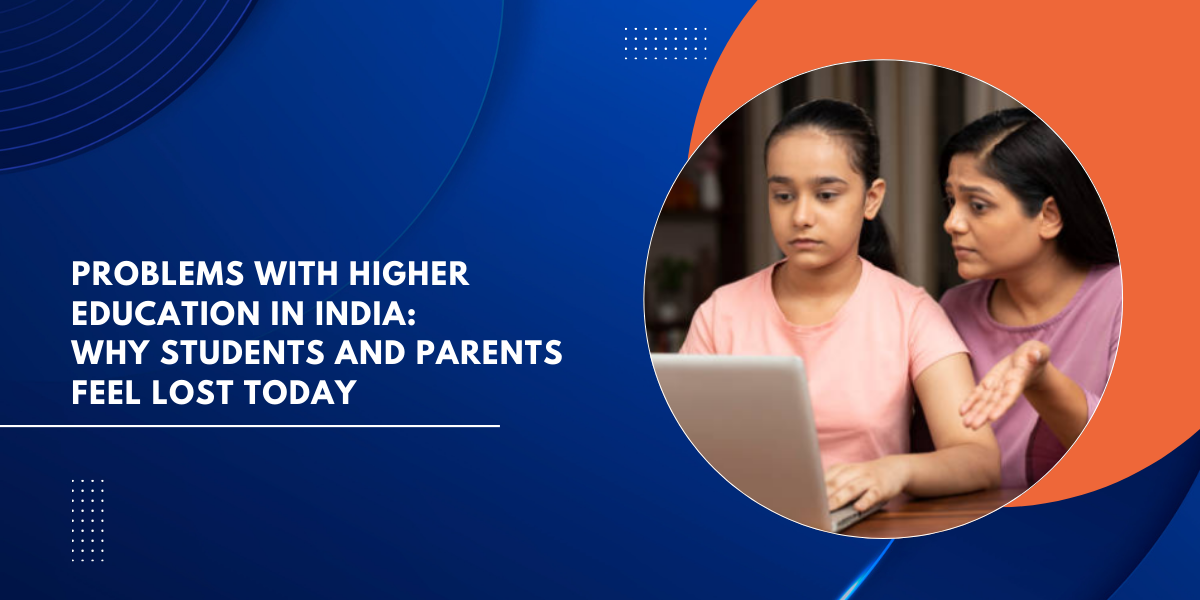
It’s a familiar scene in many Indian households. A parent sits across the table from their child, admission letter in hand, trying to feel proud—but instead feeling uneasy. The college is reputed, the degree sounds impressive, and the fees are high. Yet a quiet question lingers: Will this actually lead to a job, or just another certificate on the wall?
For decades, higher education in India was seen as a clear path to stability. Study hard, earn a degree, secure a respectable career. Today, that certainty has started to crack. Students are investing years of their lives, and parents are pouring in savings, only to discover that a degree alone no longer guarantees employability or direction.
For many students, college life starts to feel like an endless race. Long hours of classes, coaching, exams, and expectations pile up quickly.
Sleep becomes optional, stress becomes normal, and asking for help feels like weakness. According to a recent IJEFM (Journal of Economics, Finance & Management Studies) report, the challenges facing higher education in India go beyond the classroom.
One of the most pressing issues lies in the widening gap between what students are taught and what the real world demands. The education system remains largely focused on rote learning and theoretical concepts, leaving little room for practical exposure, problem-solving, or industry-relevant skills.
As a result, many graduates step out of college feeling unprepared—and often overwhelmed—when faced with actual workplace expectations.
Parents, too, are caught in a bind. While they invest their resources and energy into ensuring their children attend prestigious institutions, they often wonder if their children’s degrees will truly translate into career opportunities. With the rising costs of education, the pressure to succeed becomes even more daunting.
According to an ET Education blog, industry experts should co-teach advanced modules to ensure students stay current with the latest trends.
However, this is far from happening, although some universities are trying to implement it in India.
Industry voices have repeatedly emphasized the need for stronger collaboration between academia and the professional world.
While some institutions are attempting change, meaningful integration of industry-led learning remains limited.
This disconnect continues to fuel frustration among families who expected education to open doors—only to find those doors half-closed.
Understanding the Challenges in Higher Education in India
The issues plaguing higher education in India aren’t just confined to outdated infrastructure or a mismatch between academic and industry needs. It’s a deeper issue that affects both students and parents alike.
According to an article published in The Hindu newspaper on India’s employability crisis, only 42.6% of graduates are considered job-ready, highlighting a growing gap between academic learning and the needs of the industry.
To truly address the challenges in higher education, it’s essential to explore them through practical lenses.
Here’s a breakdown of the most pressing problems with higher education in India:

1. The "Quality vs. Quantity" Dilemma – The Pressure of Scaling Education
What it is: The rush to expand the number of colleges and universities across India has led to a situation where quantity often compromises quality.
Many institutions are poorly equipped to deliver the promised education due to lack of resources, outdated curriculums, and inadequately trained faculty.
According to the Unessa Foundation Blog, India’s education system shows a stark divide between well-resourced urban schools and underfunded rural schools.
While enrollment rates are high, learning outcomes are poor, with many students lacking basic skills like reading and arithmetic.
Example: Neha, a bright student from a tier-2 city, enrolled in an engineering program at a local university.
Despite the institution’s promises of modern facilities, the reality was starkly different.
It had outdated laboratories, poor teaching methodologies, and limited exposure to industry practices.
Why it matters: The gap between the rapid expansion of higher education and the actual quality of teaching is one of the major problems with higher education in India.
Students often graduate without acquiring the skills necessary for today’s competitive job market, leading to a disconnect between what’s taught and what’s expected in the workplace.
Parent Tip: Before choosing a college or university, research not just the ranking, but the quality of the faculty, industry connections, and infrastructure.
Quality should always come before quantity.

2. The "Employability Gap" – A Disconnect with Industry Needs
What it is: A key problem with higher education in India is that most courses aren’t aligned with the current demands of the job market.
Graduates often find themselves struggling to secure jobs due to the gap between their academic education and practical industry needs.
Example: Ravi, a computer science graduate, expected to be hired by a top tech firm in Bengaluru, but his knowledge was limited to theoretical concepts.
When faced with practical tests during job interviews, he was unable to apply his learning effectively.
Why it matters: The failure to bridge the gap between academic learning and real-world job skills leaves students unprepared for the workforce, which is one of the biggest challenges in higher education today.
According to a blog published by 21K School, many Indian universities still use outdated syllabi that are more theoretical than practical, leaving students underprepared for the job market.
Student Tip: Students should seek internships, part-time jobs, or skill-building workshops outside of their course to gain real-world experience.
3. The "Fees and Financial Burden" – Costly Education Without Guaranteed Returns
What it is: Rising tuition fees, coupled with living expenses, make higher education in India a significant financial burden for families.
Despite the soaring costs, the quality of education doesn’t always justify the expense.
Example: Aditi’s parents scraped together funds for her medical school fees, but they worried about her future.
They weren’t sure if the degree would truly secure a well-paying job or if the cost would lead them into debt.
According to an Invest4Edu blog from 2025, education inflation in India has been rising steadily, significantly increasing the cost of higher education and placing a heavy burden on families while affecting long-term financial planning.
Why it matters: High tuition fees without a clear return on investment can leave students and parents questioning the value of higher education in India.
This financial stress contributes to the growing dissatisfaction with the system.
Parent Tip: Explore scholarship opportunities, financial aid, or more affordable public institutions. Prioritize value over prestige when selecting colleges or courses.
4. The "Access vs. Equity" Problem – Limited Access to Quality Education for All
What it is: A Government of India PIB report dated 13 February 2025 states that in 1947, India had only 17 universities and 636 colleges, serving approximately 2.38 lakh students, with a literacy rate of just 14%.
Today, India has 495 State Public Universities and over 46,000 affiliated institutions.
While the number of universities has significantly increased, access to high-quality education remains limited, often restricted to urban areas.
Students from rural or lower-income backgrounds frequently face barriers in accessing the same educational opportunities as their urban counterparts, resulting in a considerable equity issue.
Example: Sameer, a bright student from a small village in Uttar Pradesh, had to travel long distances to access better colleges.
Despite his talent, financial constraints and logistical challenges limited his opportunities for higher education.
Why it matters: The lack of equal access to quality education perpetuates broader social inequalities. This disparity hinders both personal growth and national development.
Parent Tip: Encourage your child to explore government schemes, scholarships, and online courses, which can help level the playing field and provide access to better opportunities.
5. The "Outdated Curriculum" – A Curriculum That Doesn’t Evolve with Time
What it is: One of the most significant drawbacks of higher education in India is the outdated curriculum. It fails to keep up with global trends or the needs of modern industries.
Many universities still follow traditional, theoretical models of teaching that don’t prepare students for the fast-evolving job market.
Example: Arvind, studying mechanical engineering, found his coursework focused heavily on outdated machinery and theories.
When he entered the workforce, he realized that the industry was heavily focused on automation and AI—topics not covered in his studies.
Why it matters: An outdated curriculum creates a disconnect between what students are learning and the skills employers are seeking.
This further contributes to the problems with higher education that students face today.
Student Tip: Supplement your education with online courses and certifications in emerging fields like AI, blockchain, or digital marketing to stay ahead of the curve.
With employability rates showing that a significant portion of graduates are still not job-ready, the sense of disillusionment is growing.
Caught between outdated systems and modern career demands, both students and parents are left searching for answers.
Real-World Stories of How Students Overcame Challenges in Higher Education in India
Case Study 1: Priya — From Feeling Left Behind to Building Something of Her Own
Myth: “I don’t have the right connections, so I can’t succeed in higher education.”
Priya was the first in her family to attend college. Coming from a small rural village, she enrolled in a local government college that didn’t have fancy labs, startup cells, or placement talks. Most days, she felt like the system wasn’t built for someone with her background.
What bothered her most wasn’t the lack of resources—it was the feeling of being invisible. She noticed how skilled local artisans in her village struggled to sell their products beyond weekly markets, while online platforms were booming everywhere else. That’s when she stopped asking, “What am I missing?” and started asking, “What problem do I already understand better than others?”
She decided to act. Priya started small—very small. Her first goal wasn’t to build a perfect business but to help a handful of artisans get visibility online. She broke the problem down in her own way: understand the situation, figure out what needed to be done, take action step by step, and track whether it was actually working.
Some days were chaotic. Messages from artisans, supplier calls, content uploads—it all felt urgent. So she learned to focus on what truly moved the needle first, pushing less important tasks to later instead of trying to do everything at once. Slowly, things started clicking.
Whenever she hit a knowledge gap—pricing, marketing, logistics—she didn’t wait for her college to teach her. She reached out to mentors online, watched tutorials late at night, and asked uncomfortable questions in business forums. Six months in, artisan sales had grown by nearly half.
That initiative became her strongest proof of capability. Not her college name. Not her grades. Her work helped her earn a scholarship into a startup accelerator, and after graduation, she turned the project into a full-fledged business supporting multiple rural families.
Parent takeaway: Where a student studies matters less than how they think, act, and take responsibility for their learning.
Why it matters: Priya’s story shows that even within the limits of India’s higher education system, students who learn to identify problems, prioritize action, and seek guidance can build real opportunities—on their own terms.
Case Study 2: Vikram — From Degree Holder to Industry-Ready Professional
Myth: “A traditional engineering degree will guarantee me a good job.”
Vikram graduated from a tier-2 engineering college with decent grades and big expectations. Reality hit quickly. Interviews didn’t go well. Employers kept asking about skills he had barely touched—AI, machine learning, real-world applications.
Instead of blaming the system (though it would’ve been fair), Vikram took a hard look at job descriptions. He noticed a pattern. Companies weren’t rejecting him for lack of effort—they just couldn’t see a clear match between his degree and their needs.
So he flipped his approach. Instead of randomly applying everywhere, he shortlisted companies first, studied what they actually wanted, and then worked backwards. If a role demanded machine learning experience, he built a small project around it. If companies wanted problem-solvers, he focused on showing how he approached challenges, not just what he studied.
Progress felt slow at first. To avoid burnout, Vikram made a simple rule—do something career-related every day, even if it was just ten minutes. Updating his resume, tweaking a project, reaching out to someone on LinkedIn. Small steps, daily momentum.
He also stopped job-hunting in isolation. Tech forums, meetups, online communities—these spaces helped him learn faster and connect directly with people inside companies. By the time interviews came around again, he wasn’t just answering questions—he was showing proof.
Within two years, Vikram landed a role at a leading tech firm and grew into a team-lead position. His degree opened the door, but his self-driven learning and industry alignment pushed him through it.
Parent takeaway: A degree alone isn’t a safety net anymore. Skills, adaptability, and continuous learning are what create stability.
Why it matters: Vikram’s journey reflects a larger truth about higher education in India. While curricula often lag behind industry needs, students who learn how to bridge that gap themselves can still build strong, future-ready careers.
From taking initiative and gaining skills outside the classroom to strategically applying for scholarships, the key to success lies in how students approach their educational journey.
Securing a successful higher education experience in India isn’t about simply following the status quo—it’s about being strategic, persistent, and proactive.
The journey to overcoming the problems with higher education in India starts with understanding the landscape (what you’re up against), followed by alignment (choosing the right fit for your needs), and finally execution (taking concrete steps to bridge the gap).
A 2025 blog by Online Manipal notes that while India’s education system has made significant progress, challenges related to infrastructure, rural access, and overall quality continue to persist. Strengthening the foundation of education remains a key priority for the future.
Conclusion
Are you ready to take the first step toward transforming your educational journey? At NextMovez, we provide personalized strategies to help students navigate the complexities of higher education in India, ensuring they make informed choices for their future.
Book your Clarity Call today to receive tailored guidance on choosing the right educational path, securing scholarships, and building a profile that stands out.
This one conversation can save you months of uncertainty and set you on the path to a bright, successful future.
References and Resources
IJEFM (Journal of Economics, Finance & Management Studies) report (2025)
Blog by Online Manipal (2025), on progress in India’s education system
NxtWave’s Continuous Career Building Programs (CCBP) report (2025)
Deloitte’s Report on Higher Education Trends (2025)
Government of India’s PIB report (2025)
Blog published by ET Education (2025)
Invest4Edu blog (2025), on rising education inflation in India
21Kschool Blog (November 2025), on outdated syllabi in Indian universities
Unessa Foundation Blog (2025), on the divide in India’s education system