
Blog written by Indu R Eswarappa, Career Coach & Education Change-Maker
When Aarav finished Class 12, he knew one thing for sure — he wanted to pursue a career in operations management, a field that was dynamic, challenging, and offered opportunities for leadership. However, his parents weren’t as confident. They were concerned about the stability of his career choice, worried about the long-term prospects in an ever-changing job market.
Aarav’s parents, like many parents, had their own worries. “Will this career be stable in 10 years?” they wondered. The world was evolving rapidly, and the idea of taking on a leadership role in such a volatile environment seemed risky. They had always emphasized the importance of job security and a steady income — qualities they felt Aarav’s chosen path didn’t guarantee.
Aarav, on the other hand, was determined. He was passionate about leadership and management and knew he wanted a role in operations where he could influence change and make decisions. But he also recognized that his parents’ concerns were valid. This led Aarav to seek the help of a career coach, someone who could provide clarity and help him chart a stable path within the dynamic field of operations management.
But, what does an operations manager do from morning till evening? And how can someone build a career in this field?
In my experience, this is a common question among students who enjoy organizing, problem-solving, and coordinating multiple tasks. They’re eager to take on responsibility, but often wonder how to turn their skills and interests into a structured career path.
Operations Management: More Than Just Overseeing Daily Tasks
In the next decade, Operations Managers with AI skills may outearn traditional MBAs. As industries embrace automation and data-driven decision-making, the demand for tech-savvy Operations Managers is skyrocketing. AI, automation, and advanced analytics are no longer optional—they’re essential tools that will define the future of operations management.
According to the Times of India Job Report, 70% of operations roles in 2025 will require data analytics skills. This highlights the seismic shift in the skills landscape, where traditional operational knowledge is now complemented by technological expertise
Try This Now:
Do you enjoy solving logistical puzzles, like planning a family event? Try mapping out the process—from organizing the guest list to making sure everything runs smoothly on the day of the event. This will help you test your operations mindset and give you a taste of the problem-solving skills needed in this role.
In this blog, I’ll guide you through everything you need to know — from the essential skills and courses to job roles and industries actively hiring Operations Managers.
Let’s get started.
Introduction to the Career
If you ask me, one of the most impactful yet often overlooked careers right now is Operations Management. It’s not just about supervising day-to-day tasks or keeping things running smoothly. An Operations Manager drives teams, optimizes processes, and ensures that businesses achieve their goals efficiently. They work across industries, from manufacturing plants to IT companies, logistics firms to e-commerce giants, making sure operations are streamlined and objectives are met on time.
In my experience, companies today are under real pressure to perform—not just for profits, but because customers, investors, and stakeholders demand efficiency and results. That’s where Operations Managers play a crucial role. They coordinate teams, analyze processes, implement improvements, and manage resources—all while ensuring smooth business operations.
In operations management, data isn’t just king—it’s the entire kingdom. The role is evolving rapidly, blending strategy, data-driven insights, and digital tools to stay competitive in an increasingly fast-paced market. Industries are expanding, and the demand for skilled Operations Managers continues to rise, making it a financially rewarding and growth-oriented career.
In India, this field is growing faster than most people realize. According to NASSCOM’s 2024 IT Industry Report, operations and process management roles have seen a 15% annual growth in hiring over the past few years, and the demand continues to grow across sectors.
Similarly, the World Bank’s 2023 Logistics Report highlights India’s expanding supply chain sector, which is directly increasing the need for skilled operations managers.
According to LinkedIn’s 2023 Workforce Report, operations roles are among the top ten most in-demand positions in India’s job market. The UGC 2023 National Career Insights Report further shows a significant increase in student enrollment in operations-related academic programs, a clear indication of the growing interest in this career path.
From manufacturing units expanding capacity, IT companies scaling up operations, to e-commerce startups improving supply chain efficiency—opportunities are everywhere.
So if you’re a student (or a parent helping one decide), and you’re looking for a career after Class 12 that combines strategy, team management, and tangible results, Operations Management is absolutely worth exploring.
A lot of students I meet are curious about operations — but aren’t exactly sure what an Operations Manager does on a daily basis. Let’s break it down. Understanding the different responsibilities can help you figure out what part of operations excites you most, and where your strengths might fit.
Operations Management is a broad field. Depending on your industry, company size, or team structure, your role could look quite different. Here are some common focus areas:
Team Lead & Coach
- Manages and motivates a team of operations staff
- Sets goals, monitors performance, and provides feedback
- Trains team members on process improvements, workflow efficiency, and quality standards
Process & Strategy Planner
- Develops operational plans and strategies to improve efficiency
- Analyses workflows, resource allocation, and process bottlenecks
- Identifies opportunities to streamline operations and reduce costs
Resource & Supply Chain Manager
- Oversees procurement, inventory, and logistics operations
- Coordinates with vendors, suppliers, and internal teams
- Ensures smooth movement of materials, products, or services
Project Coordinator
- Monitors ongoing projects to ensure deadlines and quality standards are met
- Coordinates between different departments like production, logistics, and quality assurance
- Prepares reports and presentations for senior management
Operations Analyst & Reporting
- Tracks operational metrics and prepares reports for management
- Uses software and analytics tools to optimize workflows
- Helps in decision-making by providing data-driven insights
So if you’re exploring this career, ask yourself: Do you enjoy organizing and improving processes? Are you motivated by efficiency, strategy, and problem-solving? Do you like leading teams or analyzing data to make decisions? Your answers will help you identify which operations path fits you best.
Work Environment of an Operations Manager
Operations Managers thrive in environments where strategy, coordination, and problem-solving come together to ensure smooth business operations. While you might not be directly designing products or coding software, the decisions you make have a direct impact on team performance, process efficiency, and the overall success of the business.
Where Operations Managers Work
Operations Managers are essential in small, medium, and large companies across all industries. Wherever there’s a need to manage processes, optimize workflows, or ensure smooth operations, there’s a place for an Operations Manager.
You’ll find Operations Managers in:
- Manufacturing and production units
- IT and SaaS companies
- Logistics and supply chain firms
- E-commerce and retail brands
- Startups and scale-ups of all kinds
In short, any company that wants to operate efficiently and grow benefits from an Operations Manager, no matter its size or sector.
Day-to-Day Responsibilities
An Operations Manager’s daily tasks can vary widely depending on the industry and company focus. Here’s what a typical day might involve:
- Leading and motivating operations teams to achieve efficiency and quality targets
- Analyzing workflows, processes, and data to identify bottlenecks or improvement areas
- Coordinating effectively with departments like production, logistics, HR, finance, and IT
- Implementing strategies to optimize operations, reduce costs, and improve customer satisfaction
- Monitoring resources, timelines, and project progress to ensure smooth execution
Whether you’re coordinating teams on the floor, analyzing data in reports, or strategizing process improvements in meetings, this role is all about creating measurable impact. If you enjoy problem-solving, strategic thinking, and managing people while improving business outcomes, then Operations Management could be the perfect fit.

Building a Career as an Operations Manager After Class 12
If you’re planning to build a career as an Operations Manager after Class 12, here’s some good news — there isn’t just one route. Whether you’re strong in business studies, mathematics, logistics, or even tech, there’s a path that fits your strengths and interests.
Think of operations management like conducting an orchestra—every section must work in harmony. Similarly, in operations, different departments must collaborate smoothly to achieve business goals. No matter your background, you can contribute to this symphony of efficiency and productivity.
Different Routes to Becoming an Operations Manager
Business Studies Background
If you’re inclined towards business management, you can pursue a BBA or BMS degree, which will lay the foundation for operations. These programs will help you understand management principles, organizational behavior, and strategy, all essential for a career in operations.
Mathematics and Data Lovers
If you have a knack for mathematics and data analysis, consider a course in Operations Research or Industrial Engineering. These fields will equip you with the quantitative skills needed to optimize processes and make data-driven decisions.
Logistics Enthusiasts
For those passionate about logistics and supply chain management, specialized courses in logistics management or supply chain engineering could be your best fit. Operations Managers often oversee inventory management, supplier coordination, and distribution — and these fields provide valuable expertise for such roles.
Tech-Savvy Path
If you’re more into technology, operations management today is increasingly about embracing automation, AI, and data analytics. Studying information technology or data science can set you on a path to become an Operations Manager who drives technological innovations to optimize business operations.
Here’s a structured look at popular courses:
Depending on your interest—leading teams, optimizing processes, managing resources, or coordinating projects—you can choose the path that fits you best. In my experience, the most successful Operations Managers are those who combine strategic thinking with people skills and practical problem-solving.
Necessary Soft Skills & Technical Abilities
If you’re considering a career in operations management, remember—it’s not just about overseeing tasks or workflows. From my experience, the most successful Operations Managers combine strategic thinking, people skills, and operational expertise.
Soft Skills:
- Communication: Clear, persuasive, and empathetic communication is key—whether you’re talking to team members, senior management, or vendors.
- Leadership: Guiding teams, motivating staff, and ensuring smooth execution of processes.
- Critical Thinking & Problem-Solving: Analyzing workflows, identifying bottlenecks, and crafting practical solutions.
- Time Management & Organisation: Prioritizing tasks, projects, and resources efficiently.
- Adaptability & Emotional Intelligence: Operations can change rapidly; understanding team dynamics and adjusting strategies is vital.
- Decision-Making: Making informed choices quickly to keep processes on track.
Technical Skills:
- Process & Workflow Management: Knowledge of tools and techniques to optimize operations.
- Data Analysis & Metrics: Understanding KPIs, production efficiency, cost management, and operational performance.
- Project Management Tools: Proficiency in software like MS Project, Trello, Asana, or ERP systems.
- Supply Chain & Logistics Awareness: Knowledge of procurement, inventory management, and logistics workflows.
- Reporting & Documentation: Creating clear operational reports, dashboards, and process documentation.
- Digital & Automation Tools: Awareness of digital tools and automation to streamline processes.
In short, being an Operations Manager isn’t just about overseeing tasks—it’s about improving processes, leading teams, and solving business challenges. Strong soft skills combined with technical know-how often set you apart, turning strategies into tangible results.

Career Progression and Growth Opportunities
One of the most exciting aspects of operations management is how dynamic and rewarding the growth path can be. Whether you start with a BBA, an MBA, or any undergraduate background, there are plenty of opportunities to climb the ladder—as long as you keep learning and adapting.
Typical Career Path in Operations Management:
- Entry-Level: Operations Executive, Junior Process Analyst, Logistics Coordinator
- Mid-Level: Operations Manager, Team Lead, Project Coordinator
- Advanced-Level: Senior Operations Manager, Regional Operations Head, Director of Operations
- Specialised Roles: Supply Chain Manager, Production Manager, Process Improvement Lead
- Entrepreneurship & Advisory: Founder of a process consulting firm, operations consultant, or startup operations lead
In addition, many Operations Managers explore international opportunities—working in multinational corporations, global supply chains, or cross-border project management. With experience, you can specialise in industries like manufacturing, IT, logistics, e-commerce, or healthcare, or move into strategic planning, business operations, or general management leadership.
In short, a career in operations management doesn’t just give you a job—it gives you a platform to improve processes, lead teams, and make a measurable impact. Each step forward strengthens your skills, your influence, and your ability to shape business success.
Salary Expectations & ROI
If you’re wondering whether a career in operations management is “worth it” in the long run, let’s break down both sides—what you invest in education and training, and what you can realistically earn back.
Return on Investment (ROI):
Degrees and certifications in operations or management are generally affordable compared to highly specialized professional programs. More importantly, they often include internships, live projects, and hands-on experience, which prepare you for the real world before you even enter the workforce.
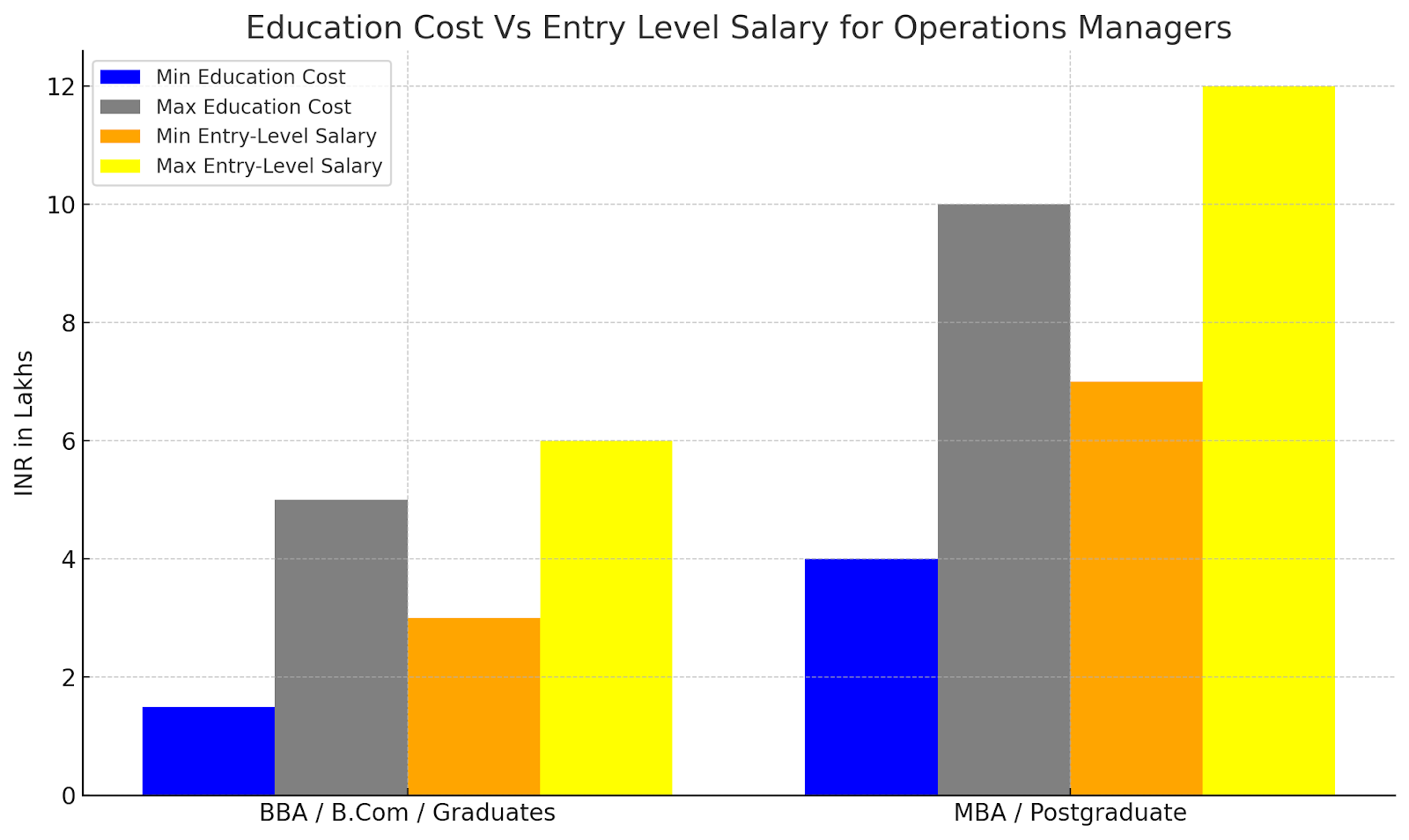
Education Costs (approximate):
- BBA / B.Com: ₹1.5–5 lakh over 3 years
- MBA in Operations / Supply Chain / Business Management: ₹4–10 lakh depending on the institute
Earnings Potential:
- Entry-level (0–2 years): ₹3–6 LPA as Operations Executive or Coordinator; MBA graduates can expect ₹7–12 LPA at entry level.
- Senior level (8+ years): ₹15+ LPA as Senior Operations Manager, Regional Operations Head, or Director of Operations
High-performing Operations Managers, especially in logistics, e-commerce, IT, or manufacturing, can exceed these numbers through performance bonuses, profit-sharing, and project incentives, which are often a large part of the compensation.
Return on Time (ROT)
Let’s talk time—because for many students and parents, how long it takes to start earning matters just as much as the salary.
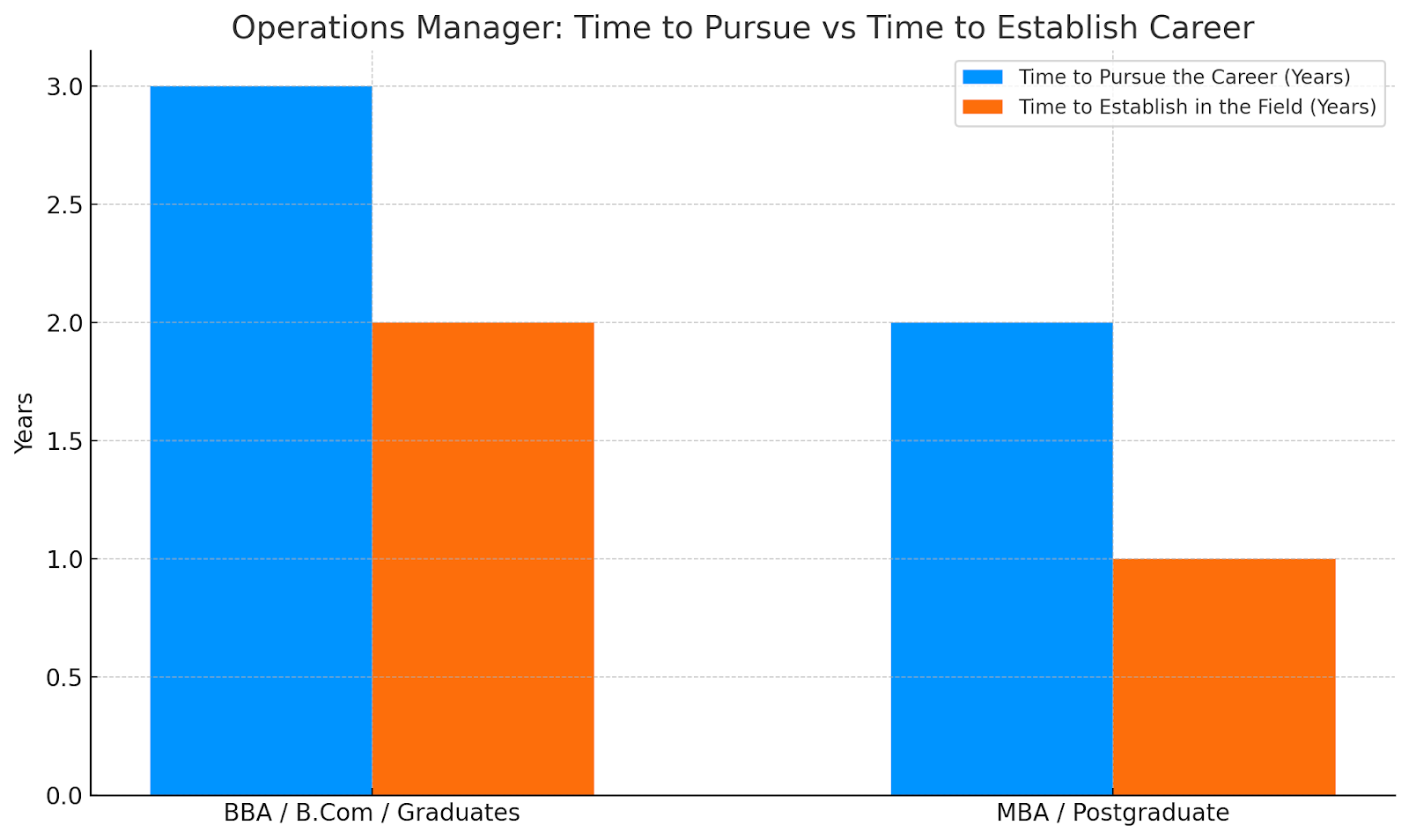
Education Duration:
- BBA / B.Com / Graduates: 3 years
- MBA in Operations / Supply Chain / Business Management: 2 years
Break-even Point:
From what I’ve seen, many students land their first operations roles—like Operations Executive, Junior Process Analyst, or Logistics Coordinator—within 2 years of completing their undergraduate programs. MBA graduates can often secure relevant roles within 1 year after completing their degree.
Fast-Track Options:
If you want to jumpstart your career, short-term certificate courses in operations, process management, project coordination, or ERP tools right after Class 12 or during college can help you gain practical exposure. This allows you to start earning early, build confidence, and test your skills before committing to a full degree or MBA program.
Future Prospects: The Next 20–30 Years
Operations management is no longer just about keeping things running smoothly—it’s now central to business growth, driven by rapid technological advancements and evolving organizational needs.
Over the next 20–30 years, AI, automation, and advanced analytics will transform the way operations teams work, making the need for skilled, tech-savvy Operations Managers even more essential. These advancements will allow operations managers to make data-driven decisions, optimize supply chains, and improve business efficiency like never before. As industries evolve, the demand for operations managers who can adapt to these changes will only grow.
Emerging Certifications to Boost Your Career
To stay ahead in this rapidly changing field, obtaining certifications in areas like Six Sigma, Lean, or ERP (Enterprise Resource Planning)-specific courses can significantly enhance your skill set. These certifications demonstrate expertise in process improvement, data analysis, and system integration, all of which are vital for an operations manager in the age of AI and automation.
- Six Sigma: Focuses on reducing defects and improving processes, making it ideal for operations managers aiming to enhance efficiency.
- Lean Management: Teaches how to eliminate waste and optimize workflows, an essential skill in today’s fast-paced business environment.
- ERP Systems: Understanding ERP software like SAP or Oracle is crucial for streamlining operations and integrating business processes.
Conclusion
Thinking about becoming an Operations Manager? If you enjoy improving processes, leading teams, and driving operational excellence, this could be the career for you. But today, it’s more than just traditional management—it’s about integrating technology, leveraging AI, and staying ahead in a rapidly changing business environment.
You don’t need a single fixed path to get there. Whether you come from a background in commerce, business, science, or even arts, there’s room for you in this space. The key is to stay curious, develop leadership and analytical skills, and embrace modern operational tools—like ERP systems, data analytics, and AI-driven platforms. Gaining real-world exposure through internships or part-time operational roles, where you can work with these tools, will help set you apart.
The best part? You can start building your foundation right after Class 12. Explore online courses in operations, supply chain, project management, or AI applications in operations. Attend workshops, take part in internships with startups or corporates, and embrace digital operational tools—every small step will help you understand processes and sharpen your skills.
Operations management today is not just about overseeing tasks; it’s about leading tech-driven teams, making data-backed decisions, and improving efficiency at every level. The sooner you start gaining experience, understanding workflows, and exploring how technology can enhance operations, the faster you’ll progress into leadership roles.
I hope this guide gave you some clarity and direction. If you’re still figuring out which niche in operations—like logistics, supply chain, IT operations, or manufacturing—suits you best, feel free to reach out—explore your operations niche with our free Career Clarity Compass™ session. I’d be happy to guide you along the way.